
WARNING: THE MATH USED IN THIS POST IS OFF, DUE TO POOR RESEARCH ON MY PART. POINT OF THE POST IS THAT GOVERNMENT OVERHEAD SEEMS HIGH. IF ANYONE IS ABLE TO MAKE AN ACCURATE ASSESMENT OF GOVERNMENT OVERHEAD, AND COMPARE IT TO OTHER GOVERNMENTS/PRIVATE ORGANISATIONS, PLEASE LET ME KNOW.
Edit: the calculation of average wage is not a representation of how much every employee actually earns, as this is also public data. Rather it is a way to break down the 8.3 billion expense into a more understandable number. Spending 8k a month on average per employee seems very high. The fact that the vast majority don’t actually receive anywhere close to that amount does not make that any better.
Edit 2: it seems that even that is an exaggeration, as the number of employees covered by that 8.3 billion is not the 85.000 I was working of, as this does not count pensions and apparently other groups of federal employees, such as the military. As I dont have those numbers easily available and dont want to spend more time doing the math, I’ll just ask to take the 8k figure with a grain of salt. The main point was never that nimber, rather that the government seems to be wasteful and/or inefficient in its expenses, and that adressing that issue would free up funds that could be used to enact policies.
Not taking the post down, because while the numbers may be off, I still feel an in depth look would be interesting. If it turns out im wrong and federal overhead is no higher than the private sector with a similar number of employees, I will happily take it down.
TLDR: the government is overpaying itself while complaining they don’t have the money to take the measures it’s population needs.
​
This is gonna be a long one, but I felt the need to rant.
​
**A bit of introduction on taxes in Belgium:**
items are taxed at 3 rates:
* 21% for standard goods
* 12% reduced rate (usually to support certain segments of the economy, like catering, social housing construction etc.)
* 6% reduced rate (typically for basic needs, such as water, food and medication)
​
Electricity is taxed at the full 21%, despite it pretty clearly being a basic necessity in the 21st century (footnote, coal is taxed at 12%, so I don’t think it’s an environmental thing)
​
The reason that’s brought up why it isn’t lowered is because of the cost on the budget (€2 billion according to Open VLD – [https://www.vrt.be/vrtnws/nl/2022/01/20/maggie-de-block-btw-verlaging-energie-is-boerenbedrog/](https://www.vrt.be/vrtnws/nl/2022/01/20/maggie-de-block-btw-verlaging-energie-is-boerenbedrog/))
**What’s your Point?**
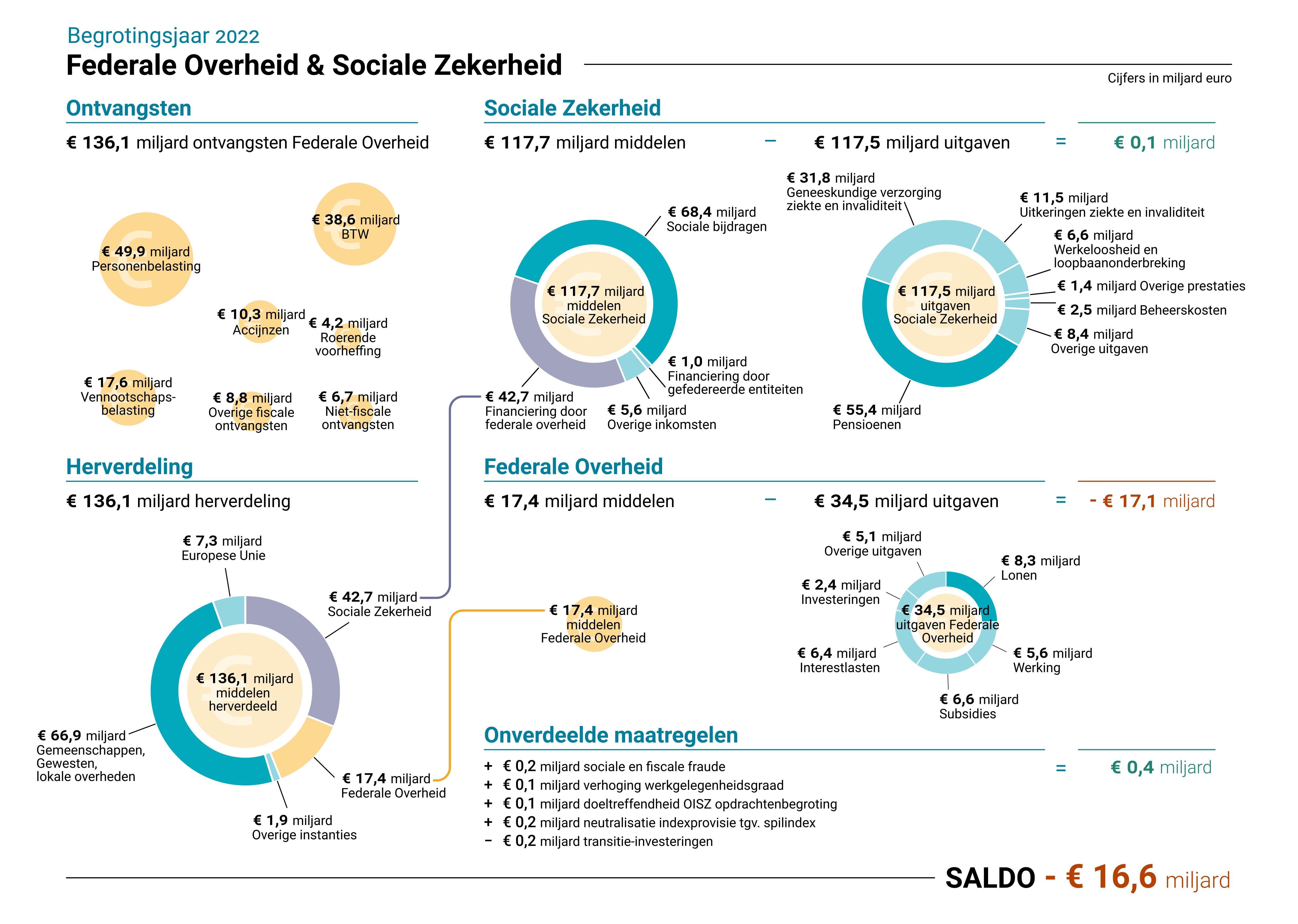
[Begroting Federale overheid – https://bosa.belgium.be/nl/overheidsbegroting](https://preview.redd.it/rrkthugatuc81.jpg?width=4917&format=pjpg&auto=webp&s=2301aec47c468e9b114ffddd60b2e750bf4c2080)
According to the most recent data the federal government spent €8,3 billion on wages ([https://bosa.belgium.be/nl/overheidsbegroting](https://bosa.belgium.be/nl/overheidsbegroting)).
​
According to the personnel statistics of the government we have about 85.000 federal employees. ([https://data.gov.be/nl/dataset/b61475cd7b8c4f44fe73e53d7cf72a9a3819945f](https://data.gov.be/nl/dataset/b61475cd7b8c4f44fe73e53d7cf72a9a3819945f))
​
Assuming everyone works full-time, that makes an average yearly paycheck of €97 647, or €8 137 per month.
This means they are paid more than 4x the average income in Belgium which swings somewhere around €20 000 ([https://statbel.fgov.be/nl/themas/huishoudens/fiscale-inkomens](https://statbel.fgov.be/nl/themas/huishoudens/fiscale-inkomens))
Why is no one talking about this.
P.S. If €8.3 billion is already being spent on wages, what exactly is that €5.6 billion of “functioning costs” spent on?
13 comments
Well firstly you assume that everyone is paid the same salary which is not the case. Most people working for the government have maybe a really good, but still normal salary which is based on a fixed barema, which is definitely not 8k a month. That said, there quite some very high earners inside the government that’s true but I don’t have all the information on that
Functioning cost are probably restaurant visits, wine and food for minister and his cabinet, transport costs, car lease, external personnel ( a lot of staff is consultant or detachee from somewhere), catering, plant delivery and maintenance, window cleaning.
Because you’re comparing apples with green-ish oranges?
The 8k is probably gross, so about 5k of that is going back as taxes? Or are gov paychecks handled differently than regular companies concerning taxes?
What are you trying to debate?
Please use more comparable and correct data. The monthly salary is obtained by dividing annual by 13,92, not by 12.
Plus, the salary there is total cost, so should include patronale bijdragen en whatnot.
What you’re comparing those government numbers to is also not salary, it’s income, which means it includes pensions, OCMW leegkomen,… and is netto taxable, so excludes patronale bijdragen etc.
You’re basically comparing oranges to elephants…
Do you really have no idea what the ‘functioning costs’ could be? Let me ask you this then: are wages the only cost a business has?
Of course not… They’ve got rent, maintenance, utilities, supplies, etc to pay as well.
Wow. Just wow.
You’re either trying to troll or are very riled up because you are misreading and misinterpreting data.
Federal civil servants get paid a fixed wage, no bonuses or anything.
These wages are freely available: https://fedweb.belgium.be/nl/verloning_en_voordelen/wedde/weddeschalen
The reason no one talks about it, is because no one but the very top brass (“de topambtenaren”, those that are at the highest rank) makes big money.
This is a simulator: https://fedweb.belgium.be/nl/verloning_en_voordelen/wedde/calculator
A federal civil servant, A5.4 (about the highest you can get), with 20 years of service, married, no children to take care for, earns 4746€ net.
Way off your 8.000€ remark.
As others have pointed out, this is a complete misrepresentation of how the system works, and the numbers are way off.
You are confounding state expenditure with government expenditure. Amongst others.
De Block has right that lowering VAT will carry a cost(approx. 2 billion?) that must be met either by future borrowing (and higher taxes into the future) or higher taxes now.
However raising or lowering VAT is first and foremost a political choice and there are very good arguments against and in favour of that.
Your back-of-the-envelope calculation however is not one of them.
Math is a bitch as you are just showing here.
You are comparing costs for all people on the government payroll with numbers for a subset of civil servants. You missed a lot of people (military, some police, etc.). Further, this is pre-tax and everything. So if you make the correct calculation, you get to a decent but not awesome salary for most civil servants.
You’re forgetting the pensions.
Dont forget.. the prices of power had been 4x the price it was 4 jears ago.. so the goverment wins 4x as much tax.. it still isnt enough.. its clearly no issue for them to increase prices of energy.
Lets close all nuclear reactors, so we need to buy more energy from neighboring countries, because we can not sustain our own power.
Lets also spin our windmills at 30% rate because otherwise we overproduce??
The higher energyprices get the more tax we will pay. Thank u government
Not saying it’s accurate; but hypothetically: If a company or the government spends 100k / yr per employee on average(the cost to the company or government – not the employees net income!) – would that be unreasonable?