Subscribe now for full access and no adverts
The Tollense Valley in Mecklenburg-Western Pomerania, north-east Germany, is well known in archaeology as the location of large armed conflict in the 13th century BC. Excavations, metal-detecting, and diving surveys carried out over almost two decades have uncovered substantial evidence of violent fighting at multiple points along a 3km stretch of the River Tollense. Among the finds are various types of weapons, including wooden clubs and flint arrowheads, and bronze knives, palstaves, spearheads, and arrowheads, as well as other metal artefacts. Also found in the area were c.12,500 bones, representing a minimum of 150 individuals. Most of these were young males, and many have evidence of perimortem injuries of a type likely caused by arrows; there are even two examples of bones with arrowheads still embedded in them. It is believed that the remains of many more victims of the conflict are still lying in the valley, and that the number of individuals involved could be in the thousands. Conflict of this scale is unprecedented for the Nordic Bronze Age, and the Tollense Valley is widely considered ‘Europe’s oldest battlefield’.
At present, not much is known about the identities of those involved in the battle. However, recent strontium-isotope analysis of the human remains suggests that some of them belonged to a group of people not from the local area. This is supported by the presence of several artefacts in the assemblage that are of types more commonly found in other regions, such as a palstave of Bohemian type, a Riegsee-type sword, and gold spiral rings and bronze dress-pins in styles usually discovered in southern Central Europe.
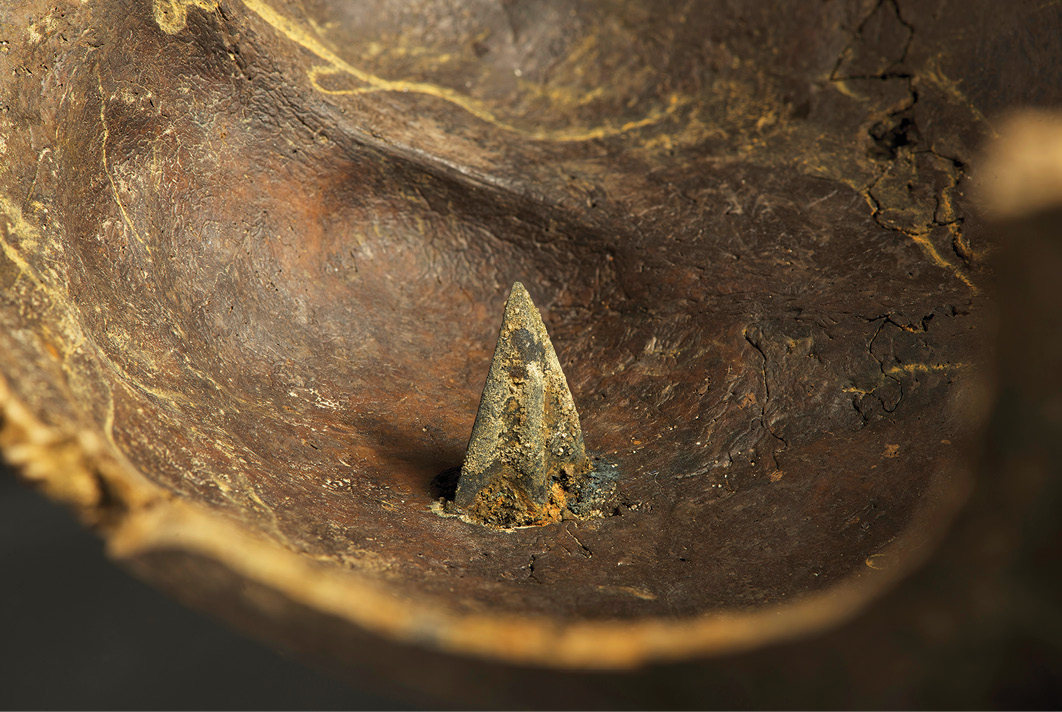 Above & below: A number of arrowheads associated with a violent conflict in the 13th century have been found in the Tollense Valley, including this example embedded in a human skull (above). In a recent study, researchers compared these objects with other Bronze Age arrowheads from across Europe (below) to find out more about their origins.
The latest study, recently published in Antiquity (https://doi.org/10.15184/aqy.2024.140), set out to test this hypothesis by carrying out an in-depth study of the arrowheads associated with the conflict. The team analysed 10 flint arrowheads and 54 bronze arrowheads found in the valley, and compared them with more than 4,000 other arrowheads from the Bronze Age found across Central Europe.
They determined that all of the flint arrowheads and some of the bronze arrowheads associated with the Tollense Valley conflict were almost certainly local in origin, as examples of similar objects have been found in occasional burials and as single finds in this region. However, the researchers also identified several styles of bronze arrowhead that are much better known from an area further south, encompassing modern-day Bavaria and Moravia. Indeed, some of these types are not found at all in northern Germany, except at the Tollense Valley battlefield. The fact that these southern bronze arrowheads do not occur in any burials in the Tollense region speaks against the possibility that they were being sourced through trade and adopted by local people for their own use. Instead, it seems very likely that at least some of the people fighting in the Tollense Valley conflict came from these areas to the south, and brought their favoured types of arrowheads with them.
Further investigation is needed, but the distribution of the different types of arrowhead across the valley strongly supports the suggestion of a violent, armed conflict occurring between local people from the Tollense Valley region and an external group coming in from elsewhere, possibly southern Central Europe. If this is the case, it would make the Tollense Valley battle the earliest known example of large-scale inter-regional conflict in Europe.
More broadly, the study highlights, too, the large number of bronze arrowheads found at contemporary sites in southern Germany, which indicates that the 13th century BC was a time when armed conflict may have been becoming more prevalent in general. It is interesting that the large-scale fighting in the Tollense Valley coincides with this increase in organised violence. Questions remain, however, about the exact nature of these conflicts. Suggestions include fights between coalitions of different tribes, encounters between groups fighting on behalf of warring leaders or ‘warlords’, or even the armies of early ‘kingdoms’ of sorts. It is hoped that further excavations and scientific analysis of material from the Tollense Valley will continue to shed light on this fascinating and macabre moment in time.
Text: Amy Brunskill / Images: Volker Minkus; Leif Inselmann