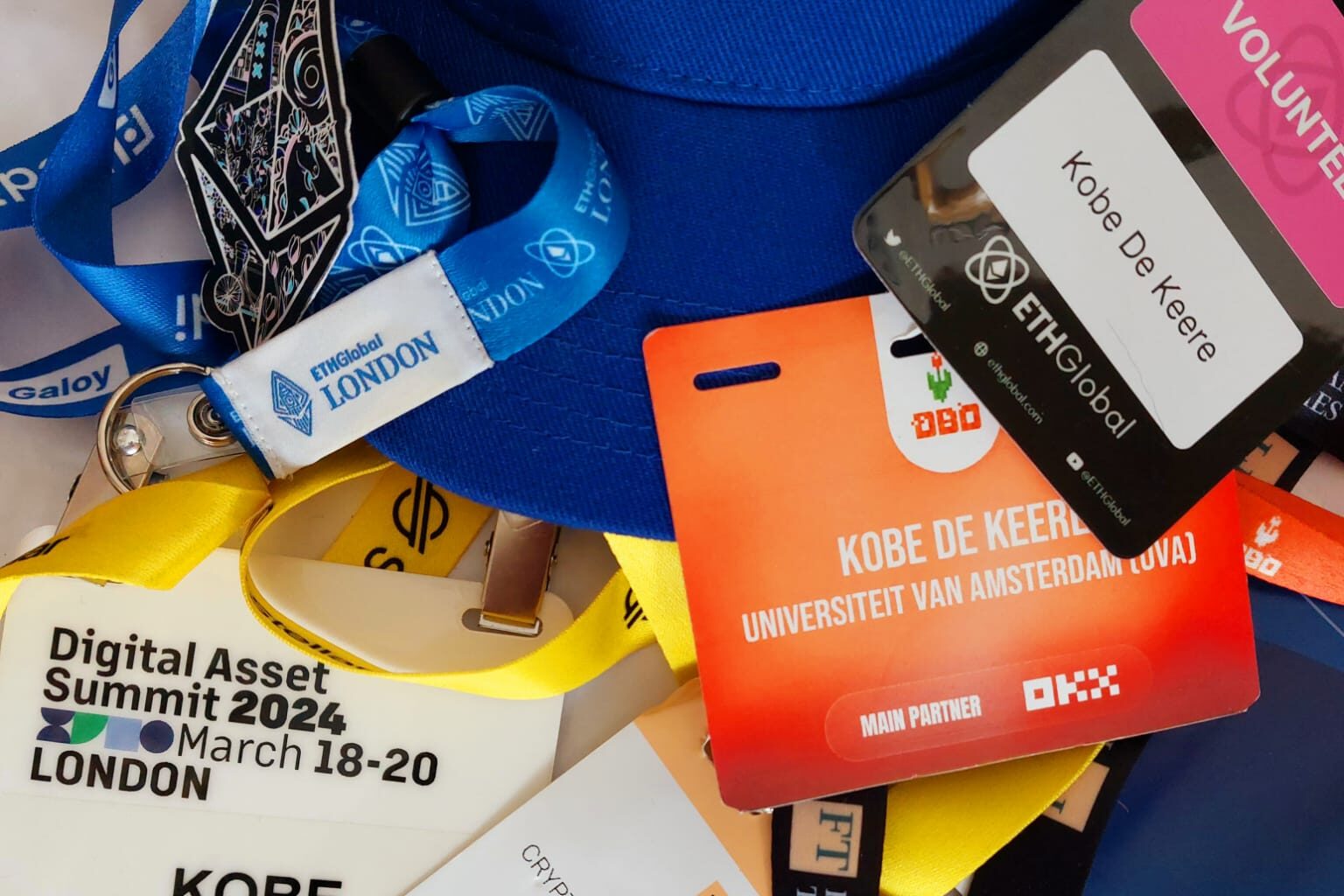
In this blog post, Kobe De Keere opens his journal of fieldnotes and takes us into the often-concealed world of cryptocurrencies. While crypto often gets a bad rap for producing get-rich-quick schemes and illegal online markets, his journey uncovered a far more complex ecosystem. Certainly, scams, market manipulation, and criminality are rife, but there is much more beneath the surface. Surprisingly, as Kobe ventured down the crypto rabbit hole, he faced more pushback from his sociological peers than from the crypto enthusiasts studied.
Only two years ago, I had a very limited understanding of cryptocurrency. I certainly failed to grasp its appeal. Despite my rudimentary knowledge, I still found myself annoyed by it. For me, crypto was something mainly naive young men would be interested in because they want to outsmart all of us and get rich quickly. I felt little sympathy for it and thus largely ignored it. Yet, when 2021 the market hit a huge bull run, pushing the overall market capitalisation over 2 trillion USD, I was struck by the fact that the many of the most powerful players within finance, such as JP Morgan, SEC or ECB, appeared to be largely hostile towards this newly emerging financial product. It made me wonder: could it really be challenging our current financial system? And if so, is that necessarily a bad thing? Knowing how the financialisation of our contemporary economy, as Neely and Lin pointed out, has hardened elite reproduction, and sharpened economic inequalities, I decided to jump down the crypto rabbit hole, leading me on a journey which has proven to be dizzying and disorienting. I came out the other end both awestruck and concerned. These are notes from my journey.
Entering an unknown territory
Entering a completely new field comes with at least two major challenges: a knowledge problem and an access problem. In terms of the former, not only is the crypto market a newly emerging field that does not yet have many institutionalised sources of knowledge, at the same time, one needs to get a basic grasp of the technical intricacies behind cryptocurrency. Familiarising myself with concepts such as distributed ledgers, hash functions, staking, proof-of-work, smart contracts, or zero-knowledge proof was necessary to descend deeper into the rabbit hole. Much like Alice in Wonderland eating the mushroom, I learned through buying, receiving, sending or swapping (tiny amounts of) crypto myself. It was only through this process that I started to comprehend the logic behind crypto and came to understand the ideological aspirations encoded within it. This process of initially buying and subsequently understanding is often described in the crypto ecosystem as the Trojan horse effect: the digital coin that you buy is eventually revealed to contain an entire worldview.
Although we are talking about a digital market, the world of crypto has both an online and offline existence. All over the world, people organise meet-ups, developer workshops, hackathons, and global conferences. I encountered a very welcoming ecosystem, where people are eager to explain what they are supporting, building or improving. As Koray Çalışkan showed in his pioneering ethnography, many cryptocurrency projects – and the variety in projects and objectives is enormous – start out as community projects marked by volunteering, voting systems and donations. This eagerness to guide newcomers through their crypto world, I noticed, is (at least partially) grounded in a feeling of stigma. Many crypto devotees I talked to lament a general lack of knowledge among “normies” – those who have not (yet) bought into crypto –or being misrepresented by public media. Jokingly, my respondents would often point towards a website tallying media reports about Bitcoin’s alleged demise.
Unexpected resistance
Far from experiencing resistance when entering the field, I was welcomed into crypto communities, asked to volunteer at hackathons and invited to the offices of several crypto exchange platforms. In contrast, resistance comes more often from my academic peers than from crypto world. Most of my disciplinary surrounding recognises the relevance of crypto as a topic. But I have experienced continuous pressure to reframe it to fit the general stereotypes surrounding crypto. Often fellow sociologists try to convince me that crypto is either a get-rich scam embedded within toxic masculinity or claim that it is merely criminal money used to fund terrorist organisations, drug cartels, and dictatorial regimes. None of these assumptions resonate with my fieldwork experience, nor are they grounded in empirical evidence (for example, only 0.3% of crypto transactions are thought to involve criminality).
So, my reluctance to label crypto as merely a scam or as a greed-infested field has been met with either confusion or hostility. This situation of having to first rinse off all these preconceptions about crypto (some of which I initially held myself) in order to get to the actual study was certainly an unforeseen challenge. Yet, crypto is so new that we find ourselves still in the phase of what Robert Merton called “establishing the phenomenon”. Part of the work that needs to be done is to first describe, define, and situate the full social meaning of crypto.
The versatility of crypto
“Money is a versatile thing. You have to give it credit for that,” says John Self, the protagonist of Martin Amis’ dazzling 1984 novel Money. This certainly also holds for digital money. The introduction of digital scarcity, through blockchain, has the performative potential to reshape our economic lives in a variety of ways. A recent study I conducted with colleagues on crypto-related YouTube content revealed multiple sociotechnical imaginaries at play that attribute value to crypto. While there is certainly a speculative aspect to it, especially in the way “finfluences” try to convince their audiences that crypto trading will make them rich, we also found a more political-economic repertoire – largely inspired by Austrian School economics – about replacing our fiat-based monetary systems with protocol economies.
But it is also about how crypto can bank the unbanked around the world while facilitating international remittance. It transcends our typical discussions on money and allows us to reimagine property rights, privacy, and the organisation of economic power. In this case, crypto is about decentralised organisational structures (DAO’s), Web3 and the creation of an internet of value.
While scammers, pyramid schemes, and terrorist networks do exploit cryptocurrency markets, I would argue that they parasitically attach themselves to – rather than define – this socio-economic ecosystem. The crypto world is multifaceted and hard to grasp using traditional sociological categories. What comes next, then, is not just a question of merely applying our old tools to a new topic, but rather, as Ori Schwarz writes in the context of digital sociology, a total reimagining of our theoretical instruments altogether.
Image credit: Kobe De Keere
All articles posted on this blog give the views of the author(s), and not the position of the Department of Sociology, nor of the London School of Economics and Political Science.