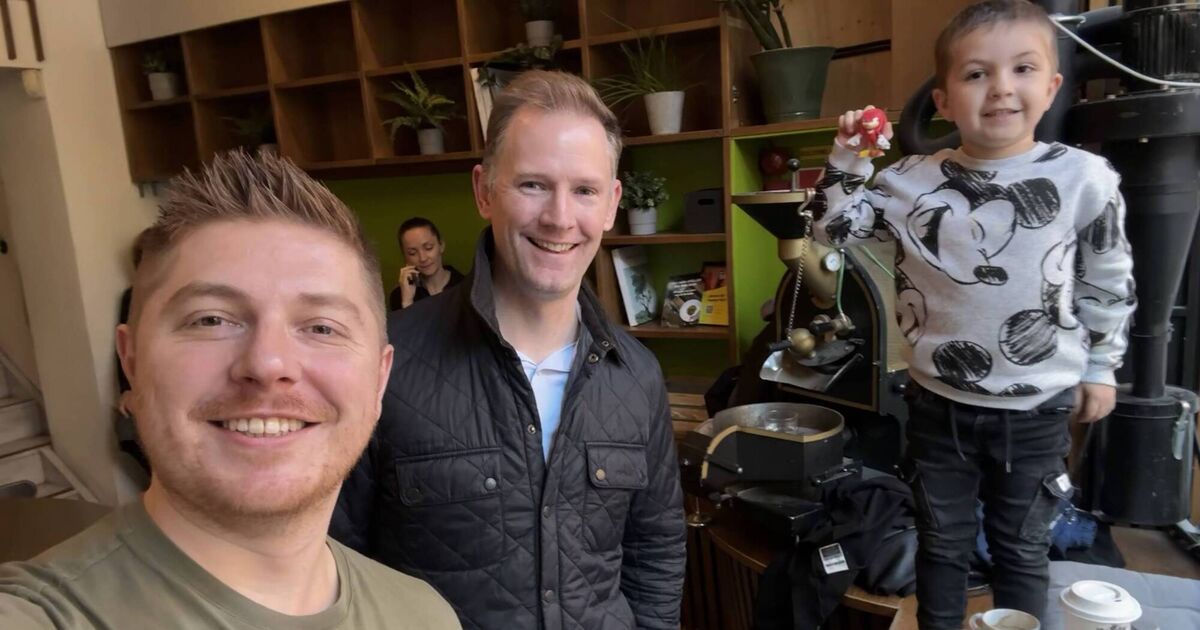
Cork native Rob Hilliard has been in Sweden for 12 years, with a son in childcare/forskola for the last four of them.
Matthew, Rob’s son with his Georgian wife Ana, is now five. He’s with Rob when we meet in central Stockholm, and is a good advertisement for Sweden’s early years system — bright, bubbly and in great form.
I first spoke to Rob — who works for gaming giant Electronic Arts — when Matthew was two, and his enthusiasm for the childcare system in the country was unqualified. He’s a little more introspective on this occasion although, to be fair, it is at my urging.
While clearly enthused about the endless advantages of the Swedish system — “Did you know they potty-train your child for you?” — and the flat-rate childcare it delivers for all, Rob has enough Irish in him to recognise some of the quirks of Swedish society that are somewhat at odds with his home country’s sensibility.
When asked what negatives may exist in the system, Rob says of Matthew’s experience of “daycare can sometimes be a bit baby-ish”. Rob’s son won’t enter school proper until next year, roughly 18 months after Irish kids begin primary school.

“Conformity is seen as a desirable thing, to blend in. ‘You’re not special’. It’s a culture thing. It’s a conformist society. And Irish people would hate that,” he says.
I get the impression that they try to stifle individuality and enforce conformity.
“I can get that, you want the kids to sit down and behave, and some kids are more quiet, but others are more engaged. They want all the kids in a very narrow range of behaviour.
“They try to teach the kids to be independent, and they’re very gentle, but also very strict say in terms of waiting your turn to speak. It’s nearly military in a sense, but also in a gentle manner.”
He notes the strict nature of how the educational system operates generally, and raises the case of a Swedish couple earlier this year who took their children out of primary school for an extended period of time to travel to Thailand for work, and were fined roughly €5,000 by the authorities upon their return despite having placed the children in schools while they were away.
That fine resulted from the local municipal board of education ruling that there were no qualifying reasons for the children’s absence.
He says:
A lot of people could be a bit socially naive. They become kind of docile, and have total trust in the State, ‘I think the Government should solve everything for me’, that sort of way.
“Whereas in Ireland you know you have to look after yourself, to buy your house, to save for your pension, here they expect the Government to look after them.”
He notes that, as good as the childcare system is in Sweden, it goes hand in hand with “a strong societal pressure to be working”.
“You would be scorned socially for working cash-in-hand for example.”
Sweden’s prioritisation of behaviours seen as for the good of society can sometimes rankle also, Rob says. “Sometimes you need to drive, for example,” he says.
“Driving is really expensive and really complicated here. They tax the hell out of it. So if you need to get to the inner city say, it’s €5 every time. If you go five times you pay five times. They have huge taxes on petrol. But people do drive, it just costs them a lot of money.”
“Food and alcohol are massively taxed too. Restaurants are very expensive here because of the living wage, they’re seen as a luxury here. You can pay €100 going for a pint and fish and chips.”