By Brett Knight, Forbes Staff
In the weeks since the Los Angeles Clippers moved into their new $2 billion home, the Intuit Dome in Inglewood, much of the attention has focused on the arena’s enormous Halo Board, with its embedded T-shirt cannons, and on the steep seating section called the Wall, reserved for chanting superfans. Also being touted are the four-button gaming pads built into the armrests and the 1,400 toilets spread around the arena—three times the NBA average.
But the vast majority of fans at the 18,000-capacity building won’t ever see what may be its crowning achievement: the premium seats.
There are the standard luxury boxes on the upper level, of course, but fans in prime spots along the sidelines can also book “backstage bungalows,” posh private rooms that come with high-end food and drinks, a concierge and parking passes in the players’ garage. Those sitting along one of the baselines can take just a couple of steps down from their seats into private “courtside cabanas,” built underneath the stands. Then there are the luxurious communal club spaces, such as the Red Lounge for courtside fans, who reportedly have to pay between $25,000 and $35,000 per season ticket. Most impressive is the Lexus Courtside Lounge, where the players walk past a private bar and through a rope line on their way from the locker room to the court.
For decades, arenas have reserved upgraded spaces for VIPs and corporate sponsors, but the Clippers’ new offerings are just as cutting edge as the facial recognition technology at the Intuit Dome’s grab-and-go concession stands, reflecting an industrywide rethinking of the approach to premium seating. And that new philosophy is already translating to many more millions in revenue for teams.
The luxury seating evolution boils down to providing a much wider range of premium options. “Ten, really 15, 20 years ago, there would be one suite type, and that was it,” says Tracy Payne, a senior interior designer at Populous, the Kansas City, Missouri-based architecture firm that has designed modern sports and entertainment venues including the Atlanta Braves’ Truist Park, the New York Islanders’ UBS Arena and the Sphere in Las Vegas. “Now, we create an incredible breadth of premium inventory for each client, at different price points and different demographics.” Wesley Crosby, Populous’ interior design director, notes that one client now offers 13 different premium experiences.
For starters, the shift means fewer traditional luxury suites. When the Clippers’ old home, Crypto.com Arena in Downtown Los Angeles, opened in 1999, the trend was to cram as many as possible into a sports venue, and the arena was stuffed with an astonishing 170. Now, the Intuit Dome has 46 on its main suite level.
Similarly, the NHL’s Calgary Flames, who started construction on Scotia Place in July and expect the building to be ready for the 2027-28 season, are dropping to 54 suites, from 80 at their current arena, the Scotiabank Saddledome. And the NFL’s Tennessee Titans, who broke ground on a new Nissan Stadium in February for a 2027 grand opening, are going from 177 to 130.
The suites that remain are becoming more customizable and available in more configurations—sometimes as many as five different types of suites, in different sizes and with different amenities, Payne says. And some of those spaces are reaching new levels of opulence. The Titans, for example, will have a special subset of 23 top-of-the-line suites between what they are calling the Adams Club and the 1350 Suites, with access to an exclusive club space, and they are also building 11 field-level Touchdown Suites behind one end zone. (The pricing has yet to be determined, but the cost for a personal seat license at the new stadium—reserving the right to buy a season ticket—reportedly ranges from $750 all the way up to $75,000.)
The perks for these new spaces at modern stadiums go beyond marble countertops and fancy meals from celebrity chefs, starting outside the actual building with VIP parking or drop-off and a dedicated arena entrance. Premium customers may have access to otherwise restricted areas of the stadium—or even be able to fly to games with the team—and may get visits from the team mascot or a legendary retired player.
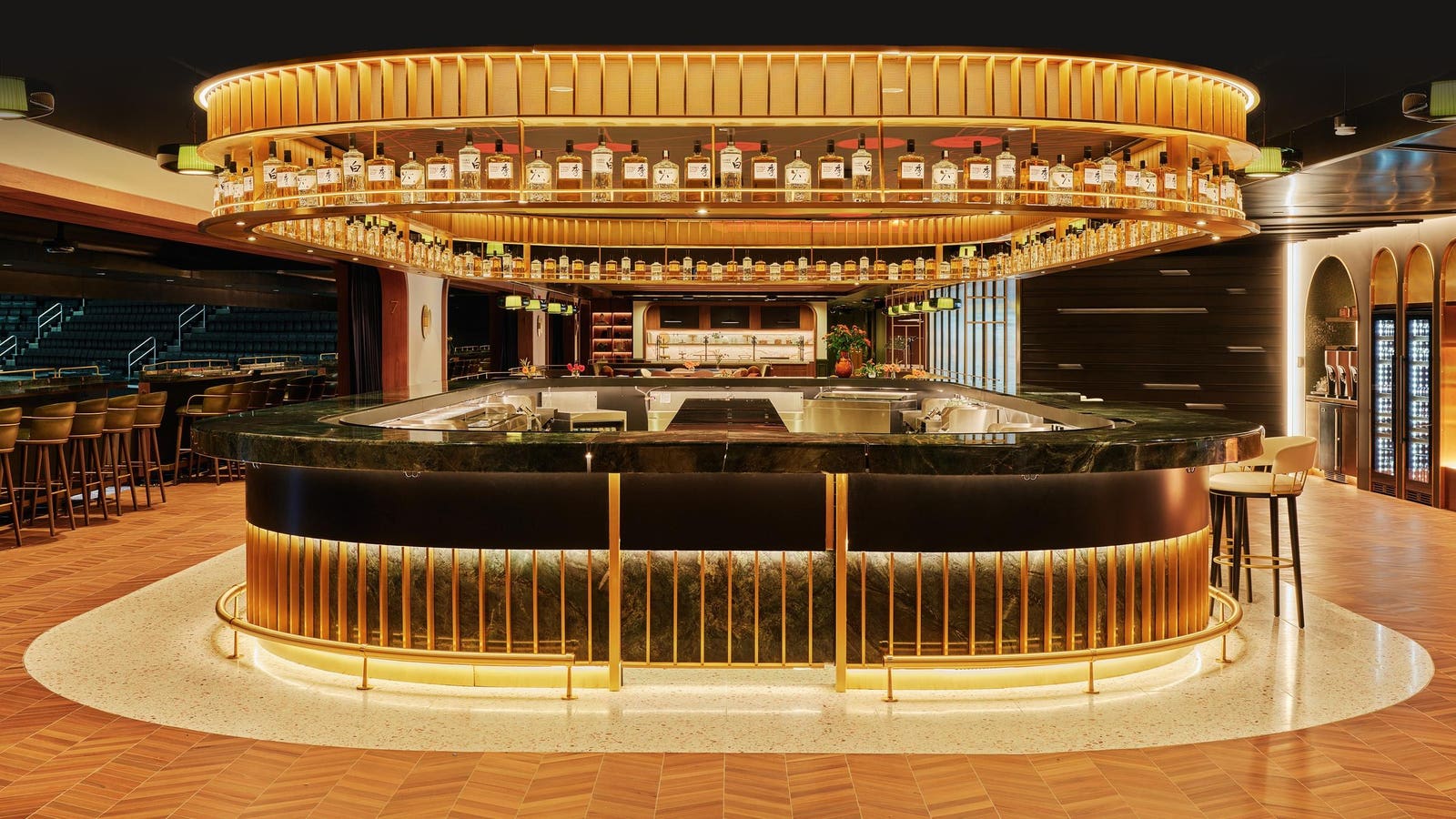
New on the Menu: The Patron Tequila Club is one of the new premium spaces at the Los Angeles Clippers’ $2 billion Intuit Dome, which has far fewer traditional suites than at the team’s old home, Crypto.com Arena.
L.A. Clippers
While the Titans are building an outdoor terrace area for premium customers, the San Francisco 49ers’ Levi’s Stadium is adding pool and shuffleboard tables and bocce courts as part of its new renovation. Venues may also offer opportunities to purchase limited-edition merchandise or have in-suite ice machines—or, in the case of the Vegas Golden Knights’ T-Mobile Arena, an entire ice room, churning out spherical cubes and clear ice for cocktails.
“Ice is a real thing,” Payne says, only somewhat tongue-in-cheek.
In some cases, these new amenities are meant to elevate an already-desirable location, like a seat at the 50-yard line. In others, they’re enough to overcome less-than-ideal sight lines, turning an arena dead zone into a hot spot.
“When I first was able to pay for my own tickets, my seats were very high, and I remember looking down to the courtside tickets—I’m like, I want to get down there,” says Shanon Ferguson, chief hospitality officer at BSE Global, parent of the Brooklyn Nets and Barclays Center. “Now the way we’re approaching this in the arena is we want everybody sitting courtside to look to the upper concourse and be like: ‘What’s going on up there? I want to go up there.’”
Dream Suites
An ultra-luxury experience for a marquee event can cost more than $1 million. Here are some of 2024’s most extravagant offerings.
🏈
Event: Super Bowl LVIII
Sport: NFL
Reported Price: $2.5 million
Selected Perks: Private space for 20 people, a full-service bar and high-end food (including wagyu beef hot dogs and lobster-stuffed potatoes), VIP parking passes, access to a VIP stadium entrance and to luxury club spaces
🥊
Event: Jake Paul vs. Mike Tyson fight
Sport: Boxing
Reported Price: $2 million
Selected Perks: Ringside seats, pre-fight and post-fight meet-and-greets, a post-fight in-ring photo opportunity, autographed gloves, access to a VIP lounge, a concierge and a security escort, two nights at a luxury hotel
🏎️
Event: Las Vegas Grand Prix
Sport: Formula 1
Reported Price: $1 million
Selected Perks: The Fontainebleau’s 2024 package included travel by private jet, a five-night stay, a table in the DJ booth at the LIV nightclub, a private dinner, food and resort credits, access to a suite for the race, and a limited-edition 2025 Aston Martin Vanquish (base price: $434,000).
Fueling the luxury suite trend is an increasing emphasis on business-to-business marketing and corporate hospitality. “Our experiences team works with over 200 brands per year,” says Flavil Hampsten, president for property sales at Charlotte, North Carolina-based sports consulting firm Elevate, “and we’ve seen clients’ spending increase 20% to 30%, generally being allocated toward bespoke, very unique experiences, oftentimes surrounding a sporting event.”
Teams are just as excited, however, about the opportunities at lower price points, what some are calling “entry-level premium.” Those offerings could be “mini suites,” with capacity for 10 or 12 rather than a more traditional 18 to 25, or even smaller semiprivate groups of seats, an increasingly popular stadium product that goes by many names (“loge boxes” and “opera boxes” among them). The Clippers’ Intuit Dome, for example, has 396 seats across what it is calling Halo Lofts while the Titans’ new stadium will have 576 seats—in configurations of four, six or eight—across 126 studio boxes.
“Think of leather movie theater seats,” says Dan Werly, the Titans’ chief operating officer. “They each have individual TVs in front of them, and they have their own cooler or refrigerator, too. And then each seat will also have access to a club.”
On a per-seat basis, loge boxes are significantly pricier than what a team could get for a regular ticket, often requiring six-figure lease payments. But given that teams typically require that traditional suites be rented on a season-long or multi-season basis—meaning a customer must pay for 20 or so seats across more than 40 games a year in the NBA and the NHL—these smaller spaces can reduce the cost considerably. “It’s opened up this whole new buyer group for teams to monetize,” Elevate executive vice president Dustin Vicari says.
Small Wonder: The Tennessee Titans’ new stadium will have 126 semiprivate “studio boxes,” in configurations of four, six or eight seats.
Manica/Tennessee Titans
The new premium customer could be a small business owner who wants to entertain just a client or two at a sporting event, or it could be a HENRY—“high earner, not rich yet,” to use a common marketing term. Regardless, there is clearly demand, fueled in part by a new emphasis on in-person experiences in the wake of the Covid-19 pandemic. Brian Ruede, CEO of Quint—a Charlotte-based premium hospitality company that was purchased by Liberty Media this year and creates luxury experiences at marquee events in partnership with leagues and teams—says that nearly 85% of the firm’s customers are individuals, not companies. And according to a study by Elevate, 34% of the buyers of one Southeastern Conference football program’s highest-priced premium offerings had household incomes of less than $100,000.
“We recognize that we’ve got fans that want to have popcorn and a beer, and we’ve also got fans that want to have a glass of Barolo and a lobster tail and a tomahawk steak,” says Lorenzo DeCicco, the Flames’ chief operating officer. “So we want to try to capture everything in between.”
The exact approach will differ by sport—based largely on the wildly different numbers of regular-season home games on, say, the NFL (eight or nine) and MLB (81) schedules—and by market. (Is the local fan base affluent? What are the potential corporate partners in the area? Should you bother building outdoor spaces if you play a winter sport in a northern city?) The financial impact will vary accordingly.
But for any team in the four big U.S. pro leagues, premium seating means major money—on average, an estimated $54 million in the NFL, $45 million in the NBA, $41 million in MLB and $35 million in the NHL during the most recent season of Forbes data. (Those figures represent increases of between 14% and 36%, depending on the league, since the last pre-pandemic season.)
For 15 teams across the four leagues, revenue from premium seating actually exceeded general ticket sales in that same season. Two teams—the Golden State Warriors, whose Chase Center opened in 2019, and the Los Angeles Kings, who play at Crypto.com Arena—made more from premium seating than from any other revenue stream, including media rights, according to Forbes estimates. And the luxury spaces can produce additional income by giving sponsors another spot where they can plaster their name.
“You can have large impact with large dollars in a limited number of seats by doing high-dollar functions,” Quint’s Ruede says, “but if you can figure out how to apply this down to all levels of seating, then you really have scale.”
Even older arenas are trying to capitalize on the trend, with teams recognizing that stadiums in the current environment can go only 10 or 15 years before needing a facelift. The Nets’ Barclays Center, which originally opened in 2012, is undergoing a five-year, $100 million renovation and, as part of the first phase, unveiled two new club spaces last month—JetBlue at The Key and the Toki Row—while dropping from 87 suites to just under 60. Membership starts at $12,500 and $33,000, respectively, covering a season of Nets and New York Liberty games as well as concerts and other events.
Meanwhile, the design of the Titans’ new premium spaces was inspired in part by—of all places—110-year-old Wrigley Field, which completed a five-year restoration project in 2019.
The ballpark hadn’t touched its suites since adding them for MLB’s 1990 All-Star Game, and its only other premium space was a roughly 70-person club, which had been converted later from a handful of the suites. Some stadiums can create new premium offerings by repurposing underutilized spaces—a green room or a storage room in the bowels of the building—but that wasn’t possible at Wrigley.
Dig It: To create the American Airlines 1914 Club at Wrigley Field, the Chicago Cubs had to unearth new space under the ballpark.
Chicago Cubs
“We excavated underneath the seating bowl, removed truckloads and truckloads of dirt,” Marquee 360 senior vice president Cale Vennum, who oversees the Chicago Cubs’ ticketing, says of three new club spaces that resulted from the renovation. (A fourth replaced two concession stands.) Wrigley’s suites, which hang from the ballpark’s upper level, gained some additional length and were revamped and enclosed, eliminating the need to travel between them on an outdoor workman’s catwalk “like you were going to change light bulbs or something,” Vennum says.
Demand remains high for the suites, which start at around $2,800 for eight people for a single game in 2025, and for the club spaces, which require commitments of at least a half-season and range from $275 to $1,000 per ticket per game. But even just five years after the end of the renovation, the Cubs know they can’t rest on their laurels.
“I think an area of opportunity that we are working on for next year—and we’ve got a concept that’s not quite ready for full reveal yet, but it’s getting close—is that four-to-eight-person elevated single-game experience,” Vennum says. “We don’t quite have that at Wrigley Field, but we think we’re going to have an offer that meets that hopefully next season.”
MORE FROM FORBESForbesFor Steve Ballmer, Building An NBA Champion Is Harder Than Running Microsoft But More FunBy Jabari YoungForbesThe Most Valuable NBA Teams 2024By Justin TeitelbaumForbesAmerica’s Richest Sports Team Owners 2024By Justin BirnbaumForbesInside The Super Bowl Of MarketingBy Brett Knight