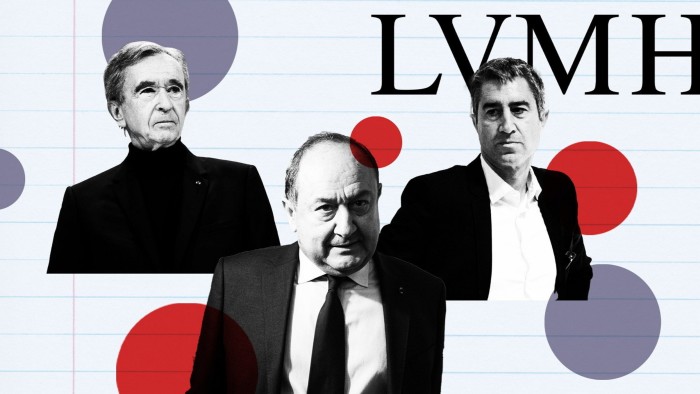
LVMH’s billionaire chief Bernard Arnault will appear in court on Thursday as a witness in a spying-gone-wrong case that has pitted France’s former intelligence chief against left-wing activists targeting the luxury group.
The trial is the culmination of a long-running investigation that has landed Bernard Squarcini, the country’s intelligence services boss under president Nicolas Sarkozy, on trial for charges related to corruption, illegal surveillance and influence peddling.
Many of the allegations relate to incidents that took place while Squarcini was employed as a private security contractor for LVMH, between 2013 to 2016.
Paris-listed LVMH, which is the world’s most valuable luxury group with a €296bn market capitalisation, already paid €10mn in 2021 to settle allegations it faced, without any admission of wrongdoing.
The scandal involving a harmless left-wing publication and activists has been an embarrassment for the owner of Dior and Louis Vuitton. It has also offered a glimpse into the paranoia simmering at some of the highest echelons of the company.
 Former French spy chief Bernard Squarcini, centre, arrives in court with his lawyers Patrick Maisonneuve, left, and Marie-Alix Canu-Bernard, right © Poitout Florian/ABACA via Reuters
The testimony of Arnault, who has been summoned to give evidence as a witness, is one of the highlights of the 15-day trial that started earlier this month.
One of the incidents at the heart of the affair is a kerfuffle between LVMH’s security team and left-wing activists intent on confronting Arnault about factory closures at the group’s 2013 annual general meeting.
As the activists led by François Ruffin — now an MP — were swiftly spotted at the event and escorted out, one of them tried to argue his way out of the situation, giving away that he had allegedly been working undercover on behalf of the luxury group.
“Let me go, let me go — stop,” the man shouted, according to testimony from security staff read out in a Paris court last week. “I’m the mole, I’m the mole. Just ask them, they will tell you.”
The informant allegedly received several thousand euros in compensation for his services via Squarcini’s subcontractors, while a second plant — who posed as a photographer — was given camera equipment and a small sum of money.
“The ‘mole’ seemed pretty low-end to me,” the security staffer said in their testimony. “Plus he is a coward — he told me straight away that he was the mole.”
LVMH spent €2.2mn on contracts with Squarcini, who was hired in 2013 by the luxury group’s then number two executive Pierre Godé to advise on matters from fighting counterfeit goods to crisis management and prevention, according to court documents.
Squarcini in turn paid about €450,000 to a cast of former police and intelligence officials, many now also on trial, who appear to have passed on a litany of inaccurate or exaggerated intelligence, according to evidence given in court.
Ruffin, who appears as a civil party in the case, has criticised the LVMH settlement. For a group that had €86bn in revenues last year, “it’s like slapping a €10 note on the judge’s desk and saying this is forgotten”, he said in court last week.
LVMH’s former security director Laurent Marcadier, an ex-magistrate referred to as “Lolo” in Squarcini’s text messages and phone records, is among 10 other defendants.
Squarcini has denied wrongdoing, saying that protecting Arnault was a matter of “national interest”.
Born in Rabat, Morocco, Squarcini headed up intelligence in France from 2008 to 2012 under Sarkozy’s presidency. A counterterrorism specialist, he also worked on key dossiers such as the rise of Islamic extremism.
When François Hollande became president, Squarcini left for the private sector, founding his consultancy Kyrnos Conseil. LVMH was one of its main clients.
 The left-wing newspaper and activist group Fakir was founded by journalist turned MP François Ruffin © Martin Bertrand/Alamy
Squarcini in court insisted he did not know informants had been remunerated, while he and his associates have rejected the allegations that they “infiltrated” Ruffin’s circle on behalf of LVMH.
They have argued that the term is inaccurate despite it appearing in more than a dozen communications, obtained by prosecutors via phone taps and during searches performed by law enforcement, according to court documents reviewed by the Financial Times.
In one phone call in 2013, LVMH’s Godé said: “It could be interesting . . . to infiltrate them, right?”
“That’s what I’m going to look at with the people concerned”, Squarcini replied — something he described in court as a “diplomatic” answer.
In another part of the case, Squarcini is accused of using his influence to access confidential information about an investigation into LVMH’s stealth stakebuilding in luxury rival Hermès.
Paris-based Hermès fended off the takeover attempt but filed a complaint to financial prosecutors about the tactics LVMH had used in 2010 to build a 20 per cent position while avoiding disclosure requirements. LVMH later paid an €8mn fine.
The former director of the Paris judicial police was fined last year for transmitting information about open investigations to Squarcini.
LVMH’s anxiety about Ruffin’s activist group Fakir, sharpened further as Ruffin prepared to release a documentary about Arnault in 2016 called Merci Patron! (Thanks, boss!).
The film, which highlighted the plight of workers who had lost their jobs when an LVMH supplier closed a garment factory, was an unexpected hit in France, winning a César, the French equivalent of an Oscar, despite its shoestring budget.
 A model walks the runway during the Louis Vuitton Ready to Wear Spring/Summer 2025 fashion show as part of the Paris Fashion Week © Victor Virgile/Gamma-Rapho via Getty Images
The prosecution alleges that Squarcini and his associates set out to covertly obtain a copy, which now forms part of the charges. Ruffin says he would have been happy to organise a screening at LVMH “but those requests never reached me”.
Squarcini, for his part, said he never saw the film. “Now might be a good opportunity to do so,” the presiding judge suggested.
The effort to counter Fakir, then a 20-strong group with no history of violence, was “an excessive waste of human resources”, former LVMH director Marcadier said in court as he blamed the contractors around Squarcini for overhyping the situation.
Ruffin has blamed Arnault’s intolerance to criticism and former anti-terrorism officials “playing soldiers” resulting in disproportionate methods being used against Fakir’s “schoolboy” tactics.
“They are bored, they are in a small office having to study this little story,” he told the court. By “accentuating the threat, it will justify the resources [and] the invoices”.
Asked by the judge as to whether he thought “this waste of resources on Fakir” was excessive, Squarcini acquiesced.
“I was caught between two worlds, that of the exaggerated information I was given, and the concern of the people at LVMH,” he said. “Intelligence helps decision-making, but you are not the decision maker.” The case continues.