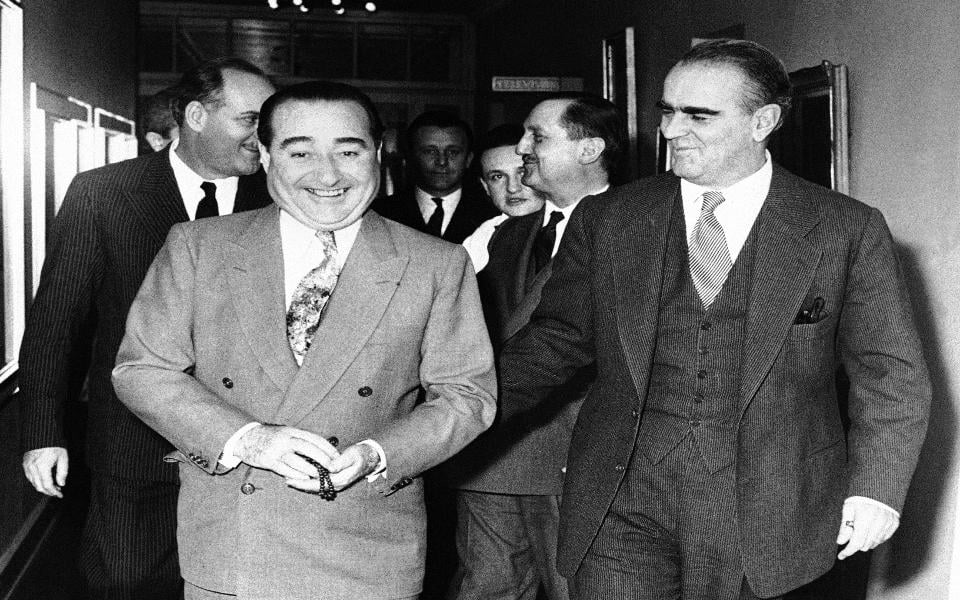
Adnan Menderes, left, Prime Minister of Turkey, and Constantine Karamanlis, right, Prime Minister of Greece, chat together as they stroll along a corridor of the Hotel Dolder in Zurich, Feb. 9, 1959, after session of the Greco-Turkish talks on Cyprus. Following them are their foreign ministers, Fatim Rustu Zorlu, left, and Evanghelos Averoff, right. [AP]
The issue of Cyprus’ accession to NATO is an old but very bitter one due to the mistakes made and the distortions it reveals in political culture. During the London Conference on February 19, 1959, which ratified the bilateral Greek-Turkish Zurich Agreement on the creation of the independent Cypriot state, a “gentlemen’s agreement” was concluded between Greek Prime Minister Konstantinos Karamanlis and his Turkish counterpart, Adnan Menderes.
The agreement was not made public, but Cypriot President Archbishop Makarios III and Turkish-Cypriot leader Dr Fazil Kucuk were informed of its existence. It stipulated, among other things, that Greece and Turkey would support Cyprus’ entry into NATO, while the establishment of NATO bases on the island “as well as their composition” would require the agreement of both Athens and Ankara. This provision did not create an obligation for Cyprus to seek membership in the Alliance: Two parties cannot, by their own agreement, bind a third, Cyprus. The agreement ensured Turkey’s consent to Cyprus’ accession, while at the same time, having a say in the “composition” of potential NATO bases, Athens could rule out the possibility of them being manned by Turkish troops – i.e. of a Turkish base being created on the island through the “back door.”
It was a remarkable strategy: Cyprus’ accession to NATO would secure the new state from the turmoil in its region, the most turbulent in the world. Moreover, NATO membership would entail a specific interpretation of the Treaty of Guarantees, as it would make a Turkish invasion of a member-state unthinkable, which would dissolve the Alliance itself. It is indicative that in 1963 the British Foreign Office, which was not at that time positive about Cyprus’ accession to the Alliance, noted that this would entail, in practice, the abandonment of the Treaty of Guarantees. This Treaty was ultimately invoked (misused) by Turkey during the invasion of Cyprus in 1974.
In a terribly ironic way, however, in the Greek and Cypriot public debate, this “gentlemen’s agreement” was considered to be a “betrayal” committed by Karamanlis and his then foreign minister Evangelos Averoff. Even in December 1989, when the British Foreign Office documents on the 1959 agreements were made public, a barrage of accusations of treason erupted against them for wanting Cyprus in NATO. Public figures, in a terribly hypocritical way, declared themselves surprised and shocked as if they were hearing it for the first time, while the agreement had become known to the public, if nothing else in the book by Stephen Xydis in his 1973 book “Cyprus: Reluctant Republic,” and therefore they knew it well. Averoff, hospitalized and unable to answer the charges, died right then, on January 2, 1990, reviled as a traitor because he wanted to secure Cyprus.
It was later argued that even if this agreement had existed, NATO would not have accepted Cyprus. This position, however, is disputed by modern research. In 1959, immediately after the conclusion of the London and Zurich agreements, the Americans explored the views of the Alliance members on the possible accession of Cyprus. The answers they received are extremely interesting. Of the countries that were likely to oppose (the Scandinavian countries, which had also disagreed with the accession of Greece and Turkey), Norway seemed rather reluctant, but declared that it would not veto if the others accepted it. Denmark replied that since it had accepted the accession of Greece and Turkey, it would not object to the accession of “another non-European state”! And in the United Kingdom the Ministerial Committee decided in the early 1960s that if such an application were made, it could not oppose it. In other words, there was a prospect of Cyprus joining, but it was Nicosia’s decision not to pursue it.
This opinion piece will not deal with the discussions about NATO involvement in the Cyprus issue in 1964, which took place in a completely different context of an evolving crisis, nor with the events of 1974, in which it played no role. However, the apparent, careful targeting of the Republic of Cyprus for institutional association with the Alliance is a major strategic decision. Together with Cyprus’ accession to the EU, it concerns the Cypriot Greeks’ belonging to the modern world. It will not be easy. It will be much more difficult than in 1960. But if this institutional upgrade is achieved, it will complete the Western identity of Cyprus, which is the main pillar of its security, prosperity and democracy. If, again, it is not achieved due to the reaction of another country, it will nevertheless confirm this Western identity and will yield results. I wish something like this had happened before 1974; the history of Cyprus would have been different.
Evanthis Hatzivassiliou is professor (post-war history) at the Department of History and Archaeology of the University of Athens, and the secretary-general of the Hellenic Parliament Foundation for Parliamentarism and Democracy.