A solid majority in the Norwegian Parliament voted in favour on Tuesday of extending women’s rights to a self-determined abortion from 12 to 18 weeks into a pregnancy. It was widely hailed as an historic liberalization of the former law that hadn’t been altered for 46 years.
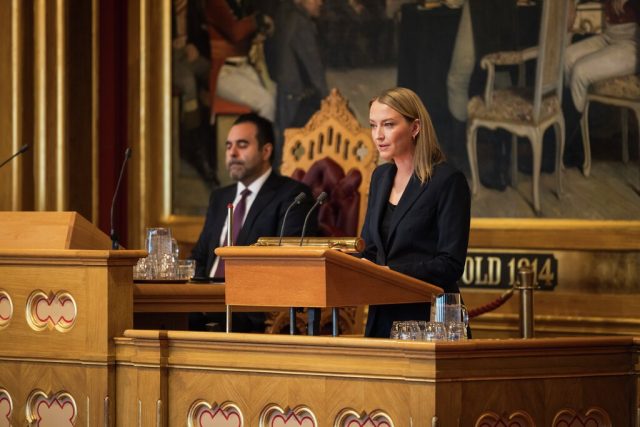 Member of Parliament Sandra Bruflot of the Conservative Party was responsible for handling Tuesday’s debate and vote on the liberalization of Norway’s abortion law. At left, the president of Norway’s Parliament (Stortinget), Masud Gharahkhani. PHOTO: Stortinget/Peter Mydske
Women have long had abortion rights in Norway, but if a pregnancy went beyond 12 weeks, they had to formally obtain permission from a medical commision called a nemd. Almost all did, but the restriction was viewed as an impediment to self-determination.
Now women can decide for themselves up to 18 weeks into a pregnancy, also if they seek fetus reduction if pregnant with, for example, twins or triplets. After that they’ll still need permission from a commission, which will now, however, be made up of mostly female doctors and a lawyer.
“This is an historic day,” said Member of Parliament Marian Hussein from the Socialist Left party (SV). “We’ve been part of securing and strengthening one of the most fundamental rights in a society based on equality, the right to decide for herself whether a woman wants an abortion. It’s about time.”
 Health Minister Jan Christian Vestre held up his ministry’s proposal for an “updated” abortion law earlier this year, claiming it was more in line with current practice and social values. PHOTO: Helse- og omsorgsdepartementet
Health Minister Jan Christian Vestre of the Labour Party also said the new law strengthens women’s rights to abortion. “We have formed a modern abortion law that reflects the times in which we live,” Vestre said, noting that the previous abortion law was approved nearly 50 years ago by a slim majority. The majority in favour this time was much larger.
Individual Members of Parliament were released from their parties’ policy on abortion and could vote freely based on their own conscience. Many veteran politicians had also changed their positions, with the now 80-old Carl I Hagen even saying he regretted his earlier, much more conservative position on the issue. “The authority and decision-making shall now rest with the pregnant woman,” Hagen said from the podium in Parliament. “She must be able to decide for herself, and not be subject to the humiliation of having to ask a board for permission to end her pregnancy.”
Another member of the conservative Progress Party, Bård Hoksrud, said there was still “broad disagreement” within the party on the abortion issue. He voted against the new law, saying that “consideration for the fetus must be high.”
Debate before Tuesday’s vote had been relatively low key, professional and with what some called the “level of voice used indoors, not outdoors.” The new law will also be re-evaluated after four years. “Then we’ll also be able to see how the new commissions (aimed at eliminating any of the fear or humiliation some women felt) have functioned,” said Health Minister Vestre.
 Dag-Inge Ulstein and members of his Christian Democrats party voted against the new abortion law. PHOTO: Stortinget
It was an emotional afternoon for some Members of Parliament, with Vestre’s predecessor Ingvild Kjerkol of Labour saying she was proud to be part of the liberalization, while some members of the anti-abortion Christian Democrats said they felt sad. Their leader Dag-Inge Ulstein also fears that some unborn children may be aborted because of their gender or health problems. More than 50,000 Norwegians had also signed a petition against the abortion law liberalization.
Sandra Bruflot of the Conservative Party, who was in charge of the issue in Parliament, was glad individual MPs could vote based on their own conscience, and not the policy of the their parties. While Labour favoured the liberalization, for example, its own health policy spokeswoman Tone Wilhelmsen Trøen thinks 18 weeks is too late in a pregnancy for an abortion.
Bruflot herself was in favour of the law change, noting that 84 percent of all women in Norway who’ve opted for an abortion undergo the procedure before the ninth week, and 95 percent before the 12th week. Many who waited beyond the 12th week found it a burden to have to appear before a commission to seek permission. “I think we must rely on the woman herself, to make the best decision in her own situation,” Bruflot said.
NewsinEnglish.no/Nina Berglund