
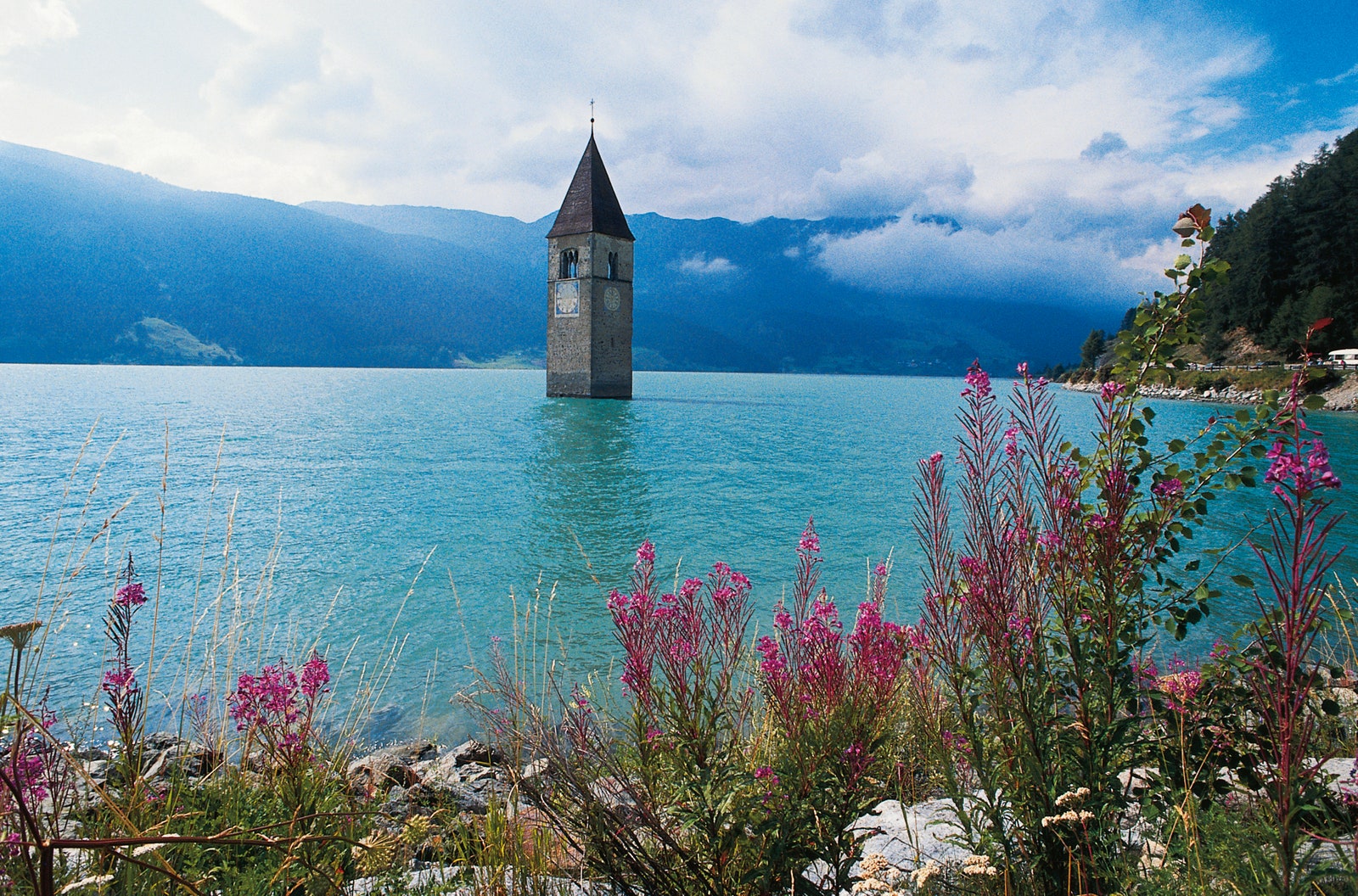
The Bell Tower in Lake Resia
The campanile or bell tower in Lake Resia has become a symbol of the Vinschgau Valley, in Italy’s South Tyrol province. While it may appear like something from a fairytale, it actually has a very sad history. The 14th-century Romanesque church that the bell tower belonged to was the victim of the construction of a dam after the end of World War II. Some unfortunate miscalculations led to the unintended flooding of the villages of Curon and Resia and the displacement of hundreds of families. The church tower remains as a monument to the unimaginable—and a warning to civil engineers and infrastructure planners.
The Cave of the Cumaean Sibyl
A priestess of Apollo, the Cumaean Sibyl mentioned by Ovid, Dante, and Petronius, lived, legend says, in this cave in what is today the Archaeological Park of Cuma, located between Naples and Puzzuoli in southern Italy. The cave was discovered in 1932 and consists of a long stone tunnel, with 12 short side openings in the hillside and shafts that allow light to filter into the tunnel, forming a special and mysterious effect of light and shadow. Deeper into the cavern, there is a vestibule and an inner chamber, with seats, where the prophetess carried out her oracular activities in a trance-like state uttering her prophecies. Some historians now believe the cave was dug in Roman times (around 37 BCE) for more practical reasons: to allow the passage on foot of soldiers arriving with their ships in Portus Julius. Along a perfectly straight path of 200 metres, ancient graffiti can still be seen—a palm tree, a fish, and a cross. Even today, the Sibyl’s cave is said to be an enchanted place, suspended between myth and reality, and it retains the evocative charm of the myth that still permeates the site today.