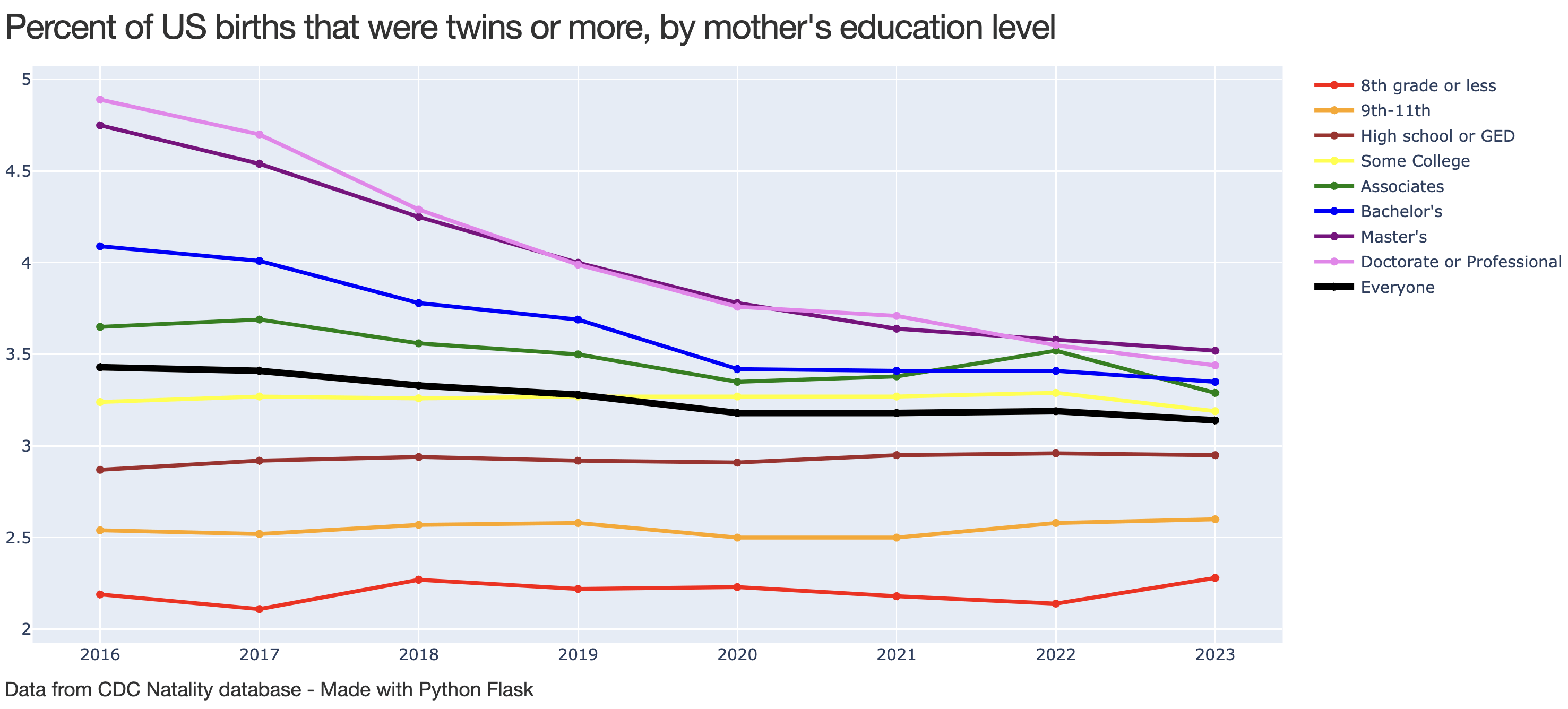
I have no idea why this trend over time is occurring. The only other determinant of twins I’m aware of is genetic, with Black Americans being highest and Asian, Native and Native-Ancestry Latinos being lowest.
Maybe it’s a change in the rates or types of fertility drugs used?
I’m hoping that by sharing I’ll hear some good theories or conclusions on why this chart looks like it does.
Interesting data. Can I assume this this a function of birth age? Presumably, the more education someone has, the later in life they’re having kids. Further, I’m assuming women giving birth in their 30s/40s are more likely to have twins than women giving birth in their teens/20s?
Edit: I’m pretty surprised that the lines are converging so much from 2016 to 2023. I think I understand the reason for the difference by education level, but I don’t really understand the difference over time.
For this to be meaningful, you’d have to exclude children that were the result of fertility treatments, or at least separate the charts on that.
How does your evaluation handle availability of IVF etc?
I wonder if that’s more of a function of later births. More educated women tend to have children later in life. In many cases there’s also fertility therapies, which may increase the incidence of twins as well.
Would the education be correlated with income/good health insurance, and thus IVF access (and often higher age when trying to conceive), which can have a higher chance of multiples? The downward trend would also make sense if that’s it, since transferring multiple embryos is not nearly as common as it used to be.
The probability of getting twins rises with the age of the women. And while I don’t have a good statistics at hand, it isn’t unreasonable to think that higher educated women just marry and get kids at a later point in life. So higher education very likely just correlates but doesn’t cause a higher twin probability.
As everyone’s said, more educated women are likely to be older mothers, and births to older mothers (both natural and with fertility treatment) are more likely to be multiple.
But what I don’t understand is why the effect is much smaller in 2023 than in 2016.
Could the reduction over time be due to more stringent IVF procedures? As in, 10 years ago, plenty of doctors would transfer 2 or 3 embryos. These days, no IVF center transfers more than 2 embryos, and they all strongly discourage transferring more than 1 in the first, and often second, cycles. This might be further impacted by the relatively faster time to pregnancy due to modern tests such as PGT-A or time-lapse imaging.
I wonder if this correlates to assisted reproductive practices which are presumably used more often by people with higher incomes…
Multi-embryo implantation used to be much more common because the success rate was so low –e.g., transferring 2+ embryos at the same time increased the odds that at least one of them would attach and result in a successful pregnancy. As the medicine has improved, the need to transfer more than one embryo has decreased and many fertility clinics will now only support singleton journeys on account of the unnecessary health risks to the mother and the babies.
IVF used to come with high odds of multiple births but recent practices in IVF have reduced those chances of multiple births- they used to implant multiple embryos knowing that there was a decent chance they wouldn’t all make it (but there was also a chance they would). Now with genetic testing and other information you can get pre-implantation they’re better at picking single embryos with the highest chance of survival, so the “best practices” are to only implant one at a time. I suspect that explains a lot of the downward trajectory on the “higher education” lines.
What is the y axis here? The title is “percentage of US births that were twins or more”, with the everyone line seeming to indicate the actual percentage of US births that were twins or more. But in that case the summation of the other lines should result in the Everyone quantity, which clearly is not the case.
Can you do one of these with ADHD diagnoses based on induced labor?
My sister had kids and did the class mother then Teachers Assistant and then Library School/Librarian and during all her time at school she asked the parents of the ADHD (mainly boys, so few many fewer girls) kids and asked if they had induced labor and in every case she and I have asked parents it has been across the board yea they did induce for hyper little Johnny.
Turns out the AMA journal won’t post 2 school librarians anecdotal data in their ‘Journal’ but both she and I were shocked to have the connection be there across the board.
IVF has to be factored in no? Changes in IVF process has led to less multiples no?
Wait… does this mean women with master’s degree or higher have more chance to give birth to twins😭
Is this based solely on education level at time of birth? Would affect conclusions drawn from the data.
Please fix the y axis origin at zero, then it may be beautiful.
Thanks for all the suggestions and information.
Fwiw – I was able to pull the data with and without fertility treatments and I can confirm it seems to explain most of the variation, but there is still some amount that appears correlated with age, education and especially ancestry. Education and age would be hard to disentangle, but I guess my assumption is age is a more likely driver than education.
I don’t think I’ll be able to make an updated chart anytime soon, but if you’re curious about this topic, like I was, those are the “TIL” takeaways, at least for me..
![[OC] Percent of US births that were twins or more, by mother's education level](https://www.europesays.com/wp-content/uploads/2024/12/2mgkiiiou85e1-1920x1024.png)
19 comments
Tool: Python Flask, Data: CDC Wonder Natality Database.
I have no idea why this trend over time is occurring. The only other determinant of twins I’m aware of is genetic, with Black Americans being highest and Asian, Native and Native-Ancestry Latinos being lowest.
Maybe it’s a change in the rates or types of fertility drugs used?
I’m hoping that by sharing I’ll hear some good theories or conclusions on why this chart looks like it does.
Interesting data. Can I assume this this a function of birth age? Presumably, the more education someone has, the later in life they’re having kids. Further, I’m assuming women giving birth in their 30s/40s are more likely to have twins than women giving birth in their teens/20s?
Edit: I’m pretty surprised that the lines are converging so much from 2016 to 2023. I think I understand the reason for the difference by education level, but I don’t really understand the difference over time.
For this to be meaningful, you’d have to exclude children that were the result of fertility treatments, or at least separate the charts on that.
How does your evaluation handle availability of IVF etc?
I wonder if that’s more of a function of later births. More educated women tend to have children later in life. In many cases there’s also fertility therapies, which may increase the incidence of twins as well.
Would the education be correlated with income/good health insurance, and thus IVF access (and often higher age when trying to conceive), which can have a higher chance of multiples? The downward trend would also make sense if that’s it, since transferring multiple embryos is not nearly as common as it used to be.
“Among cycles reported to the Society for Assisted Reproductive Technology (SART) in 2017, 12.4% of women <38 years of age who had a successful IVF cycle had a twin gestation, down from 23% in 2014 but still significantly more than baseline.” [source](https://www.asrm.org/practice-guidance/practice-committee-documents/guidance-on-the-limits-to-the-number-of-embryos-to-transfer-a—committee-opinion-2021/) (not super current, but shows a sharp decline even just from 2014 to 2017)
The probability of getting twins rises with the age of the women. And while I don’t have a good statistics at hand, it isn’t unreasonable to think that higher educated women just marry and get kids at a later point in life. So higher education very likely just correlates but doesn’t cause a higher twin probability.
As everyone’s said, more educated women are likely to be older mothers, and births to older mothers (both natural and with fertility treatment) are more likely to be multiple.
But what I don’t understand is why the effect is much smaller in 2023 than in 2016.
Could the reduction over time be due to more stringent IVF procedures? As in, 10 years ago, plenty of doctors would transfer 2 or 3 embryos. These days, no IVF center transfers more than 2 embryos, and they all strongly discourage transferring more than 1 in the first, and often second, cycles. This might be further impacted by the relatively faster time to pregnancy due to modern tests such as PGT-A or time-lapse imaging.
I wonder if this correlates to assisted reproductive practices which are presumably used more often by people with higher incomes…
Multi-embryo implantation used to be much more common because the success rate was so low –e.g., transferring 2+ embryos at the same time increased the odds that at least one of them would attach and result in a successful pregnancy. As the medicine has improved, the need to transfer more than one embryo has decreased and many fertility clinics will now only support singleton journeys on account of the unnecessary health risks to the mother and the babies.
IVF used to come with high odds of multiple births but recent practices in IVF have reduced those chances of multiple births- they used to implant multiple embryos knowing that there was a decent chance they wouldn’t all make it (but there was also a chance they would). Now with genetic testing and other information you can get pre-implantation they’re better at picking single embryos with the highest chance of survival, so the “best practices” are to only implant one at a time. I suspect that explains a lot of the downward trajectory on the “higher education” lines.
What is the y axis here? The title is “percentage of US births that were twins or more”, with the everyone line seeming to indicate the actual percentage of US births that were twins or more. But in that case the summation of the other lines should result in the Everyone quantity, which clearly is not the case.
Can you do one of these with ADHD diagnoses based on induced labor?
My sister had kids and did the class mother then Teachers Assistant and then Library School/Librarian and during all her time at school she asked the parents of the ADHD (mainly boys, so few many fewer girls) kids and asked if they had induced labor and in every case she and I have asked parents it has been across the board yea they did induce for hyper little Johnny.
Turns out the AMA journal won’t post 2 school librarians anecdotal data in their ‘Journal’ but both she and I were shocked to have the connection be there across the board.
IVF has to be factored in no? Changes in IVF process has led to less multiples no?
Wait… does this mean women with master’s degree or higher have more chance to give birth to twins😭
Is this based solely on education level at time of birth? Would affect conclusions drawn from the data.
Please fix the y axis origin at zero, then it may be beautiful.
Thanks for all the suggestions and information.
Fwiw – I was able to pull the data with and without fertility treatments and I can confirm it seems to explain most of the variation, but there is still some amount that appears correlated with age, education and especially ancestry. Education and age would be hard to disentangle, but I guess my assumption is age is a more likely driver than education.
I don’t think I’ll be able to make an updated chart anytime soon, but if you’re curious about this topic, like I was, those are the “TIL” takeaways, at least for me..
Clomid is one hell of a drug!
Comments are closed.