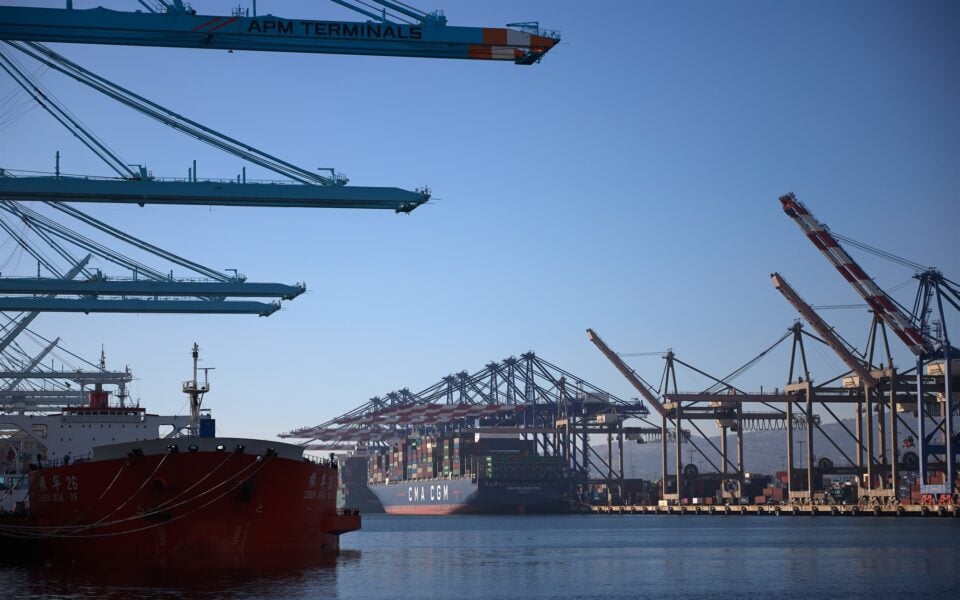
Cranes unload a container ship at the Port of Los Angeles in California on December 3, 2024. US President-elect Donald J. Trump has said he would impose tariffs against Canada, Mexico and China. [EPA]
Europe’s economic news agenda is dominated by the urgent question of what the continent’s reaction should be to protectionary measures heralded by the incoming US administration. Should the European Union become embroiled in a tariff race that could disrupt global trade flows, and how should it position itself between China and Western economies?
If a broader shift toward protectionism and away from free trade does take place, how will it impact the dynamics between highly export-oriented EU countries like Germany and those more concerned by the cost of imports? Additionally, how might the structure of production be affected, particularly for goods versus services, where the United States holds a dominant position and is less vulnerable to protectionist measures?
There are many who believe that the significant challenges brought to light by the present circumstances also point to deeper structural problems in Europe. Can Europe reverse its productivity deficit vis-a-vis the more dynamic economies of Asia and America? Can European economies boost savings that can be mobilized to bolster investments, particularly in high-tech sectors and businesses? Can it reverse the aging of the population and attract dynamic groups of people who might consider migrating? Finally, is a substantial transformation of economic performance feasible, given Europe’s social characteristics and political structure?
The link between how institutions operate and economic prosperity in Europe is particularly important. In the decades that followed World War II, and especially after the creation of the European Economic Community and the OPEC oil crisis, the stability and transparency of the institutions supporting the democratic system, combined with a strong safety net from the welfare state and respect for freedoms and the environment, progressed hand in hand with economic growth. The gradual but marked rise of economies in a political and social context that departs from the European acquis in Asia and elsewhere in recent years may give rise to the question of whether a different framework, one with less democracy and respect for human rights, could enhance economic prosperity even more. Recent political developments in the United States have a complementary effect, in the sense of concentrating power at the government level at the expense of other institutions, such as the central bank, and withdrawing from international organizations and agreements.
It may not simply be about whether incomes will rise by a few percentage points, but whether institutional foundations and freedoms in Europe might be undermined
The challenge may be even bigger than it appears in this context. It is not just about whether and how a system with institutional checks and balances – with potentially complex relationships of majority rule, but with respect for minorities and protection for the vulnerable – can sustain strong growth dynamics in the same way a more centralized system might drive them in the short term. The reverse question also arises: If Europe continues to lag economically behind other regions, to what extent might there emerge a tendency to retreat from or reverse critical aspects of its institutions, whether at the national or European level?
Therefore, the quest for ways to substantially enhance growth and economic prosperity in Europe becomes even more critical. It may not simply be about whether incomes will rise by a few percentage points, but whether institutional foundations and freedoms in Europe might be undermined. There’s a lot that needs to change in how European states, institutions and markets operate to create a new momentum in Europe. Without these changes, pressure on citizens’ incomes will turn into political pressure, which could, in turn, erode a series of important achievements and objectives. With Europe’s economic and demographic clout diminishing, the current trend is not favorable. Where the European economy goes from here – whether it can get onto a stronger growth path – may determine a lot more than merely increasing incomes.
Nikos Vettas is the general director of the Foundation for Economic and Industrial Research (IOBE) and professor of economics at the Athens University of Economics and Business.