Previous post was removed – reposted with a less sensational headline.
Right but transportation is useful. Blowing up skyscrapers isn’t that useful.
Would be more apt to compare cars to bikes or trains.
Lmao that’s actually the dumbest sub. And they think carbrain is an actual insult that wouldn’t just get you laughed out of any room you say that in.
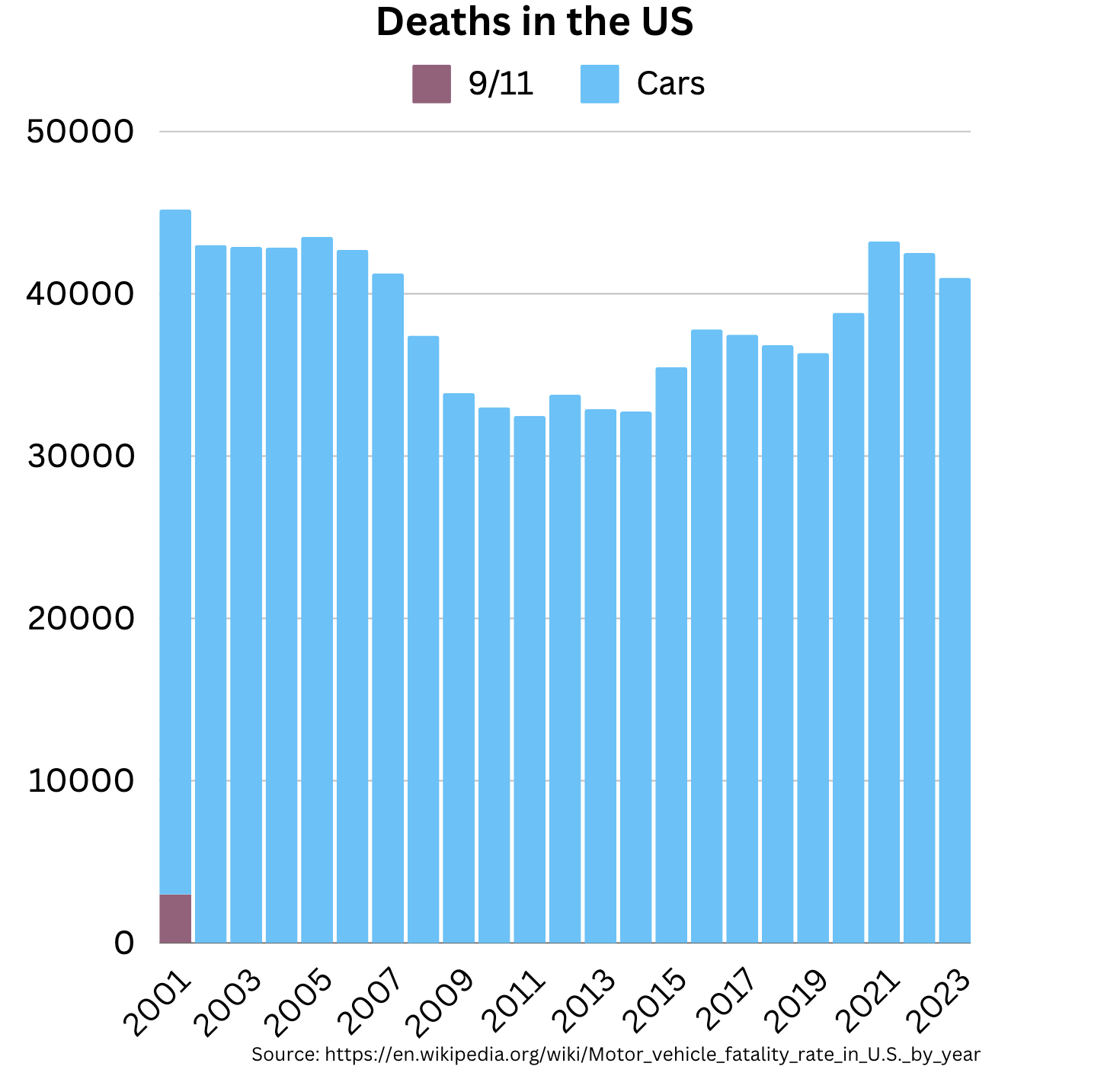
Is the point of this supposed to be that we should care about car crashes more than 9/11?
What a weird post.
“Moderately risky activity that tens of millions engage in on a daily basis kills more annually than scary terrorists that one day”
Not the most interesting chart if I’m being honest.
[deleted]
Car collisions: The constant slow moving pandemic that officials continually refuse to do anything about.
[deleted]
Hey big boy, your graph is completely wrong. This might surprise you but people still die from the toxic materials related to ground zero. You also had people dying all around the world due to the acts of 9/11. It is estimated half a million civilians died in both Afghanistan and Iraq.
With Americans taking 400 billion car trips a year, you’re just doomed to get deaths. That’s a 0.00001% chance of dying on a trip, which is actually impressive.
I guess one issue I have is that you are comparing deaths which involved a relative small subset of the US population.
According to this tool [1], about 27M people live within 100 miles of Manhattan. So ~5k of 27M would perhaps be more like the ~40k auto-deaths divided by around 10.5 (US population was 285M in 2001), so now we’re at about ~5k versus around ~4k. (And I think using a 100 mile range is pretty generous here)
And most of those deaths occurred on a single day, while the other metric is for a full year… so ~5k versus ~4k/365, about 10.
When the comp is 5000 versus 10, I think it is fair to put a little more reverence on the former.
[1]https://www.statsamerica.org/radius/big.aspx
Cars are the real terrorists. They are weapons of mass destruction
Interesting juxtaposition. 9/11 is considered a major tragedy which resulted in major policy change and restrictions even though it impacted (relatively) fewer people.
Car fatalities, on the other hand, affects way more people yet doesn’t receive the same public outrage, policy change, etc… That should change.
Some context for people wanting to argue about whether this is bigger than it should / could be: https://ourworldindata.org/grapher/road-accident-deaths-per-passenger-kilometers
everywhere I’ve been gives drivers license away like they belong in a box of cereal. We treat driving like it’s a human right. We really need to be more stringent on who gets to drive. The amount of drivers that are scared of their own shadow when behind the wheel is an issue.
In my city, they started a Vision Zero initiative, not too different from what The Netherlands has done in the past.
The idea is to provide policy and design changes to move towards zero traffic fatalities.
Once the city government realized it meant making changes to how culturally the city approaches parking and driving, and putting real physical barrier in places and drastically overhauling intersections, they began walking it back until finally the next Mayor canned the whole fucking thing.
It’s clear what needs to be done, there is not the political will to do it.
Compare it to traffic fatalities involving alcohol and then you will really see who the terrorists are.
I’d rather see car fatalities vs obesity-related fatalities.
These are two very different numbers. One statistic shows accidental deaths while operating vehicles. The other shows how many people were murdered during a major coordinated terrorist attack. People do the same comparisons when there’s a school shooting to downplay people calling for gun reform. It’s manipulating the numbers by comparing apples and oranges.
Car fatalities and crashes are more of a culture problem and not a policy problem.
At least in my area, most fatalities and accidents occur in rush hours or late at night.
De-emphasizing the “If you’re not on time, you’re late” corporate mentality and incentivizing remote work will go a long ways to reducing car accidents.
I’m not too sure on this, but it feels like the U.S. is the only business culture in the western world that emphasizes rigid early morning timeliness (which induces traffic congestion and activity at specific times later in the day).
21 comments
Previous post was removed – reposted with a less sensational headline.
Right but transportation is useful. Blowing up skyscrapers isn’t that useful.
Would be more apt to compare cars to bikes or trains.
Lmao that’s actually the dumbest sub. And they think carbrain is an actual insult that wouldn’t just get you laughed out of any room you say that in.
Is the point of this supposed to be that we should care about car crashes more than 9/11?
What a weird post.
“Moderately risky activity that tens of millions engage in on a daily basis kills more annually than scary terrorists that one day”
Not the most interesting chart if I’m being honest.
[deleted]
Car collisions: The constant slow moving pandemic that officials continually refuse to do anything about.
[deleted]
Hey big boy, your graph is completely wrong. This might surprise you but people still die from the toxic materials related to ground zero. You also had people dying all around the world due to the acts of 9/11. It is estimated half a million civilians died in both Afghanistan and Iraq.
With Americans taking 400 billion car trips a year, you’re just doomed to get deaths. That’s a 0.00001% chance of dying on a trip, which is actually impressive.
I guess one issue I have is that you are comparing deaths which involved a relative small subset of the US population.
According to this tool [1], about 27M people live within 100 miles of Manhattan. So ~5k of 27M would perhaps be more like the ~40k auto-deaths divided by around 10.5 (US population was 285M in 2001), so now we’re at about ~5k versus around ~4k. (And I think using a 100 mile range is pretty generous here)
And most of those deaths occurred on a single day, while the other metric is for a full year… so ~5k versus ~4k/365, about 10.
When the comp is 5000 versus 10, I think it is fair to put a little more reverence on the former.
[1]https://www.statsamerica.org/radius/big.aspx
Cars are the real terrorists. They are weapons of mass destruction
Interesting juxtaposition. 9/11 is considered a major tragedy which resulted in major policy change and restrictions even though it impacted (relatively) fewer people.
Car fatalities, on the other hand, affects way more people yet doesn’t receive the same public outrage, policy change, etc… That should change.
Some context for people wanting to argue about whether this is bigger than it should / could be: https://ourworldindata.org/grapher/road-accident-deaths-per-passenger-kilometers
everywhere I’ve been gives drivers license away like they belong in a box of cereal. We treat driving like it’s a human right. We really need to be more stringent on who gets to drive. The amount of drivers that are scared of their own shadow when behind the wheel is an issue.
In my city, they started a Vision Zero initiative, not too different from what The Netherlands has done in the past.
The idea is to provide policy and design changes to move towards zero traffic fatalities.
Once the city government realized it meant making changes to how culturally the city approaches parking and driving, and putting real physical barrier in places and drastically overhauling intersections, they began walking it back until finally the next Mayor canned the whole fucking thing.
It’s clear what needs to be done, there is not the political will to do it.
Compare it to traffic fatalities involving alcohol and then you will really see who the terrorists are.
I’d rather see car fatalities vs obesity-related fatalities.
These are two very different numbers. One statistic shows accidental deaths while operating vehicles. The other shows how many people were murdered during a major coordinated terrorist attack. People do the same comparisons when there’s a school shooting to downplay people calling for gun reform. It’s manipulating the numbers by comparing apples and oranges.
Car fatalities and crashes are more of a culture problem and not a policy problem.
At least in my area, most fatalities and accidents occur in rush hours or late at night.
De-emphasizing the “If you’re not on time, you’re late” corporate mentality and incentivizing remote work will go a long ways to reducing car accidents.
I’m not too sure on this, but it feels like the U.S. is the only business culture in the western world that emphasizes rigid early morning timeliness (which induces traffic congestion and activity at specific times later in the day).
This is not a particularly valuable comparison.
Comments are closed.