
On a sunny Friday in September, 21-year-old Henry Earle took a break from class, scrolling on his phone in a quiet corner of the breakroom.
The light-eyed, soft-smiled Detroit native harbors dreams of opening a string of vacation rentals. To get there, Earle found a path through the Detroit Training Center, a workforce development hub tucked in an industrial corner of the city, where he hoped to learn how to install drywall.
But Earle caught a flat tire heading to class. So he walked.
“I am indeed a hustler,” he said. “I got a lot of people counting on me.”
Founded in 2012, the Detroit Training Center caters to students in search of second chances. Some have experienced difficulty finding jobs that match their educational credentials or due to prior charges and past convictions. Others have been laid off and hope to start new careers in a rapidly changing economy.
The center’s work is one innovative example of how many in Detroit are hoping to build a more inclusive workforce as the city rebounds from a historic 2013 bankruptcy. Accelerated by years of job loss, population decline and a foreclosure crisis, Detroit’s downward spiral has finally showed signs of reversal. And with the help of a $200 million investment from JPMorgan Chase — a leading influence in Detroit’s comeback — money is flowing to people, places and entities designed to lift the city back up.
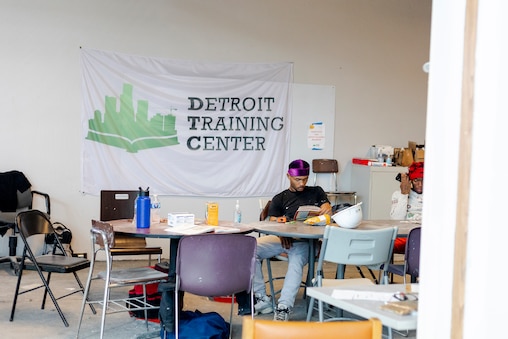 Dave’on Gilmer, 24, reads at the Detroit Training Center.
(Sylvia Jarrus for The Baltimore Banner)
 Andre Andrews, a Detroit Training Center instructor, guides Myron Logan on mudding technique. (Sylvia Jarrus for The Baltimore Banner)
As JPMorgan Chase turns its attention to Baltimore, some cautioned that the added investment may not touch everyone equally; homelessness, joblessness and violence haven’t been eradicated from Detroit, and the economic gains there have been slow. Still, those involved in Detroit’s upturn said there are ways to ensure even the most economically disadvantaged can benefit from the renewed focus — and it could start at the intersection of Baltimore’s vacant housing epidemic.
Housing the people
Much of the skepticism surrounding Detroit’s resurgence stems from young people reeling from rising rents and wages that haven’t kept pace.
Look no further, they said, than downtown Detroit, which has been retooled with coffee shops, entertainment venues and expensive retailers.
“And that’s all beautiful,” said Amanda Brezzell, an urban farmer and food systems policy specialist who has helped build a network of farms and gardens in Detroit. “But … who is it for?”
Working the land on a bright Saturday morning, Brezzell cut tomatoes from the vine and set out cartons full of them for neighbors to grab. They see farming as a gateway to greater community resilience — especially in the face of rising housing, food and fuel costs in Detroit and outside of it.
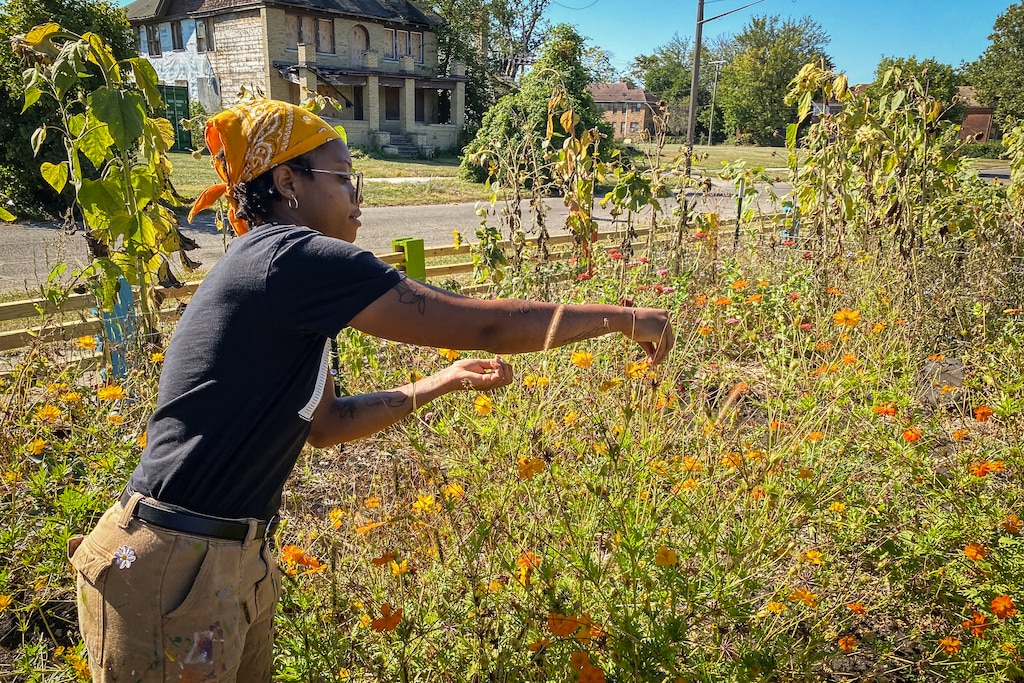 Amanda Brezzell, co-founder of Fennigan’s Farms, works the urban farmland on a Saturday in September. (Hallie Miller/The Baltimore Banner)
 Cartons of bright-colored vegetables, free for the taking, harvested by Fennigan’s Farms. (Hallie Miller/The Baltimore Banner)
But Brezzell is old enough to recall the gloom of the 2008 foreclosure crisis that helped push Detroit to the brink and thinks the emphasis has wrongly shifted from boosting the social safety net for residents toward enticing wealthier people into the city.
“So for us and the work that we’re doing,” Brezzell said, “we’re here to kind of get in the way of that, disrupt that.”
To keep more native Detroiters stable, housing must first be made more affordable for renters in areas with rich amenities, transit and walkable streets, said Dave Blaszkiewicz, president and CEO of Invest Detroit, a community development financial institution and a major funding recipient of JPMorgan Chase. That means adding supply, entering into partnerships with government and philanthropists, and removing bureaucratic barriers whenever possible.
The COVID-19 pandemic, which caused soaring inflation, heightened materials prices and increased labor costs, stunted housing supply growth in the initial years and made the progress seem lopsided, Blaszkiewicz said. But now, with some of the pandemic’s financial headwinds receding, Invest Detroit — which provides money to those who can’t get loans from traditional lenders — has helped fund an increasing number of housing deals and is seeing more interest from private sector partners in building more.
Still, Blaszkiewicz said, “It took us 70 years to find ourselves in this position. It’s not going to turn overnight.”
Detroit city government leaders have tried to work in tandem with the private sector in creating more supply to bring down costs. They have, for example, partnered with the Detroit Land Bank Authority on an affordable housing strategy, used its resources to add to the city’s multifamily portfolio, and contributed resources to areas outside of the downtown core.
Julie Schneider, director of the city’s Housing & Revitalization Department, acknowledged that the work has not spread to every neighborhood, especially those most in need. But small, targeted investments in so-called “areas of strength” can help the city avoid some of its financial missteps from the past, Schneider said.
“Rather than spreading resources too thin, we wanted to be more focused,” Schneider said. “And that creates potential for expansion over time.”
Strategic policy, leadership continuity
With a few strategic moves, Detroiters have been given crucial advantages that other cities can draw from, its leaders said.
For starters, Michigan voters approved a property tax cap in 1994 known as “proposal A” that limits their annual bill to increase no more than 5%. Invest Detroit’s Blaszkiewicz said the cap has created a gentrification buffer around homeowners but is less helpful for renters, who have no protections from rising rental prices. For the first time in decades, a majority of Detroiters own their homes, according to U.S. Census Bureau data.
Detroiters have also benefited from consistent leadership in City Hall by way of Mike Duggan, who has been mayor since 2014 following the historic bankruptcy. The city has been afforded a level of continuity that Baltimore, for example, has lacked since the 1990s.
Duggan, a businessman who entered office with robust private sector connections, has negotiated with at least 17 employers to fill jobs through Detroit’s workforce agency, said Terri Weems, group executive of Workforce and Detroit at Work, the city’s workforce development umbrella organization.
“If someone says, ‘I want to be trained in basket weaving,’” Weems said, “we say: We don’t support that.” That means sometimes redirecting people who request specialized skills in some industries — such as retail — and ensuring workers find jobs that pay at least $15 an hour.
Weems said the agency also has “challenged” employers to lower their educational qualifications for some positions and lobbied successfully to “ban the box” in Detroit, which prevents employers from asking applicants about prior convictions until after an initial interview or employment offer.
Baltimore, which also follows a “ban the box” policy, has two hiring agreements for development projects at Harbor Point and Baltimore Peninsula, according to the Mayor’s Office of Employment Development.
MacKenzie Garvin, the Baltimore department’s director, said they have attempted to funnel workers into “target industries,” including professional services, government, health care and construction. City residents also have staffed up a virtual JPMorgan Chase call center that launched last year and may create as many as 125 jobs.
“When a business comes with intentionality and says we want to employ city residents … we are able to find the candidates,” Garvin said. But, in the absence of more employers, Baltimore’s unemployment rate stands at nearly 5%, or about 13,500 workers — nearly identical to the number of vacant homes on its books.
‘Yes, jobs’
With JPMorgan Chase’s commitment to invest $20 million over five years, several people in Baltimore have been tapped as recipients, many of whom have backgrounds in community development, commercial corridor revitalization and entrepreneurship.
But so far little of the funding has flowed to efforts that plump up the city’s workforce at scale.
Some see Baltimore’s comprehensive vacant housing plan as an opportunity to combine its housing goals with the chance to reskill workers who have been left out of the regional job market — which skews heavily toward government and health care jobs. The need for workers who are skilled in vacant housing restoration is acute. Maryland Gov. Wes Moore, who signed on to the city’s plan this fall, set a goal of eliminating 5,000 abandoned homes in five years.
Addressing a crowd of city boosters in October, Moore pledged that the so-called Reinvest Baltimore partnership would create more green space, build new housing and add jobs.
“Yes, jobs,” Moore emphasized, “for people in the community.”
As Detroit experienced a similar energy around vacant housing abatement around a decade ago, a landscaper and housing contractor named Patrick Beal noticed there weren’t enough people skilled in this line of work. His company trained workers one by one and partnered with the Michigan Department of Corrections to find more applicants and fill the gaps.
Eventually, leadership in state government took notice and encouraged Beal to spin off and create a full-time center. With some initial seed money from JPMorgan Chase, Beal did just that, and the center has gone on to offer training in heavy equipment operation, blight removal, commercial driver’s licenses, masonry, welding and drywall finishing, among other subjects.
Running this business involves navigating tricky financial terrain, said Bram Lesko, a training center spokesperson. The hub is a private entity that raises all its own funding, and costs per pupil can be as high as $6,000. Unemployment offices, philanthropists and employers may help foot the bill, Lesko said, but the money often comes in spurts and can be unpredictable year to year. Few students can afford to pay their own way.
Still, Lesko said, the Detroit Training Center is poised to move into a larger space and has entered into a new partnership with Wayne County to give it more breathing room. He sees the mission as an essential limb in the anatomy of Detroit’s recovery. Otherwise, he said, the short-term investments won’t be able to stand on their own.
“People need jobs. People need better jobs, but where?” he said. “And that’s the question that you have to answer, because otherwise you’re just like anybody else, trying to get jobs that may or may not exist.”