Unlock the Editor’s Digest for free
Roula Khalaf, Editor of the FT, selects her favourite stories in this weekly newsletter.
The EU is close to signing multibillion-euro deals with Jordan and Morocco to strengthen co-operation on reducing migration to the bloc, Brussels’ new commissioner for the Mediterranean has said.
Concerned by rising support for far-right, anti-immigrant parties across the bloc, the EU is increasingly leaning on countries in the Middle East and north Africa to curb migration, offering financial support in return for tougher border control measures.
The EU’s efforts to sign more strategic partnerships come as recent deals with Egypt and Tunisia have been criticised over the countries’ human rights records. Morocco, an important transit country, has already been receiving funding from Brussels to curb departures to the bloc, while Jordan houses more than a million Syrian refugees, putting pressure on the small Middle Eastern kingdom’s economy.
Commissioner Dubravka Šuica said an agreement with Amman was “almost ready” and would be signed by Jordanian King Abdullah in Brussels at the end of January or early February. “Jordan is about to happen,” Šuica told the Financial Times. “We want to have them on board and they want us on board too.”
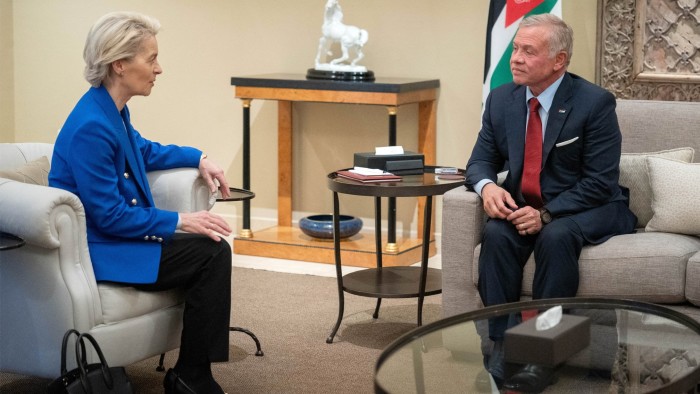
Šuica’s comments came as European Commission president Ursula von der Leyen travelled to Jordan on Monday. “I am looking forward to welcoming King Abdullah in Brussels in early 2025. Together we will launch a strengthened Strategic Partnership between the EU and Jordan,” von der Leyen said.
She added that the EU “will work closely with Jordan and our partners to ensure a political transition in Syria” after Islamist rebels toppled President Bashar al-Assad’s regime.
Last year, Brussels concluded a deal worth €165mn with Tunisia, and another one this year worth €7.4bn with Egypt, despite campaigners warning about the human rights record of both governments.
Šuica said the next deal after Jordan would be with Morocco. “Morocco is one of the most important ones,” she said, though Brussels needed to consider the impact of the status of Western Sahara — a disputed territory claimed by Rabat.
The European Court of Justice earlier this year ruled that a fishing and agriculture deal between the EU and Morocco was invalid because it had violated the right to self-determination of the people of Western Sahara. Šuica said the impact of this ruling on a possible deal with Morocco was being assessed.
Recommended

Šuica said both the agreements with Jordan and Morocco would be of a “similar” scale to the agreement with Egypt, and include trade and energy projects as well as measures to control migration.
Jordan hosts the second-largest amount of refugees as a proportion of its population, most of them coming from Syria, according to the UN refugee organisation UNHCR. Morocco and the EU have long co-operated on curbing migration, with the EU sending Rabat more than €2.1bn between 2014 and 2022, according to the commission.
Human rights activists and politicians have severely criticised the EU for its agreements with Egypt and in particular Tunisia over allegations of human rights breaches. Tunisian President Kais Saied has cracked down on the opposition and civil society, with authorities accused of trafficking and deporting migrants. Tunis has denied violating migrants’ rights.
Recommended

“The countries were on the edge of collapse and we had to help them,” Šuica said when asked about the human rights allegations. She added that “we have to really be cautious” on Tunisia.
She said partner countries “have to fulfil the criteria which are addressed within these partnership agreements”, including a human rights clause.
“No cent will be disbursed to any of these countries before they fulfil their milestones from this human rights clause,” she said.