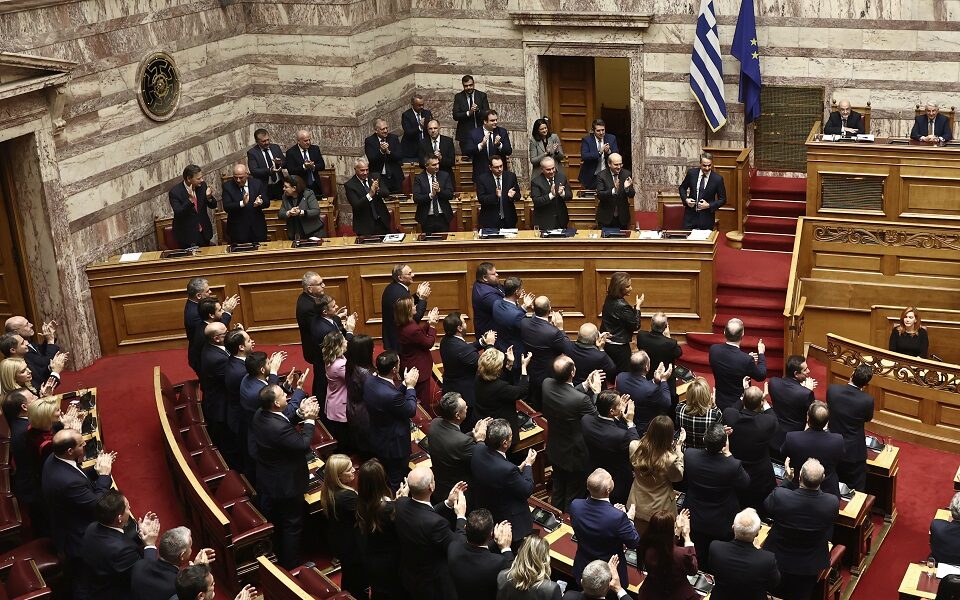
On the night of Sunday, December 15, Kyriakos Mitsotakis’ government emerged stronger from the three-day debate on the 2025 state budget proposal. The prime minister dominated the parliamentary debate and was able to focus on his policy in support of citizens on middle and lower incomes. Also, the proposal was supported by more voters than those who belong to New Democracy. The following day, in Berlin, Chancellor Olaf Scholz lost a vote of confidence, opening the way for federal elections on February 23. For Scholz, the defeat was expected and welcome, as early elections had been announced soon after the chancellor expelled the liberal Free Democratic Party (FDP) from his coalition. Both leaders were satisfied by very different outcomes in the vote of confidence in their governments, as each had different expectations and fears.
For Mitsotakis, the vote’s outcome was a welcome development after the European Parliament result (where he himself had placed the bar high, for no apparent reason), and after the expulsion of Antonis Samaras from New Democracy. The former prime minister was absent for the vote, and the political space to the right of ND does not seem to be expanding at the government’s cost. ND is recovering in the polls – but not to the extent that it could hope for a one-party government if elections were held today. The prime minister has two and a half years at his disposal to apply the policy which he believes will strengthen his party. The general indifference towards the fate of Samaras (as recorded in a recent Pulse poll for Skai Television) strengthens the impression that the most fertile ground for ND to regain its electoral strength is the center – where most of the voters who have moved away from the government seem to belong. The person that Mitsotakis will nominate for president of the republic, and policy on issues such as high prices, justice, education and protection of the environment, will determine whether ND can hope for a clear win at the end of its four-year term. Till then, Mitsotakis has the privilege of leading a country that is stable and part of the discussion on the evolution of Europe, and which for the next two years will be a member of the UN Security Council.
For Mitsotakis, the vote’s outcome was a welcome development after the European Parliament result (where he himself had placed the bar high, for no apparent reason)
In Germany, the FDP’s persistence with monetary dogma, in conjunction with the constitutionally mandated “debt brake” (since the time of Angela Merkel), highlights the system’s inertia in the face of a rising tide of challenges. Without investment in infrastructure and education, without support for growth, without social programs in favor of the weak, Germany will face an ever stronger challenge from extremist political forces. Today the conservative CDU is ahead in the polls, followed by the extreme-right AfD, and then Scholz’s SPD. The AfD, which expresses Putin’s views, has lately gained the approval of Elon Musk. It will keep growing stronger as elections approach. In other words, while Germany stuck to outdated dogma, the “unorthodox” forces of the extreme-right and extreme-left have been gaining in power. Many SPD members were relieved by the jettisoning of the FDP, even though this brought down the government. But now, even the CDU is no longer subservient to the debt brake. After the election, this new pragmatism may benefit Germany and, in turn, the European Union. A stable Greece with a strong center, and a Germany determined to evolve to deal with the time’s challenges, may find themselves to be invaluable partners on their common course in Europe.