Bad news for anyone dreaming of owning a home: In September 2024, 23.1% fewer building permits were issued compared to the previous year. Experts predict a recovery no sooner than the end of 2025 – the housing shortage is worsening, Reuters reported.
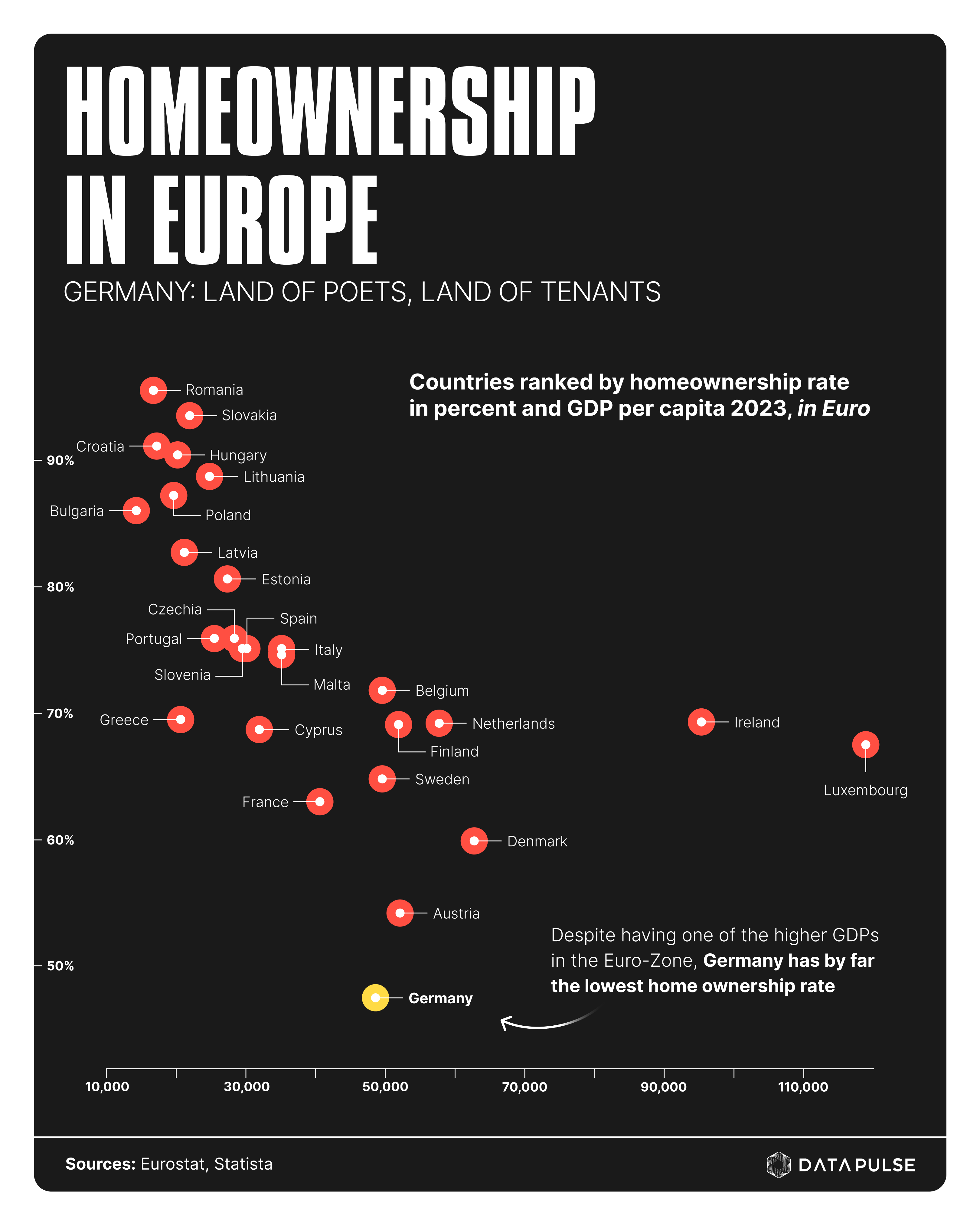
With just 46.7% homeownership, Germany ranks last in the EU. Even in countries with significantly lower GDPs, like Romania (94.8%) or Poland (84.3%), the dream of owning a home is far more common.
What’s holding Germans back? High purchasing costs and strict equity requirements play a role, but these are often even higher in other countries. Perhaps it’s the “rental culture” deeply rooted since the 19th century – or maybe we just prefer to invest in cars over real estate.
How did eastern Europe accomplish this?
Lagging behind implies that there is some kind of progression. Which there is not.
I may be very wrong here, but I’m sure I remember reading some stuff about Germany having excellent social housing and great tenant’s rights compared to a lot of other countries, so why would you bother?
Like I’m desperate to own a home here in Australia because renters have very limited rights and landlords are subhuman filth who will all be first against the wall when the revolution comes, but if I could get a long term lease protected from price increases and being sold out from underneath me, I probably wouldn’t be as bothered owning a home.
Silly saying ”despite” GDP when it’s in line with the general trend in correlation
That’s what you get when you have a good social renting program. People are happy without owning a house. I love it. Capitalism can work with socialism, you only need to assign the correct politicians.
Seems there’s some language issues here, perhaps I’m incorrect, but I’ll say them anyway:
* First, shouldn’t the title be ‘Homeownership in **the European Union**’? There’s more than 27 countries in Europe.
* Second, you also refer to the Euro-zone in your bottom-right comment, but I was under the impression Euro-zone refers to the countries that only use the Euro. However, only 20 out of 27 of the countries of the EU use the Euro. So, does the statement in the bottom refer exclusively to the 20 that use the Euro, or is it all 27?
For germany:
Renting and put the spare Money (you can Never Pay back the loan with the Same amount as renting) in Stocks will result in more Money in the end.
Also if you Rent you have lots of Rights.
You basically only buy if that is one of your Lifetime Goals to own your own Home. Its Like buying a fancy car which you always wanted.
Or you get it from Patents or cheap Land.
For a person allegedly domiciled in Germany you suspiciously can’t tell EU from Europe
Edit: label the damn axes
Weird that UK/the individual countries aren’t listed here. They’re in Europe and the Euro-zone that the graph mentions. Does this just include those in the EU?
home ownership in the EU would be a better description, you’re missing the UK for a start
now overlay a statistic of % destroyed in WW2. Homeownership is a generational progression over century’s not decades.
I love starting graphs at 50% to make differences look bigger
I get that the graph is just Europe, but I’d really like to know where the US falls in comparison.
If anything it seems like they are ahead?
Home ownership seems to decrease with increased GDP. So Germany seems to have a home ownership rate that would indicate a much higher GDP.
How in the hell does Ireland rank so high in GOP per capita? I missed that one!
Did all the poor people leave during the potato famine? /s
It’s nonsense to say that Germany is “falling behind.” It just isn’t what Germany is encouraging or subsidizing. I don’t think we in the US realize how many little ways we subsidize home ownership.
Housing is not just owning a SFH. There are many types of housing we’ve made illegal in the US.
Germany does not mandate that its cities welcome homebuilding. It makes doing so worth their while, by tethering their revenue directly to how many residents they have.
The main explanation for Germany’s exemplary record of affordable, stable housing is that the country encourages homebuilding, lots of it. Germany is a juggernaut of adding apartments, rowhouses, and other homes. From 2010 to 2019, for every hundred people added to Germany’s population, the country gave permits for construction of 97 homes. That’s right: Germany permitted almost as many new homes as it added residents. In the same period, for every 100 additional people living in the five Cascadian states (Alaska, Idaho, Montana, Oregon, and Washington), the region awarded permits for the construction of just 42 new homes: one new home for every 2.4 extra people. Adjusted for population growth, Germany permitted more than twice as many new homes as Cascadia. What’s more, Germany’s homebuilding accomplishment came in a decade when the country’s building rate was slow by its own standards. Germany built more than twice as many dwellings in the 1990s, for example. In Cascadia, mired in local zoning restrictions, homebuilding has lagged behind population growth for decades, leaving states such as Oregon and Washington with acute housing gaps. To match Germany’s record, Cascadia will have to ramp up homebuilding significantly. To match Germany not only in homebuilding but also in low-carbon living, Cascadia will have to build those homes in existing neighborhoods, inserting hundreds of thousands of rowhouses, duplexes and other “smallplexes,” and apartment buildings as “infill” into built-up areas. These forms of middle housing make up most of Germany’s housing stock.
Germany’s century-old system of fiscal equalization among the states gives localities a stake in providing abundant housing. The system distributes state funds according to a formula in which population is the main factor. Most localities get more than a quarter of their funds from equalization grants, and many of their other revenues also grow directly with population size. For example, heavily populated localities get a bigger share of their state’s value-added taxes than less populous ones. Local German officials, like local leaders everywhere, seek bigger budgets to provide more and better services to their constituents. What’s different about Germany is that the way to get bigger budgets is to increase local populations. And, as Professor Buettner says, “Ultimately, to get people, municipalities will need to support housing.”
And this is all to negate the fact that German housing is built to far higher efficiency and ecological standards.
Why is Ireland twice as prosperous (in GDP/person) as Germany, Sweden, or Austria?
As a Romanian, I tell you this is 100% BS.
The statistics made are misleading.
Many people are living under same roof as the owner, grandma, cousin, brother, mother in law and so on.
This DOES NOT make all people inside that house owner but just 1 person.
Instead I would look of the number of people that are not living in rent, nor are owner of the house in paper but living with someone else in the same house and you’ll see that many people actually are not owners.
It’s in the german culture to rent instead of buying a home… And always has been
Germany has very strong renter’s rights. At the same time, it’s pretty densely settled. So the motivation for ownership is pretty low.
In my opinion, in an ideal society, homeownership shouldn’t be an investment vehicle at all. People should be able to rent a place without feeling like they’re throwing money away because they chose not to be leveraged 3:1 buying a piece of land that locks them to a specific location on this planet.
Now do it base on percentage of population living in urban areas.
Homeownership often doesn’t make financial sense in heavily urban areas.
The data on Romania is wildly incorrect. Most people rent.
I hope ppl realize that Romania is On the top because communism built a lot of apartments and they were dirt cheap to buy. Also the data is fake. Most young ppl in Romania do not own a house, not one that they bought, at least,maybe passed down.
Also, in Romania, this data collection was made artificially. By inspecting the civilion data available. And if you have a ID with a non temporary address, you “own” q house. And that is false.
Guess which two countries are corporate tax heaven
GDP is such a horrible scale here. You should add population per square kilometers.
Just take Norway and Germany as an example. They are about the same size but Norway has a population of 5m and Germany 84m. Obviously it’s easier to own a house when you have 16x the space per capita.
Don’t write Europe when you mean European Union.
I wish people would stop saying “Europe” generally, when they actually mean the EU (European Union) – there is a difference!
I dont know about the other states, but in Germany/Austria it is financially supported to own property and rent it out. So what you want to achieve is to rent while renting out.
It’s stupid beyond belief because the owner’s have no clue about their assets (you visit it once or twice, buy it and rent it out). And the people living there have no incentive to invest into that asset (you don’t own it, live it down as much as possible but then leave).
Austria works because in Vienna and Graz the Commies and Socialists invest a ton into Social Housing. Germany is just a shithole when you want to live in bigger cities.
Tmw you can see the eastern block clearly
Interesting. Doing some lookups and conversions, Canada would be graphed near Sweden.
So what’s the situation in somewhere like Germany then? Is it that most of the houses and apartments are owned by relatively few landlords, or is the state involved? Just curious
Since when was higher GDP meant higher wealth equality??? LOL!
This is a natural trend the poorer the country is, the higher is the homeownership rate. Most telling difference is Czechia vs Slovakia. They both came out of Czechoslovakia where literally everything was the same: it was one Communist piece of shit. Now Czechia is richer so their homeownership rate is lower.
By the way, GDP charts better used low scale. It makes much more sense that way.
depending on how the data were collected and translated it can have major differences.
eg.
If I have a house in a long forgotten village with 10 population and I work 12 hours away it is useless because most probably the house cannot be sold or rented either way. so it can neither be a primary household but neither an income. (not including “vacation” houses). This can be in many countries in offivcial records as homeowners but are false data because the house cannot be used per se
Think it’s important to remember that Germany has a massive continuous immigration throughput and it takes a while for immigrants to get on the property ladder so I wonder if in Germany’s case there would be an argument for looking at ethnic Germans in their own right and then 1st generation immigrants etc etc. Any “German” (your stereotypical beer and sausage loving overweight German) I know owns their own home
Where are Russia and Ukraine?
Now do home ownership for people under 35!
Post made by an American who doesn’t understand the difference between Europe and the European Union.
Oh no, all the dirty socialist countries. How dare people own anything there.
Switzerland has an even lower rate than Germany so I have to imagine the OPis either confused about what is in Europe or has some kind of agenda
The top countries have a problem, a failure to start problem. Young adults still live with parents due to various reasons (rent prices is one of them, but I am not sure if the main one).
Ah I got to visit Eurostat’s headquarters cool place
![[OC] Home ownership in a European comparison – Germany lags behind](https://www.europesays.com/wp-content/uploads/2024/12/kz2f1ji5je9e1-1920x1024.png)
45 comments
**Article:** [https://www.datapulse.de/en/home-ownership/](https://www.datapulse.de/en/home-ownership/)
**Main data source:** [https://ec.europa.eu/](https://ec.europa.eu/eurostat), [https://www.statista.com/](https://www.statista.com/)
**Data:** [Google Sheets](https://docs.google.com/spreadsheets/d/132L69_DVD_xwjR_eG4xXif7NeHbF_920yKCStTFbylA/edit?usp=sharing)
**Tool:** Adobe Illustrator
Bad news for anyone dreaming of owning a home: In September 2024, 23.1% fewer building permits were issued compared to the previous year. Experts predict a recovery no sooner than the end of 2025 – the housing shortage is worsening, Reuters reported.
With just 46.7% homeownership, Germany ranks last in the EU. Even in countries with significantly lower GDPs, like Romania (94.8%) or Poland (84.3%), the dream of owning a home is far more common.
What’s holding Germans back? High purchasing costs and strict equity requirements play a role, but these are often even higher in other countries. Perhaps it’s the “rental culture” deeply rooted since the 19th century – or maybe we just prefer to invest in cars over real estate.
How did eastern Europe accomplish this?
Lagging behind implies that there is some kind of progression. Which there is not.
I may be very wrong here, but I’m sure I remember reading some stuff about Germany having excellent social housing and great tenant’s rights compared to a lot of other countries, so why would you bother?
Like I’m desperate to own a home here in Australia because renters have very limited rights and landlords are subhuman filth who will all be first against the wall when the revolution comes, but if I could get a long term lease protected from price increases and being sold out from underneath me, I probably wouldn’t be as bothered owning a home.
Silly saying ”despite” GDP when it’s in line with the general trend in correlation
That’s what you get when you have a good social renting program. People are happy without owning a house. I love it. Capitalism can work with socialism, you only need to assign the correct politicians.
Seems there’s some language issues here, perhaps I’m incorrect, but I’ll say them anyway:
* First, shouldn’t the title be ‘Homeownership in **the European Union**’? There’s more than 27 countries in Europe.
* Second, you also refer to the Euro-zone in your bottom-right comment, but I was under the impression Euro-zone refers to the countries that only use the Euro. However, only 20 out of 27 of the countries of the EU use the Euro. So, does the statement in the bottom refer exclusively to the 20 that use the Euro, or is it all 27?
For germany:
Renting and put the spare Money (you can Never Pay back the loan with the Same amount as renting) in Stocks will result in more Money in the end.
Also if you Rent you have lots of Rights.
You basically only buy if that is one of your Lifetime Goals to own your own Home. Its Like buying a fancy car which you always wanted.
Or you get it from Patents or cheap Land.
For a person allegedly domiciled in Germany you suspiciously can’t tell EU from Europe
Edit: label the damn axes
Weird that UK/the individual countries aren’t listed here. They’re in Europe and the Euro-zone that the graph mentions. Does this just include those in the EU?
home ownership in the EU would be a better description, you’re missing the UK for a start
now overlay a statistic of % destroyed in WW2. Homeownership is a generational progression over century’s not decades.
I love starting graphs at 50% to make differences look bigger
I get that the graph is just Europe, but I’d really like to know where the US falls in comparison.
If anything it seems like they are ahead?
Home ownership seems to decrease with increased GDP. So Germany seems to have a home ownership rate that would indicate a much higher GDP.
How in the hell does Ireland rank so high in GOP per capita? I missed that one!
Did all the poor people leave during the potato famine? /s
It’s nonsense to say that Germany is “falling behind.” It just isn’t what Germany is encouraging or subsidizing. I don’t think we in the US realize how many little ways we subsidize home ownership.
Housing is not just owning a SFH. There are many types of housing we’ve made illegal in the US.
Germany does not mandate that its cities welcome homebuilding. It makes doing so worth their while, by tethering their revenue directly to how many residents they have.
The main explanation for Germany’s exemplary record of affordable, stable housing is that the country encourages homebuilding, lots of it. Germany is a juggernaut of adding apartments, rowhouses, and other homes. From 2010 to 2019, for every hundred people added to Germany’s population, the country gave permits for construction of 97 homes. That’s right: Germany permitted almost as many new homes as it added residents. In the same period, for every 100 additional people living in the five Cascadian states (Alaska, Idaho, Montana, Oregon, and Washington), the region awarded permits for the construction of just 42 new homes: one new home for every 2.4 extra people. Adjusted for population growth, Germany permitted more than twice as many new homes as Cascadia. What’s more, Germany’s homebuilding accomplishment came in a decade when the country’s building rate was slow by its own standards. Germany built more than twice as many dwellings in the 1990s, for example. In Cascadia, mired in local zoning restrictions, homebuilding has lagged behind population growth for decades, leaving states such as Oregon and Washington with acute housing gaps. To match Germany’s record, Cascadia will have to ramp up homebuilding significantly. To match Germany not only in homebuilding but also in low-carbon living, Cascadia will have to build those homes in existing neighborhoods, inserting hundreds of thousands of rowhouses, duplexes and other “smallplexes,” and apartment buildings as “infill” into built-up areas. These forms of middle housing make up most of Germany’s housing stock.
Germany’s century-old system of fiscal equalization among the states gives localities a stake in providing abundant housing. The system distributes state funds according to a formula in which population is the main factor. Most localities get more than a quarter of their funds from equalization grants, and many of their other revenues also grow directly with population size. For example, heavily populated localities get a bigger share of their state’s value-added taxes than less populous ones. Local German officials, like local leaders everywhere, seek bigger budgets to provide more and better services to their constituents. What’s different about Germany is that the way to get bigger budgets is to increase local populations. And, as Professor Buettner says, “Ultimately, to get people, municipalities will need to support housing.”
And this is all to negate the fact that German housing is built to far higher efficiency and ecological standards.
Why is Ireland twice as prosperous (in GDP/person) as Germany, Sweden, or Austria?
As a Romanian, I tell you this is 100% BS.
The statistics made are misleading.
Many people are living under same roof as the owner, grandma, cousin, brother, mother in law and so on.
This DOES NOT make all people inside that house owner but just 1 person.
Instead I would look of the number of people that are not living in rent, nor are owner of the house in paper but living with someone else in the same house and you’ll see that many people actually are not owners.
It’s in the german culture to rent instead of buying a home… And always has been
Germany has very strong renter’s rights. At the same time, it’s pretty densely settled. So the motivation for ownership is pretty low.
In my opinion, in an ideal society, homeownership shouldn’t be an investment vehicle at all. People should be able to rent a place without feeling like they’re throwing money away because they chose not to be leveraged 3:1 buying a piece of land that locks them to a specific location on this planet.
Now do it base on percentage of population living in urban areas.
Homeownership often doesn’t make financial sense in heavily urban areas.
The data on Romania is wildly incorrect. Most people rent.
I hope ppl realize that Romania is On the top because communism built a lot of apartments and they were dirt cheap to buy. Also the data is fake. Most young ppl in Romania do not own a house, not one that they bought, at least,maybe passed down.
Also, in Romania, this data collection was made artificially. By inspecting the civilion data available. And if you have a ID with a non temporary address, you “own” q house. And that is false.
Guess which two countries are corporate tax heaven
GDP is such a horrible scale here. You should add population per square kilometers.
Just take Norway and Germany as an example. They are about the same size but Norway has a population of 5m and Germany 84m. Obviously it’s easier to own a house when you have 16x the space per capita.
Don’t write Europe when you mean European Union.
I wish people would stop saying “Europe” generally, when they actually mean the EU (European Union) – there is a difference!
I dont know about the other states, but in Germany/Austria it is financially supported to own property and rent it out. So what you want to achieve is to rent while renting out.
It’s stupid beyond belief because the owner’s have no clue about their assets (you visit it once or twice, buy it and rent it out). And the people living there have no incentive to invest into that asset (you don’t own it, live it down as much as possible but then leave).
Austria works because in Vienna and Graz the Commies and Socialists invest a ton into Social Housing. Germany is just a shithole when you want to live in bigger cities.
Tmw you can see the eastern block clearly
Interesting. Doing some lookups and conversions, Canada would be graphed near Sweden.
So what’s the situation in somewhere like Germany then? Is it that most of the houses and apartments are owned by relatively few landlords, or is the state involved? Just curious
Since when was higher GDP meant higher wealth equality??? LOL!
This is a natural trend the poorer the country is, the higher is the homeownership rate. Most telling difference is Czechia vs Slovakia. They both came out of Czechoslovakia where literally everything was the same: it was one Communist piece of shit. Now Czechia is richer so their homeownership rate is lower.
By the way, GDP charts better used low scale. It makes much more sense that way.
depending on how the data were collected and translated it can have major differences.
eg.
If I have a house in a long forgotten village with 10 population and I work 12 hours away it is useless because most probably the house cannot be sold or rented either way. so it can neither be a primary household but neither an income. (not including “vacation” houses). This can be in many countries in offivcial records as homeowners but are false data because the house cannot be used per se
Think it’s important to remember that Germany has a massive continuous immigration throughput and it takes a while for immigrants to get on the property ladder so I wonder if in Germany’s case there would be an argument for looking at ethnic Germans in their own right and then 1st generation immigrants etc etc. Any “German” (your stereotypical beer and sausage loving overweight German) I know owns their own home
Where are Russia and Ukraine?
Now do home ownership for people under 35!
Post made by an American who doesn’t understand the difference between Europe and the European Union.
Oh no, all the dirty socialist countries. How dare people own anything there.
Switzerland has an even lower rate than Germany so I have to imagine the OPis either confused about what is in Europe or has some kind of agenda
This picture is half of the story, for the full story you also need to see `Overcrowding rate`. After you see both pictures side by side, things begin to be more clear: https://ec.europa.eu/eurostat/documents/4187653/16179935/young-people-housing-07062023.png/83e12690-89bb-92d0-9caf-5e44c929c317?t=1685952917629
The top countries have a problem, a failure to start problem. Young adults still live with parents due to various reasons (rent prices is one of them, but I am not sure if the main one).
Ah I got to visit Eurostat’s headquarters cool place
Wait, Ireland is 2nd GDP per capita in Europe 🤯
Comments are closed.