Hey there! I don’t normally share my stuff to this sub because, honestly, my visualizations are usually pretty simple. But I think the way I visualized absences for a Congressmember is actually kind of neat, and the sub may appreciate it.
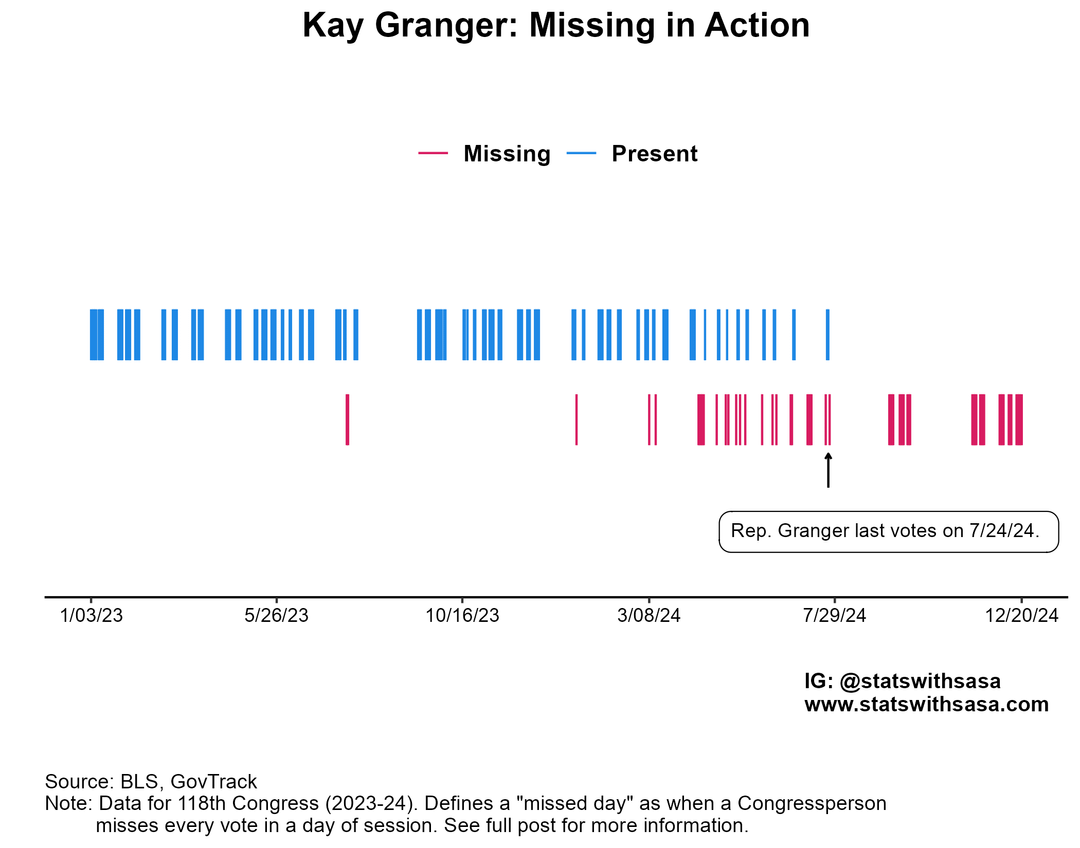
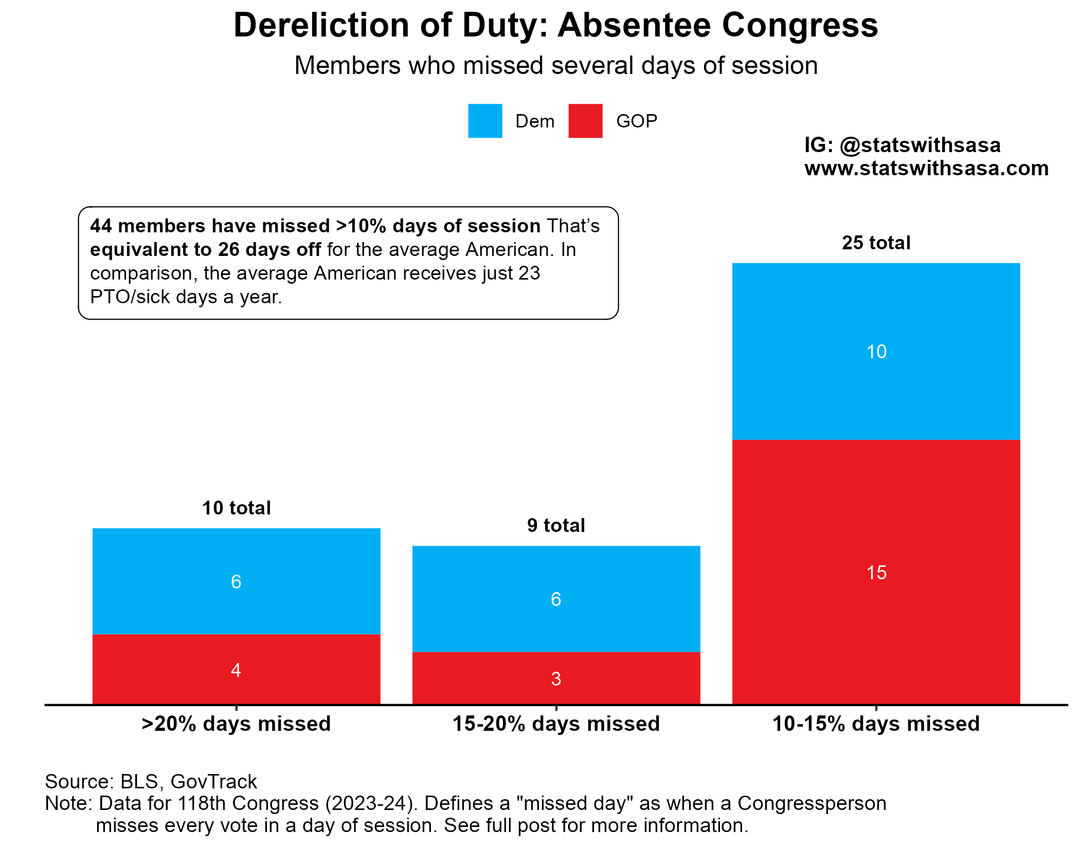
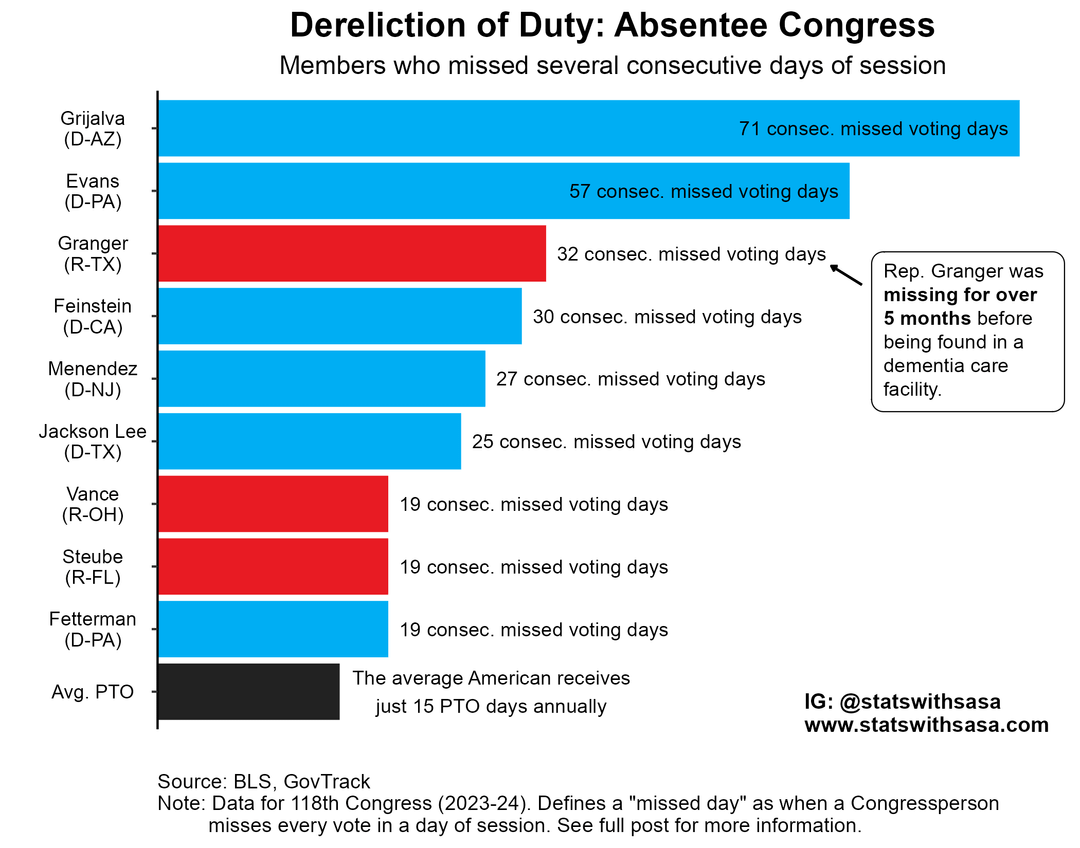
Context: After Rep. Kay Granger went missing for five months and was found in a dementia care unit, I decided to look closely at Congress absences. Congress doesn’t take attendance, so I measured days where a member missed all votes as a proxy. I found some really shocking stuff – like the fact that Rep. Granger didn’t even have the longest absence of the 118th Congress. And about 1 in 12 congress members are absent >10% of the time according to this analysis.
Sources: GovTrack (voting data) and BLS (data on average PTO for americans).
Tools: ggplot in R
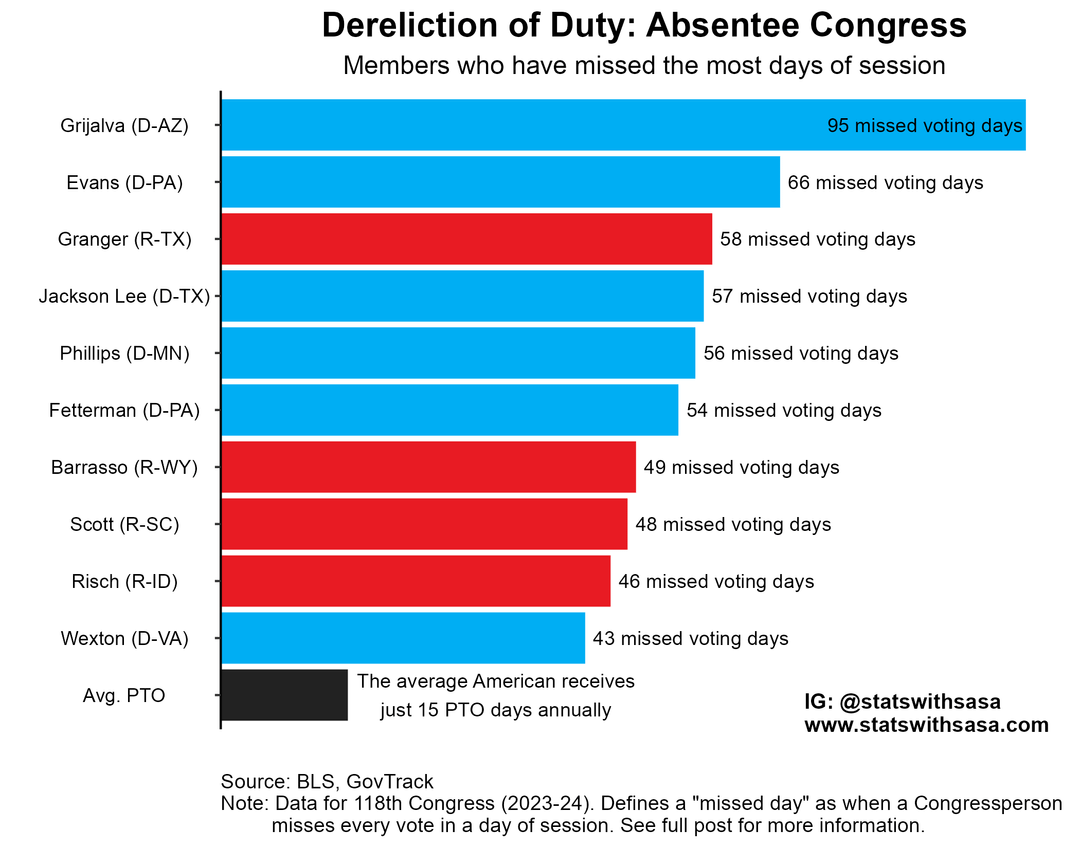
Incase anyone is wondering, for the list its mostly health issues (stroke, cancer, etc…)
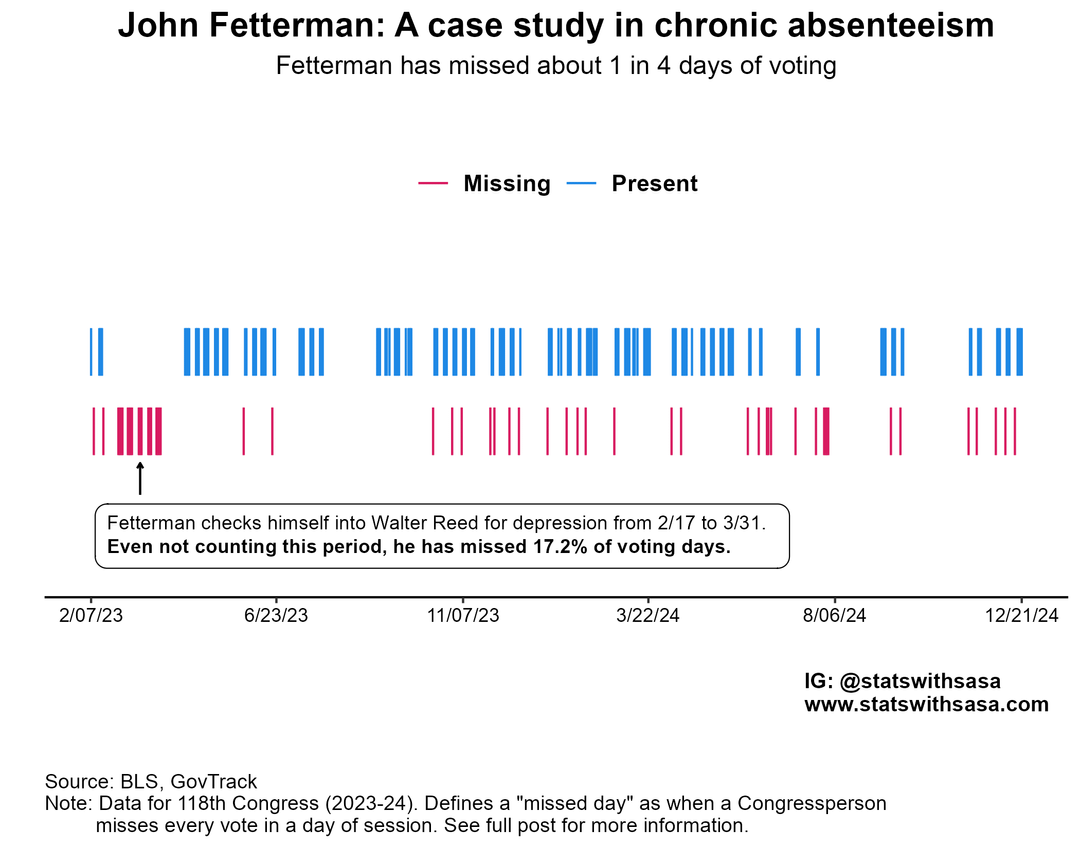
Fetterman its being a big disappointment, I have so much hope he will deliver. He should retire and go back to Pennsylvania and let Shapiro select somebody who wants to be there serving the voters.
Interesting analysis – I’d not seen these data anywhere else. This is well worth reporting!
Thanks.
I wonder what the solution to this is. Increase senators’ pay? Institute an age cap for elected officials?
I think we should just have a law (or maybe an amendment so it can’t be easily reversed by the next congress) that says if you miss x number of voting days in a row, or have less than x% attendance (say, 85% for example,) you’re automatically removed from office.
But I guess we’d have to have a way of taking attendance and an enforcement method for that to work, and the people who are _currently in office, wasting taxpayer resources_ would obviously never go for a bill that kills their easy source of money and power.
I may be wrong in this assumption, but I thought that representatives will purposefully be absent from Congress in order to abstain from voting on a given issue where they want to avoid taking a public stance.
Any person absent more than 15 days should have their position vacated and a special election called. Just like the rest of us have to deal with.
Just for context, Grijavla was undergoing chemo and Evans had a stroke
I wonder if the in-person voting requirement isn’t due for reconsideration. Just let them vote from anywhere and remove the excuse of being physically absent as a reason not to vote.
Thank you for the data. This makes me sick. If we dont show up to work we’re fired with no unemployment. It should be the same for them. If you can’t do your job, what are we paying you for?
It isn’t really appropriate to consider every absence “paid time off”. There are a number of jobs that they have beyond simply being in session, and many (most?) days nothing meaningful is being voted on. But more importantly, many of these are due to health-related issues. It’d still be better for voters to be represented by someone in good health, though.
Interesting stuff!
Any reason why you specifically chose to highlight Granger and Fetterman (3rd and 6th most missed days), rather than the representatives with the most missed days?
I understand that they have to take care of their health. But if you miss over 15% of votes you should not be allowed to run for reelection. Congress is a demanding job and if you can’t be there then you shouldn’t be allowed to be there.
There are a lot of reasons to miss a vote that don’t mean you’re neglecting your responsibilities (not that dereliction doesn’t happen) – to name a few: you’re back in your district, constituent services, foreign trips,
Campaigning for yourself or others, committee activities, fundraising… etc.
Also, if the vote isn’t close, it may not be as important as other responsibilities you have.
I’d be curious to know how it looks over the last several terms of Congress compared to which party has control. Is it more likely for someone to miss when in the minority party, and so they know ahead of time their vote is unlikely to matter?
Important question who were the most present, where is that graph?
16 comments
Hey there! I don’t normally share my stuff to this sub because, honestly, my visualizations are usually pretty simple. But I think the way I visualized absences for a Congressmember is actually kind of neat, and the sub may appreciate it.
Context: After Rep. Kay Granger went missing for five months and was found in a dementia care unit, I decided to look closely at Congress absences. Congress doesn’t take attendance, so I measured days where a member missed all votes as a proxy. I found some really shocking stuff – like the fact that Rep. Granger didn’t even have the longest absence of the 118th Congress. And about 1 in 12 congress members are absent >10% of the time according to this analysis.
Feel free to read more about this and my full methodology [on my site here](https://www.statswithsasa.com/2024/12/26/congress-attendance/).
Sources: GovTrack (voting data) and BLS (data on average PTO for americans).
Tools: ggplot in R
Incase anyone is wondering, for the list its mostly health issues (stroke, cancer, etc…)
Fetterman its being a big disappointment, I have so much hope he will deliver. He should retire and go back to Pennsylvania and let Shapiro select somebody who wants to be there serving the voters.
Interesting analysis – I’d not seen these data anywhere else. This is well worth reporting!
Thanks.
I wonder what the solution to this is. Increase senators’ pay? Institute an age cap for elected officials?
I think we should just have a law (or maybe an amendment so it can’t be easily reversed by the next congress) that says if you miss x number of voting days in a row, or have less than x% attendance (say, 85% for example,) you’re automatically removed from office.
But I guess we’d have to have a way of taking attendance and an enforcement method for that to work, and the people who are _currently in office, wasting taxpayer resources_ would obviously never go for a bill that kills their easy source of money and power.
I may be wrong in this assumption, but I thought that representatives will purposefully be absent from Congress in order to abstain from voting on a given issue where they want to avoid taking a public stance.
Any person absent more than 15 days should have their position vacated and a special election called. Just like the rest of us have to deal with.
Just for context, Grijavla was undergoing chemo and Evans had a stroke
I wonder if the in-person voting requirement isn’t due for reconsideration. Just let them vote from anywhere and remove the excuse of being physically absent as a reason not to vote.
Thank you for the data. This makes me sick. If we dont show up to work we’re fired with no unemployment. It should be the same for them. If you can’t do your job, what are we paying you for?
It isn’t really appropriate to consider every absence “paid time off”. There are a number of jobs that they have beyond simply being in session, and many (most?) days nothing meaningful is being voted on. But more importantly, many of these are due to health-related issues. It’d still be better for voters to be represented by someone in good health, though.
Interesting stuff!
Any reason why you specifically chose to highlight Granger and Fetterman (3rd and 6th most missed days), rather than the representatives with the most missed days?
I understand that they have to take care of their health. But if you miss over 15% of votes you should not be allowed to run for reelection. Congress is a demanding job and if you can’t be there then you shouldn’t be allowed to be there.
There are a lot of reasons to miss a vote that don’t mean you’re neglecting your responsibilities (not that dereliction doesn’t happen) – to name a few: you’re back in your district, constituent services, foreign trips,
Campaigning for yourself or others, committee activities, fundraising… etc.
Also, if the vote isn’t close, it may not be as important as other responsibilities you have.
I’d be curious to know how it looks over the last several terms of Congress compared to which party has control. Is it more likely for someone to miss when in the minority party, and so they know ahead of time their vote is unlikely to matter?
Important question who were the most present, where is that graph?
Comments are closed.