
While the low-cost sector represents a thriving part of the short-haul market in modern European aviation, the long-haul market has been a tougher nut to crack for the continent’s budget carriers. However, in the last few years, French bee has established itself as one of the key players in this part of the airline industry, operating low-cost intercontinental flights from its base at Paris Orly Airport
(ORY).
For the most part, French bee
is known for its high-density economy class seating configurations, which see its aircraft fitted with one more seat than the norm in every row. However, while economy class passengers do make up the vast majority of French bee’s day-to-day business, the carrier also has small premium economy cabins on its planes for those willing to part with a little bit of extra currency.
French bee in a nutshell
Formed in 2016 as French Blue, the carrier has been operating under its current French bee identity since 2018. Having initially flown an Airbus
A330-300 on its early low-cost long-haul flights, the airline has since transitioned to be an all-A350 operator, with examples of both passenger-carrying variants at its disposal. According to data made available by ch-aviation, the split in its fleet is as follows:
A350-900: four examples at an average age of 6.8 years old.
A350-1000: two examples (plus one on lease from Air Caraïbes Atlantique) at an average age of three years old.
In terms of the current scale of its operations, scheduling data from Cirium, an aviation analytics company, shows that French bee has scheduled 220 passenger flights in December 2024. These services will offer collective totals of 92,566 seats and 458,022,768 available seat miles (ASMs), with the top destination being Roland Garros Airport (RUN) in Réunion. Other routes served this month include:
Paris Orly – Newark Liberty International Airport (EWR).
Paris Orly – Miami International Airport (MIA).
Paris Orly – San Francisco International Airport (SFO), with these flights continuing to Faaʻa International Airport (PPT) in Papeete, Tahiti.

Photo: Vincenzo Pace | Simple Flying
As a low-cost carrier, French bee enables passengers to secure cheap fares on long-haul routes by only paying for what they want and need. Similar approaches are taken by budget airlines all around the world, but one area in which French bee differs from its low-cost contemporaries is the fact that it offers a premium economy cabin, with passengers getting more than just extra space for their money.
Two different configurations
As previously mentioned, French bee operates both the A350-900 and A350-1000 variants from Airbus’ modern family of widebody twinjets, and their premium economy cabins are arranged slightly differently. Indeed, data from aeroLOPA shows that, while the A350-900 has its premium economy seats in a seven abreast (2-3-2) configuration, the larger A350-1000 has these seats laid out eight abreast (2-4-2).
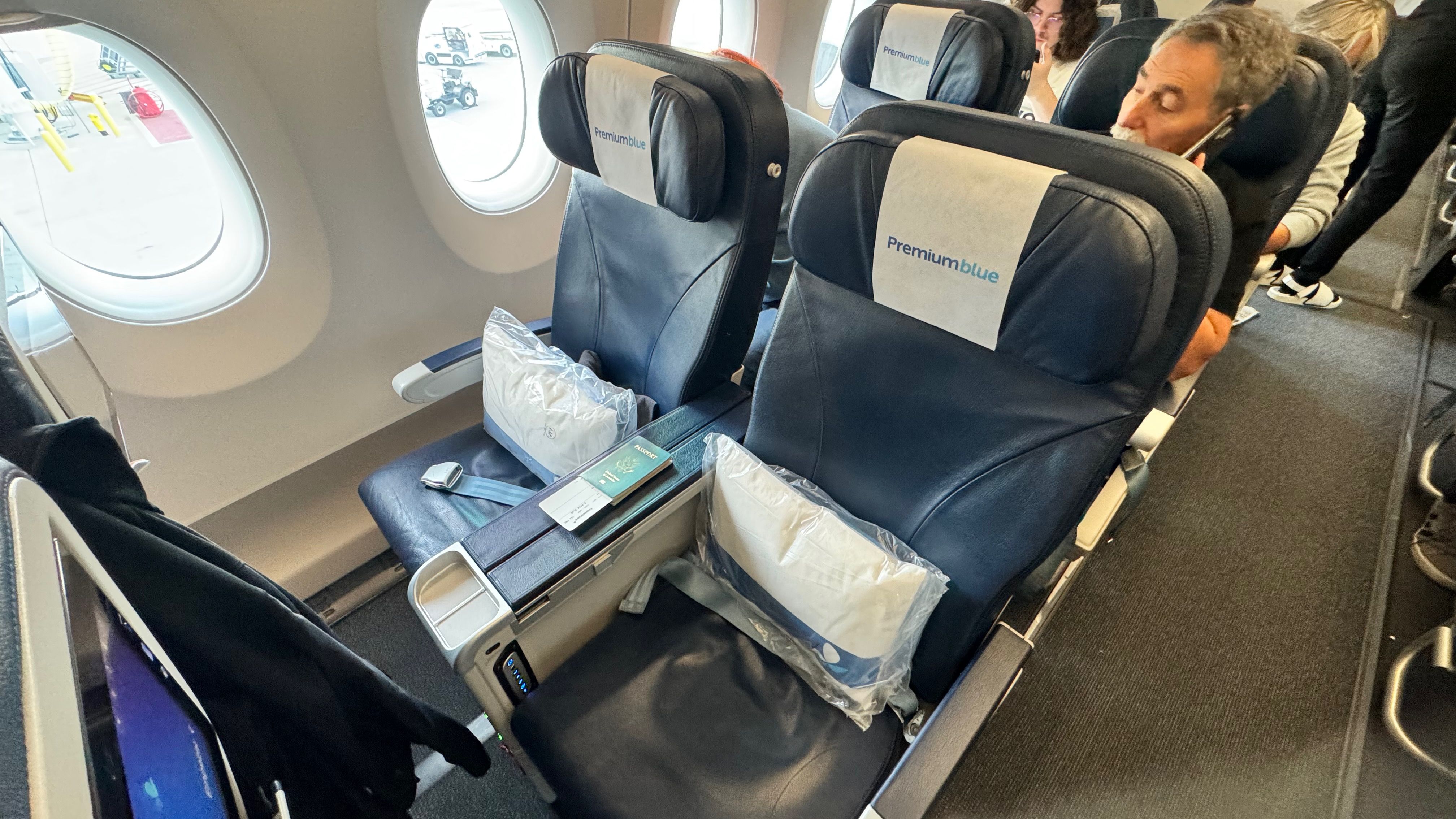
Photo: Lukas Souza | Simple Flying
In both cases, there are five rows of these seats (numbered from five to nine), meaning that the A350-900 has a premium capacity of 35 passengers compared to 40 for the A350-1000. These cabins are situated at the front of the aircraft, with the remaining space behind them being occupied by French bee’s famous 10-abreast (3-4-3) economy class seating, which defies the usual trend of nine abreast (3-3-3).
French bee’s Airbus A350-900s have 376 economy class seats onboard, giving them a total capacity of 411 passengers. This means that premium economy accounts for around 8.5% of the plane’s total capacity, compared to the slightly lower of 8.33% on the larger A350-1000. These aircraft have a whopping 440 economy class seats behind the 40 in premium economy, giving them a total capacity of 480.
Special seating
French bee describes its premium seats as having “measurements straight out of a dream,” and, while they may not be the most spacious on the market, they are certainly a welcome luxury for those craving a bit of extra space. These seats offer a seat pitch of 36 inches and are 18 inches wide, meaning that, compared to the 32-inch pitch found in economy class, they have an extra 12.5% of legroom.

Photo: Wenjie Zheng | Shutterstock
As is customary with most premium economy cabins, these seats also have the ability to recline, with passengers being supported in this endeavor by the presence of integrated rests for their legs and feet. At the other end of the body, premium economy passengers can expect head and neck support in the form of an adjustable headrest with four positions, which is covered by an elegant white antimacassar.
When it comes to onboard entertainment, passengers can expect 12-inch touchscreens in these seats, with other electronic features such as a power outlet, USB port, and headphone jack at their disposal. Between the seats, passengers can find a relatively larger center console, which also features a handy cup holder for those wanting to have a drink without unfolding their in-seat tray table.
The premier experience in French bee’s premium economy cabin begins before takeoff, as passengers are offered a welcome drink when boarding. While passengers on most economy class ticket types (except for the lowest ‘Bee Light’ fare) get a hot meal onboard their flight, those in premium economy are also entitled to a second meal service, with both soft and alcoholic drinks included.

Photo: GingChen | Shutterstock
Premium economy passengers also get more to play with in terms of their luggage allowance. Indeed, while Bee Light basic economy class fares only entitle passengers to a small personal item, and other economy tickets include a carry-on and one checked bag, French bee’s premier passengers are allowed to check in two pieces of luggage. For each of these, the maximum weight limit is 23 kg or 50 lbs.
Priority is also given to premium economy passengers when it comes to check-in and boarding, with standard seat selection included for free on Premium Smart tickets. The only exception to this is for the first row of the cabin, which is known as ‘Maxi Leg’ due to the additional legroom that seats in this row offer passengers. The cost of reserving these starts at €80, but is included for Premium Flex passengers.

Premium economy tickets are also relatively flexible on French bee, with even the lowest Premium Smart tariff offering passengers the ability to change their booking for a fee. However, for passengers seeking optimum flexibility, the more expensive Premium Flex tariff is the way to go, with these tickets entitling paying customers to change their bookings without fees, as well as the option of fee-free refunds.
How much more expensive is it?
With French bee being a low-cost carrier, its passengers are likely to pay closer attention to the costs, whether big or small, associated with their flights. With this in mind, it is worth taking a closer look at how much more you have to pay in order to be granted access to the exclusivity of the premium economy cabin on French bee. We will use a flight from Paris to Newark on March 8th as an example.
This Saturday flight, which departs the French capital at 18:40 and is scheduled to touch down in New Jersey eight hours and 20 minutes later at 21:00 local time, is numbered as BF720. At the time of writing, it was scheduled to be operated by an Airbus A350-900, with 35 premium economy seats laid out seven abreast in five rows of 2-3-2 seating. The lowest Bee Light economy fare costs €265 ($278).

Moving up through the remaining economy class fares, the mid-tier Bee Smart tariff comes to €335 ($351), compared to €435 ($456) for the highly flexible Bee Flex fare. As for premium economy, the fares in this cabin for the flight and date in question came to €424 ($445) in Premium Smart and €564 ($591.50) in Premium Flex. Demand was clearly high, with only six premium economy seats available.
As such, we can see that, for the most part, the fare difference between economy and premium economy class on French bee is relatively minimal. Of course, passengers only wanting to pay for what they need to on the Bee Light tariff may not feel the need to splash out the extra cash required to travel in premium economy, but, for higher economy tiers, the minimal difference may be worth paying.
Is it worth it?
While I have not personally flown with French bee, I can certainly say that the prospect of an upgrade to the carrier’s premium economy cabin would be a tempting one for me. As a taller-than-average UK male, every inch counts, and, on the long-haul flights that the airline operates, the extra space offered by the premium economy cabin could make or break a flight, especially overnight.

Earlier this year, Simple Flying did have the chance to travel in the airline’s premium economy cabin, and subsequently published a review of the flight in question (from Los Angeles International Airport to Paris Orly). While our correspondent found the food in the cabin to be somewhat lacking, their overall reflections on the flight were positive, and you can read their thoughts in full in the article here.