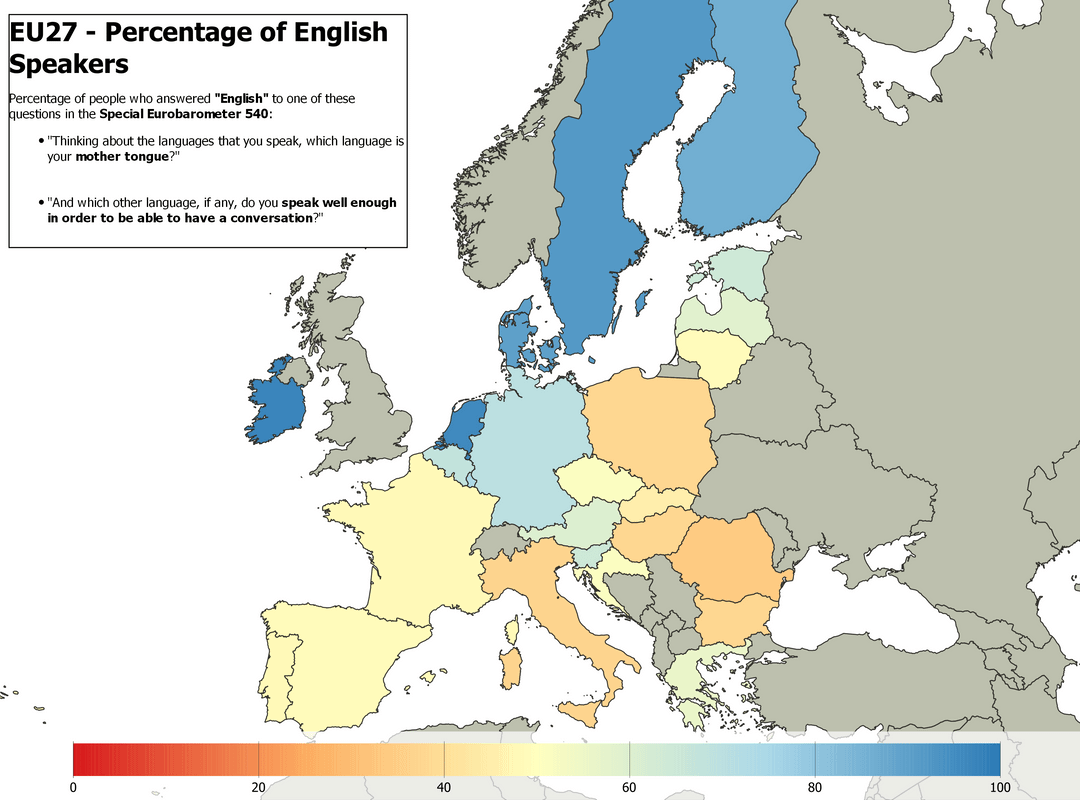
This is something people often have conflicting views on. The popular EF English Proficiency Index is not build on a randomized sample but only among those who took the EF test. The Special Eurobarometer is a random survey with 26.523 people answering this question (around 1000 from every country included, around 500 for Luxembourg, Malta and Cyprus). It is presumably a good picture of how widely spread english conversationability is in the population at large. The number measured is the percentage of all people in the country who either speak english as their mothertongue or who are otherwise conversational in it.
In the table with the raw data I provided along with the map, D-W is West Germany, D-E is east Germany and EL is Eurostat’s code for the Greece (percentage sign is missing but you get the point). I decided not to map east and west Germany because it’s been 34 years but as you can see there is a 20 point difference.
Interesting how big the difference is between countries that aren’t so far apart. Here in the Netherlands even the elderly all speak perfectly conversational English, but looking at this it seems that in Germany and Belgium 3 out of 10 people don’t.
Poland is really high. I am 21 and pretty much 90% of people my age I get to see know English at some level. However those above 40 (especially above 50) never had a chance to learn English at school, only Russian/German because of “American imperialism”
I’ve been to Germany…the majority of people can speak English pretty well. I’d say the color should be darker blue. All of Northern European countries speak English and it’s required in school
That moment when you go to the Netherlands, and can barely understand their English accents. Only the kids are understandable.😭
Curious to see regional detail about France. What foreign languages do French students tend to learn? English, Spanish, German, Arabic..? Russian?
I think a lot of people underestimate their English skills. That has been my experience in Austria anyway. I’ve lived here 15 years and rarely actually use German.
In Ireland we can’t even speak irish
Wow! More speakers than Italy in France and Greece? I would’ve never guessed.
92% for Malta? Everyone there is bilingual since lessons in the schools are taught in English. The way the pool is conducted isn’t good.
Surprised the number in Spain is that high, especially compared to our Portuguese neighbors, that in my experience are much more fluent in the English language.
Netherlands is only 1% below the only actual English speaking country in the list! And having been to the Netherlands, that checks out.
The title here is very misleading. Take the example of a French person who speaks French, German, and English. He will answer “French” to the first question, but he could answer either “German” or “English” to the second question, and if he picks German, it will be incorrectly counted here as a non-English speaker. Really this is the percent of each country for which English is their first or second language, which will exclude a whole lot of English speakers.
They don’t show the UK, because it would be embarrassing.
14 comments
This is something people often have conflicting views on. The popular EF English Proficiency Index is not build on a randomized sample but only among those who took the EF test. The Special Eurobarometer is a random survey with 26.523 people answering this question (around 1000 from every country included, around 500 for Luxembourg, Malta and Cyprus). It is presumably a good picture of how widely spread english conversationability is in the population at large. The number measured is the percentage of all people in the country who either speak english as their mothertongue or who are otherwise conversational in it.
In the table with the raw data I provided along with the map, D-W is West Germany, D-E is east Germany and EL is Eurostat’s code for the Greece (percentage sign is missing but you get the point). I decided not to map east and west Germany because it’s been 34 years but as you can see there is a 20 point difference.
Source: [Special Eurobarometer 540](https://europa.eu/eurobarometer/surveys/detail/2979) (Volume A, table D48a-d)
Tools used: QGIS, Excel
Interesting how big the difference is between countries that aren’t so far apart. Here in the Netherlands even the elderly all speak perfectly conversational English, but looking at this it seems that in Germany and Belgium 3 out of 10 people don’t.
Poland is really high. I am 21 and pretty much 90% of people my age I get to see know English at some level. However those above 40 (especially above 50) never had a chance to learn English at school, only Russian/German because of “American imperialism”
I’ve been to Germany…the majority of people can speak English pretty well. I’d say the color should be darker blue. All of Northern European countries speak English and it’s required in school
That moment when you go to the Netherlands, and can barely understand their English accents. Only the kids are understandable.😭
Curious to see regional detail about France. What foreign languages do French students tend to learn? English, Spanish, German, Arabic..? Russian?
I think a lot of people underestimate their English skills. That has been my experience in Austria anyway. I’ve lived here 15 years and rarely actually use German.
In Ireland we can’t even speak irish
Wow! More speakers than Italy in France and Greece? I would’ve never guessed.
92% for Malta? Everyone there is bilingual since lessons in the schools are taught in English. The way the pool is conducted isn’t good.
Surprised the number in Spain is that high, especially compared to our Portuguese neighbors, that in my experience are much more fluent in the English language.
Netherlands is only 1% below the only actual English speaking country in the list! And having been to the Netherlands, that checks out.
The title here is very misleading. Take the example of a French person who speaks French, German, and English. He will answer “French” to the first question, but he could answer either “German” or “English” to the second question, and if he picks German, it will be incorrectly counted here as a non-English speaker. Really this is the percent of each country for which English is their first or second language, which will exclude a whole lot of English speakers.
They don’t show the UK, because it would be embarrassing.
Comments are closed.