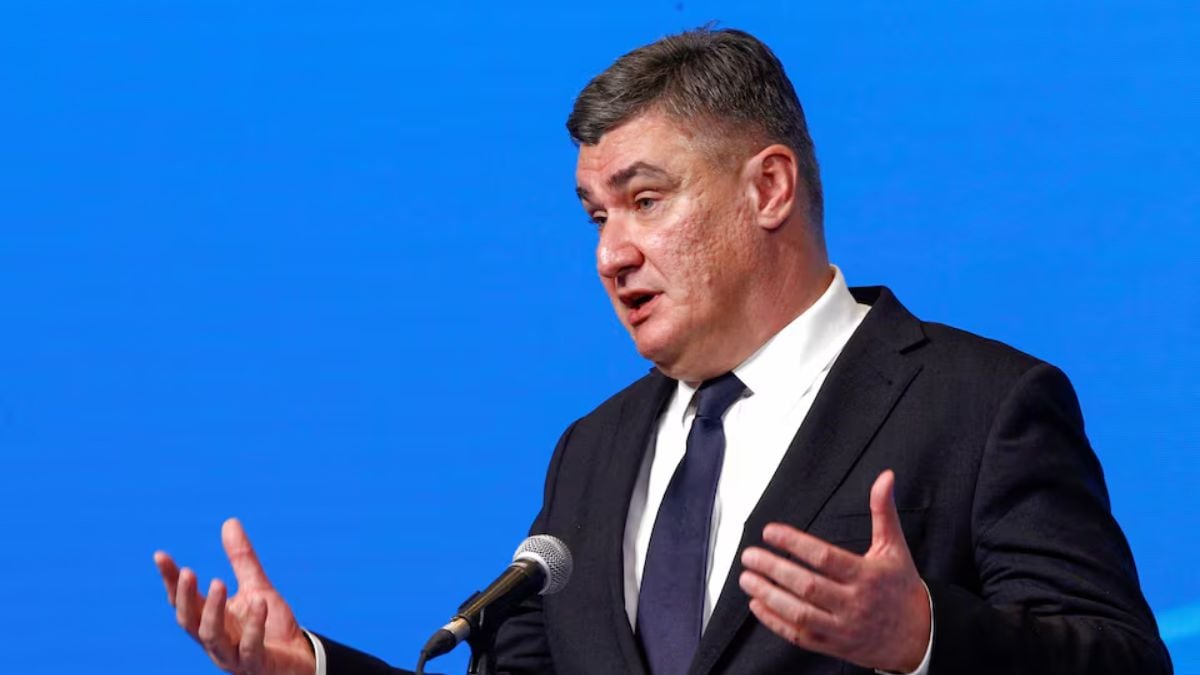
“This is a chalice from which we will all drink together … I extend my hand to everyone … I will do everything for Croatia,” said Milanović in a late-night speech following the first round of the country’s presidential election on Sundayread more
Croatian President Zoran Milanović came within a whisker of clinching a second term outright in the first round of the country’s presidential election Sunday.
According to a Politico report, in a late-night speech following the election, the rabble-rousing incumbent thanked the public for their support in giving him over 49 per cent of the vote.
“This is a chalice from which we will all drink together … I extend my hand to everyone … I will do everything for Croatia,” Politico quoted Milanović as saying.
Known as the enfant terrible of Croatian politics, Milanović proudly represents the left-leaning Social Democratic Party. First elected in 2020, he swept counties nationwide and previously served as prime minister from 2011 to 2016.
His main rival, Dragan Primorac of the ruling Croatian Democratic Union (HDZ), trailed with 19.35 per cent of the vote. While they will face off again on January 12, that runoff is widely regarded as a formality, reported Politico.
Milanović has energised a diverse base, appealing to right-wing, far-right, left-wing, and even pro-Russian supporters with his leftist credentials and populist rhetoric, often critical of NATO and the EU. This raises concerns in Brussels, as many of his supporters share these Euroskeptic views.
Although hostility toward the West is becoming more common among Central and Eastern European leaders, it remains unusual in Croatia, a country that has traditionally been pro-EU and pro-NATO despite its history of far-right politicians.
“Milanović has a bad-boy personality and image that people like, in the sense that he says what he thinks and is not restrained by political decorum or good behavior,” Politico quoted Florian Bieber, an expert on Balkan politics and authoritarianism, as saying.
According to the report, citing critics, Milanović’s public feuds with Prime Minister Andrej Plenković, his associations with war criminals, and his promises to reduce support for NATO and Ukraine have tarnished Croatia’s international reputation.
At home, however, Milanović’s candid press conferences often go viral, featuring remarks like politics is “a mere sensation.”
Analysts suggest his appeal lies in his strong opposition to the dominant conservative HDZ party, which has been in power since Croatia’s independence in 1991. Many are frustrated by the party’s entrenched corruption and lack of alternatives.
“HDZ has governed Croatia since independence with two short interruptions only, leading state and national institutions for a very long time,” Bieber was quoted as saying.
“A lot of people are frustrated with the entrenchment and corruption of the party, and the sense that there is no political alternative,” added Bieber
In contrast, Plenković is viewed as a pragmatic Eurocrat aligned with Brussels, though his government has faced corruption scandals, resulting in around 30 ministerial resignations since 2016.
While Milanović has energised various voter groups, his presidency’s limited powers raise questions about whether he can translate his appeal into effective political action.
So far, his actions have largely been symbolic, such as denying permission for Croatian troops to join NATO missions in Ukraine, a decision later overturned by the government. As Bieber noted, turning this diverse support into real governance will be challenging.
With inputs from agencies