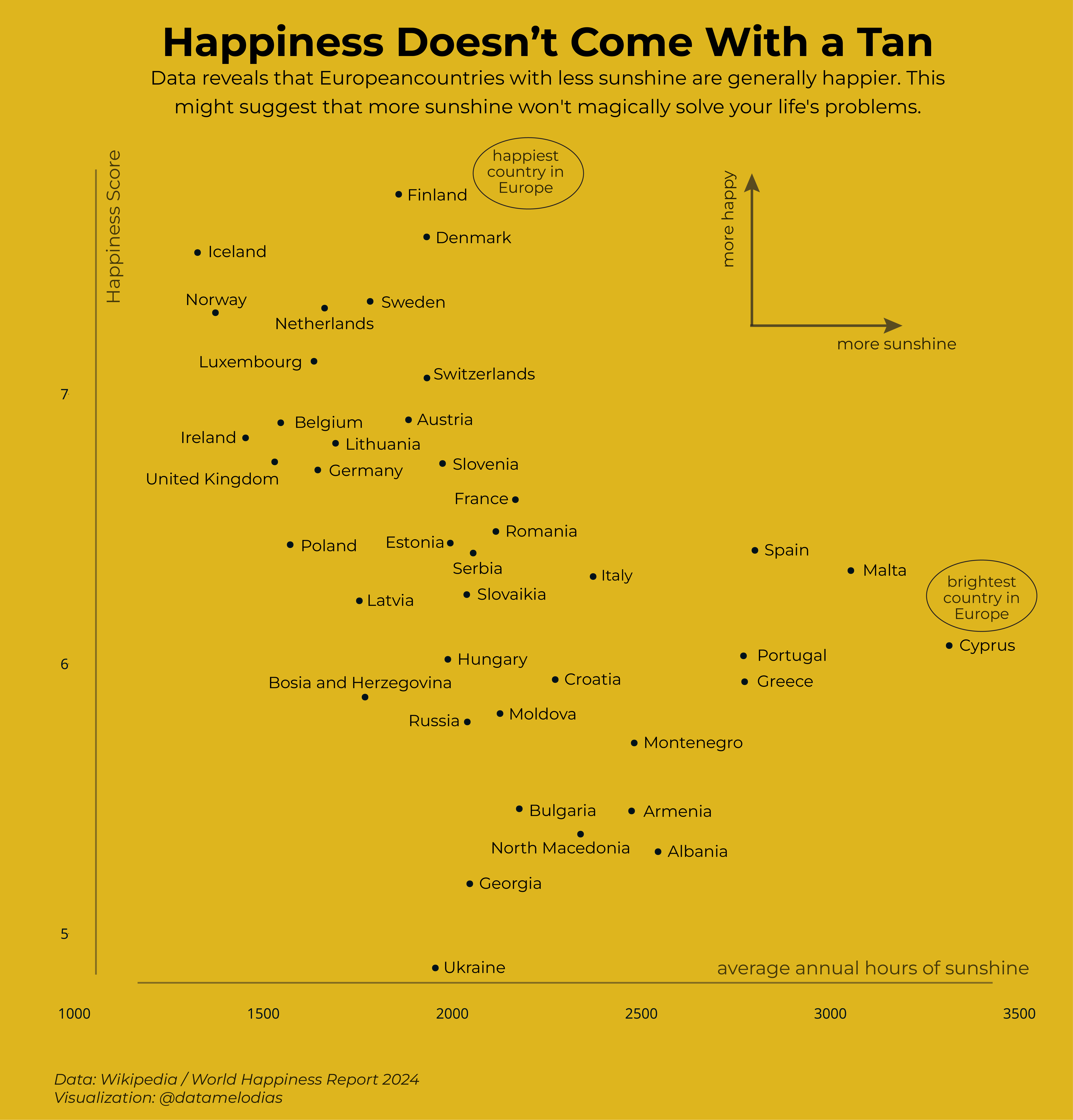
Data: Wikipedia (List of cities by sunshine duration)/World Happiness Report
Tools: created in R and ggplot2, edited in Adobe Illustrator
Disclaimer: the main audience of this plot is people who have lived in Europe and/or have some sense of humor 🙂
So rich people can vacation in the more sunshine countries when feeling sad to feel better, whereas the more sunshine but poorer people are stuck?
Most miserable country with less than about 1700 sun, you’ll never sing that
yeah, happiness comes with a good income, go figure why in this money driven world :/
Ah, the Switzerlands. Like the Netherlands but at higher altitudes. More Switzery than Nethery.
The 24 hours of sunlight in the northern countries makes up for the lack of sun in the winter. Go into hibernation for a few months in the winter and enjoy the sun in the summer from 4AM to 10 PM.
Now plot wealth on this…
What you’ll find is that almost all the unhappy countries are former Soviet bloc and have high poverty
Correlation does not equal causation…
Edited to remove suicide rates because unhappy countries do have higher suicide rates… Except Finland which is both happy and suicidal.
A very important factor, albeit not alone, is monez.
Does a spray tan make you happy?
You need bright leaders no bright weather
Does the graph suggest that lack of sunshine might magically solve all of your problems??
Funny enough, those top the happiest places are some of the most racist countries in Europe 😂
Its like correlation is not causation … And there are like a billion other factors for “happiness”. Now do the same chart with depression and suicide rates and see how “happy” that looks 🙂
this is a simple correlation plot. you must attempt a causality estimate to see if sunshine has any meaningful impact on happiness.
To people saying that the people are happy just because they are more wealthy, the book Why Nations Fail by Daron Acemoglu & James Robinson argues that freedom is necessary for wealth. History has shown that it is very difficult to combine a dictatorship (low freedom) with wealth. In most cases, the dictatorship will start giving monopolies to friends of the dictatorship which in turn makes the population poorer. For example, South Africa has constant blackouts since the people who run the energy monopoly rather spend the money on villa’s than on maintaining power plants. Also, dictatorships often do not believe in property rights which means that people often will not benefit from their innovation. The book gives examples from North Korea or African countries were people actively decide to not get better tools since the tool would end up in the hands of the dictator anyway.
When you don’t have sun every day, you work harder and become richer. You also learn to find joy in the things you can do on your own or at home.
Russia: happiness median of all Eur🙂pe
Plot suicide rates instead of “happiness”. That’s more objective.
Lol yeah lets just ignore the 285939362 other variables at play here
The happier nordic ones also have less innequality. [Richard Wilkinson: How innequality harms societies](https://youtu.be/cZ7LzE3u7Bw). The surprise of that TED talk is that even richer people are negatively affected by innequality.
Social safety nets make people happy.
Holy Confounding Variables Batman
“Happiness” in these surveys and statistics translates properly to “contentness.” Germans and Scandinavians are not happy. They have some of the highest suicide and alcoholism rates in the world, and are not known for happy things in the culture – usually quite the opposite. They are content and have fewer worries (such as worry of being bankrupted by healthcare, or becoming completely homeless, etc.). But they are not happy. They live in small apartments on crumbs with no aspirations and have the lowest level of social lives. It is not happy. It is content. And that can be abysmally sad to more outgoing, happy cultures.
This is in interesting correlation!
But my gripe with these annual “happiness” measurements is that **they don’t really measure happiness.**
To quote the world happiness report’s website:
*”Life evaluations from the Gallup World Poll provide the basis for the annual happiness rankings. They are based on answers to the main life evaluation question. The Cantril Ladder asks respondents to think of a ladder, with the best possible life for them being a 10 and the worst possible life being a 0. They are then asked to rate their own current lives on that 0 to 10 scale.”*
This is very different from asking people how happy they are. It orients people toward measuring their lives in terms of abstract stages or steps on a ladder, whether in their careers or personal lives, rather than whether or not their lives are “happy”. I would suspect a married, middle-aged executive with two kids to say that their life is pretty close to the “best”, even if they’re actually depressed.
As someone with Finnish family, who has been to the country dozens of times, I can tell you that Finns are some of the most generally depressed bunch of people you will ever meet – especially Finnish men. That’s true despite the great Nordic social programs and everything that comes with them. If I had to guess, I would say that the median Cypriot on the median day is having a better time than the median Finn, but that the Cypriot would still say that they’re further from some abstract “best” life, and therefore would be ranked lower on the world happiness report.
I work closely with Danish folks and have visited often.
When I mentioned the happiness thing to one of them, he said “it’s not that we’re so happy, we just have low expectations.”
I bet the music created in the unhappiest countries is pretty interesting though.
As someone who developed a vitamin D definciency living in the Seattle area that was mostly reselved within 2 years of living in Virginia, I kinda feel like the sun can in fact help.
Countries with too much sun/heat will drive people inside to air conditioning, as my father used to say “down south you are more a prisoner of your home in the summer than we are in the north during the winter; you can put on a heavier coat but down there you can’t ever take enough off.”
.
IIRC the happiness index is based on measuring things that *should* make people happy *about their government*. It’s not like a survey of “on a scale of 1 to 10, how happy are you?” Like you might imagine. Also recognize the insane deviation between places like Finland and Ukraine. If anything, this is a weak correlation between things like government corruption and sunlight.
![[OC] Happiness doesn't come with a tan](https://www.europesays.com/wp-content/uploads/2025/01/zkmmadgmxyae1-1920x1024.png)
32 comments
Data: Wikipedia (List of cities by sunshine duration)/World Happiness Report
Tools: created in R and ggplot2, edited in Adobe Illustrator
Disclaimer: the main audience of this plot is people who have lived in Europe and/or have some sense of humor 🙂
So rich people can vacation in the more sunshine countries when feeling sad to feel better, whereas the more sunshine but poorer people are stuck?
Most miserable country with less than about 1700 sun, you’ll never sing that
yeah, happiness comes with a good income, go figure why in this money driven world :/
Ah, the Switzerlands. Like the Netherlands but at higher altitudes. More Switzery than Nethery.
The 24 hours of sunlight in the northern countries makes up for the lack of sun in the winter. Go into hibernation for a few months in the winter and enjoy the sun in the summer from 4AM to 10 PM.
Now plot wealth on this…
What you’ll find is that almost all the unhappy countries are former Soviet bloc and have high poverty
Correlation does not equal causation…
Edited to remove suicide rates because unhappy countries do have higher suicide rates… Except Finland which is both happy and suicidal.
A very important factor, albeit not alone, is monez.
Does a spray tan make you happy?
You need bright leaders no bright weather
Does the graph suggest that lack of sunshine might magically solve all of your problems??
Funny enough, those top the happiest places are some of the most racist countries in Europe 😂
Its like correlation is not causation … And there are like a billion other factors for “happiness”. Now do the same chart with depression and suicide rates and see how “happy” that looks 🙂
this is a simple correlation plot. you must attempt a causality estimate to see if sunshine has any meaningful impact on happiness.
Seems there is a large overlap between happiness scores and freedom scores: https://freedomhouse.org/countries/freedom-world/scores.
To people saying that the people are happy just because they are more wealthy, the book Why Nations Fail by Daron Acemoglu & James Robinson argues that freedom is necessary for wealth. History has shown that it is very difficult to combine a dictatorship (low freedom) with wealth. In most cases, the dictatorship will start giving monopolies to friends of the dictatorship which in turn makes the population poorer. For example, South Africa has constant blackouts since the people who run the energy monopoly rather spend the money on villa’s than on maintaining power plants. Also, dictatorships often do not believe in property rights which means that people often will not benefit from their innovation. The book gives examples from North Korea or African countries were people actively decide to not get better tools since the tool would end up in the hands of the dictator anyway.
When you don’t have sun every day, you work harder and become richer. You also learn to find joy in the things you can do on your own or at home.
Russia: happiness median of all Eur🙂pe
Plot suicide rates instead of “happiness”. That’s more objective.
Lol yeah lets just ignore the 285939362 other variables at play here
The happier nordic ones also have less innequality. [Richard Wilkinson: How innequality harms societies](https://youtu.be/cZ7LzE3u7Bw). The surprise of that TED talk is that even richer people are negatively affected by innequality.
Social safety nets make people happy.
Holy Confounding Variables Batman
“Happiness” in these surveys and statistics translates properly to “contentness.” Germans and Scandinavians are not happy. They have some of the highest suicide and alcoholism rates in the world, and are not known for happy things in the culture – usually quite the opposite. They are content and have fewer worries (such as worry of being bankrupted by healthcare, or becoming completely homeless, etc.). But they are not happy. They live in small apartments on crumbs with no aspirations and have the lowest level of social lives. It is not happy. It is content. And that can be abysmally sad to more outgoing, happy cultures.
This is in interesting correlation!
But my gripe with these annual “happiness” measurements is that **they don’t really measure happiness.**
To quote the world happiness report’s website:
*”Life evaluations from the Gallup World Poll provide the basis for the annual happiness rankings. They are based on answers to the main life evaluation question. The Cantril Ladder asks respondents to think of a ladder, with the best possible life for them being a 10 and the worst possible life being a 0. They are then asked to rate their own current lives on that 0 to 10 scale.”*
This is very different from asking people how happy they are. It orients people toward measuring their lives in terms of abstract stages or steps on a ladder, whether in their careers or personal lives, rather than whether or not their lives are “happy”. I would suspect a married, middle-aged executive with two kids to say that their life is pretty close to the “best”, even if they’re actually depressed.
As someone with Finnish family, who has been to the country dozens of times, I can tell you that Finns are some of the most generally depressed bunch of people you will ever meet – especially Finnish men. That’s true despite the great Nordic social programs and everything that comes with them. If I had to guess, I would say that the median Cypriot on the median day is having a better time than the median Finn, but that the Cypriot would still say that they’re further from some abstract “best” life, and therefore would be ranked lower on the world happiness report.
I work closely with Danish folks and have visited often.
When I mentioned the happiness thing to one of them, he said “it’s not that we’re so happy, we just have low expectations.”
I bet the music created in the unhappiest countries is pretty interesting though.
As someone who developed a vitamin D definciency living in the Seattle area that was mostly reselved within 2 years of living in Virginia, I kinda feel like the sun can in fact help.
||
||
|[Finland](https://en.wikipedia.org/wiki/Suicide_in_Finland) |13.4|
||
||
|[Sweden](https://en.wikipedia.org/wiki/Suicide_in_Sweden) |12.4|
||
||
|[Italy](https://en.wikipedia.org/wiki/Italy) |4.3|
||
||
|[Greece](https://en.wikipedia.org/wiki/Suicide_in_Greece) |3.6|
What are these numbers? Happines?
No, it is [suicide](https://en.wikipedia.org/wiki/List_of_countries_by_suicide_rate) count
||
||
|[Finland](https://en.wikipedia.org/wiki/Suicide_in_Finland) |13.4|
||
||
|[Sweden](https://en.wikipedia.org/wiki/Suicide_in_Sweden) |12.4|
||
||
|[Italy](https://en.wikipedia.org/wiki/Italy) |4.3|
||
||
|[Greece](https://en.wikipedia.org/wiki/Suicide_in_Greece) |3.6|
What are these numbers? Happines?
Countries with too much sun/heat will drive people inside to air conditioning, as my father used to say “down south you are more a prisoner of your home in the summer than we are in the north during the winter; you can put on a heavier coat but down there you can’t ever take enough off.”
.
IIRC the happiness index is based on measuring things that *should* make people happy *about their government*. It’s not like a survey of “on a scale of 1 to 10, how happy are you?” Like you might imagine. Also recognize the insane deviation between places like Finland and Ukraine. If anything, this is a weak correlation between things like government corruption and sunlight.
Comments are closed.