I would love to see this with a Topo overlay, see if some of those pockets are due to microclimate differences.
Also very interesting to see the “corn gap”, then more wheat as you get more north. There must be a reason a sub cultivar or something to account for the climatic difference.
There is/was a massive diorama at the University of Nebraska that showed a cross section of landrace wheat and how deep the root structure was into the rich soil, some tap roots over 15ft in length.
As wheat was *improved* the roots became shallower and the seeded *heads* became heavier
Wow, Sumner, McPherson, and Harper counties are all like a bit over an hour away from me. Had no idea the rest of the country was slacking so much on wheat production. Nice map.
I never would have guessed the Palouse would be #2.
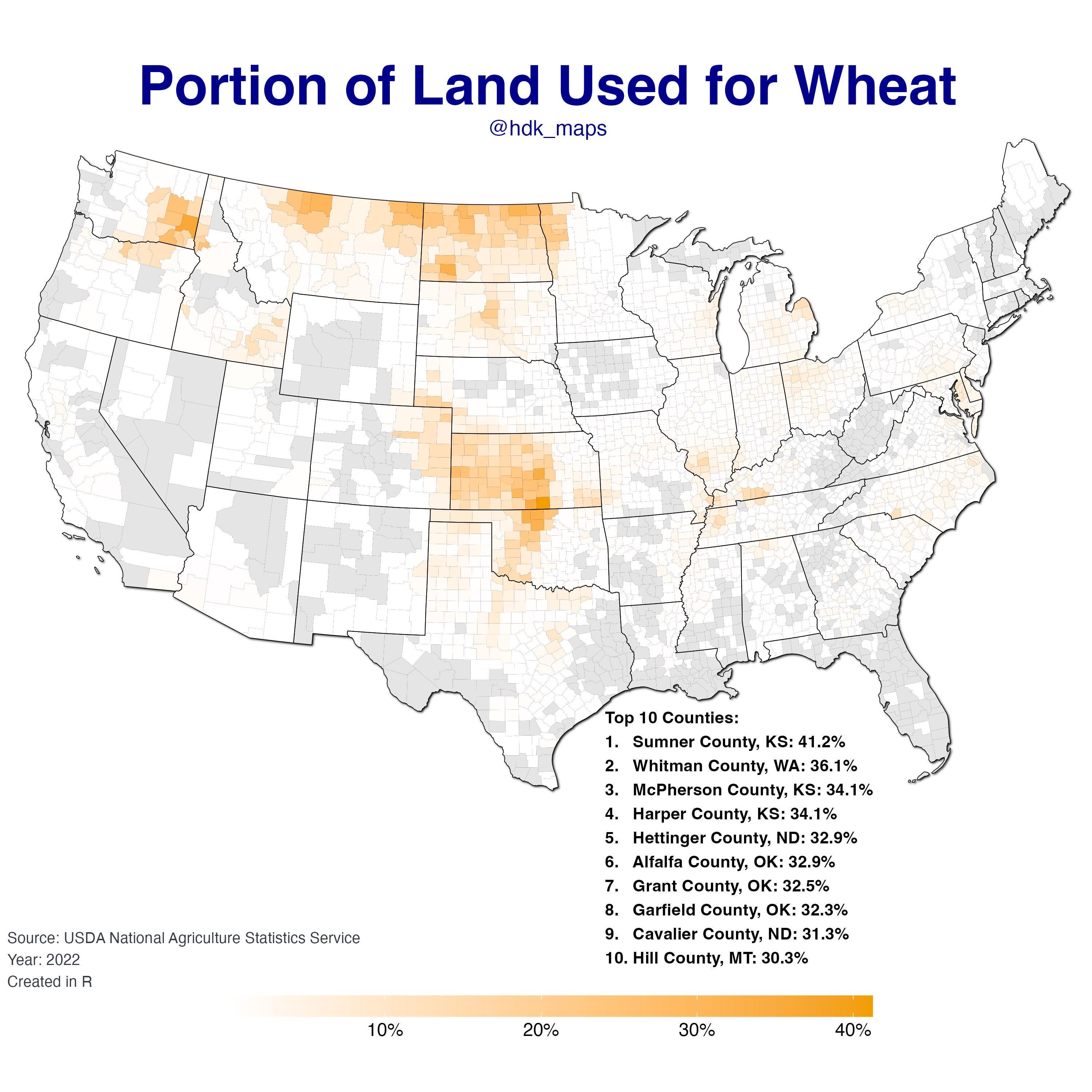
![[OC] Portion of Land Area Used for Wheat Farming in the US](https://www.europesays.com/wp-content/uploads/2025/01/erodo7996lbe1-1920x1024.jpeg)
5 comments
Data: [https://quickstats.nass.usda.gov/#192AC790-6279-32C2-9483-94F716CC6D81](https://quickstats.nass.usda.gov/#192AC790-6279-32C2-9483-94F716CC6D81)
Tools: R – packages: ggplot2, dplyr, stringr, sf, usmap, ggfx
Interesting.
I would love to see this with a Topo overlay, see if some of those pockets are due to microclimate differences.
Also very interesting to see the “corn gap”, then more wheat as you get more north. There must be a reason a sub cultivar or something to account for the climatic difference.
There is/was a massive diorama at the University of Nebraska that showed a cross section of landrace wheat and how deep the root structure was into the rich soil, some tap roots over 15ft in length.
As wheat was *improved* the roots became shallower and the seeded *heads* became heavier
Wow, Sumner, McPherson, and Harper counties are all like a bit over an hour away from me. Had no idea the rest of the country was slacking so much on wheat production. Nice map.
I never would have guessed the Palouse would be #2.
Comments are closed.