Mohammad Shafamer, a civics teacher from the Arab town of Tamra in northern Israel, last year organised a protest against Israel’s war with Hamas in Gaza.
Shafamer had obtained a permit for the demonstration, and it passed off peacefully. But hours later he was detained and charged with organising an illegal protest and disturbing the peace. He was kept in prison for two nights before finally being released after a judge threw out the charges.
“I was treated as though I was some major criminal — and all for an organised protest for which we actually had a permit,” he said. “There has always been a sense of different treatment of Palestinians and Israelis. But [since the start of the war] the environment is much more electrified.”
Shafamer’s view is widely shared among Israel’s 2mn-strong Arab minority, who make up a fifth of the country’s population, and are descendants of the Palestinians who remained inside the borders of the newly established Israeli state after the war of 1948. A further 5mn Palestinians live in the occupied West Bank and Gaza.
Since Hamas’s October 7, 2023 attack, Israeli authorities have clamped down hard on Palestinian-Israeli expressions of dissent over the war in Gaza, while Benjamin Netanyahu’s government — widely regarded as the most rightwing in the country’s history — has advanced a raft of legislation that human rights groups say is discriminatory and infringes on Palestinians’ rights.
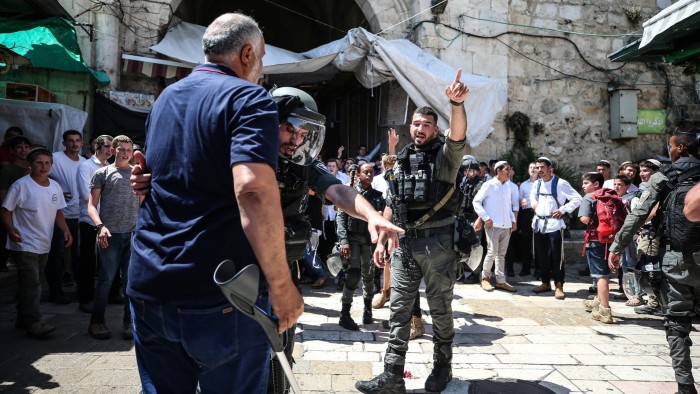
 After October 7, Israeli authorities clamped down on Palestinian protests in a way activists say encompassed not just hate speech but also legitimate opinions © Ahmad Gharabali/AFP/Getty Images
Israeli officials say the measures are part of a broader attempt to combat extremism and ensure that the horrors of the Hamas attack — in which militants killed 1,200 people, according to Israeli officials, and took 250 hostage — are never repeated.
But Palestinian citizens of Israel say the measures are an effort to silence criticism of the devastating retaliatory offensive in Gaza, which has killed more than 45,500 people, according to Palestinian officials, and fuelled a humanitarian catastrophe in the enclave.
They argue it entrenches a system that has long treated them as second-class citizens and as suspects.
“The part that is terrifying is that this not just the hand of the state coming down on you,” said Diana Buttu, a Palestinian-Israeli lawyer. “It’s [also] sending a message to Jewish Israelis that they should be watching us, and reporting on us, that they should be fighting against us as well.”
After October 7, Israeli authorities clamped down on Palestinian protests and ramped up investigations into incitement in a way activists say encompassed not just hate speech but also legitimate opinions.
According to the rights group Adalah, twice as many indictments for alleged speech-related offences were filed in the six months after October 7 as in the five years from 2018 to 2022, with “nearly all” targeting Palestinian citizens of Israel and Palestinian residents of East Jerusalem.
There have also been other restrictions on Palestinian expression, with authorities seeking to ban screenings of Palestinian films dealing with the 1948 war — known by the Palestinians as the Nakba, or catastrophe — during which hundreds of thousands of Palestinians fled or were expelled from their towns and villages by advancing Israeli troops.
 Arabs carrying their possessions flee their village in Galilee in the wake of the creation of the state of Israel © Reuters
Noa Sattah, director of the Association for Civil Rights in Israel, a human rights group, said that, taken together, the measures amounted to an attempt to “silence Palestinians and silence the Palestinian narrative”.
“It’s a denial of very basic democratic rights,” she said.
In recent months, these pressures have been accompanied by a burst of legislation that human rights groups say deepens the systemic inequalities already facing Israel’s Arab minority. “In the past, you would get maybe one or two [such] pieces of legislation in a year,” said Buttu.
“Now we’re already looking at a flurry of activity.”
Among the most controversial was a law passed in November that allows the interior minister to deport family members of people convicted of terror offences if they knew of an attack and did not take necessary measures to prevent it, or if they express support or sympathy for an attack, even if they hold Israeli citizenship.
Other laws passed in late 2024 would allow authorities to withhold benefit payments from parents of minors convicted of a security offence if an Israeli court deems it a terror offence, and allow children as young as 12 to be imprisoned if convicted of murder that is deemed an act of terrorism.
Proponents say the changes would deter would-be terrorists. But legal analysts say they discriminate against Palestinians — since Jewish Israelis are generally charged under criminal rather than counterterror laws — and further entrench the two-tier nature of Israel’s legal framework.
Sattah said the laws were designed to “mark Arab citizens and residents as disloyal” and that the law on deportations was particularly egregious.
“No democratic country deports its citizens and residents, and especially not through an administrative process controlled by a political entity,” ACRI said after the law was passed. “All citizens and residents are entitled to rights and protections, not least of which is immunity from deportation from their country, and the right to a fair trial.”
 An Arab-Israeli voter casts their ballot at a polling station © Ahmad Gharabli/AFP/Getty Images
Perhaps the most explosive proposal, however, is an amendment to Israel’s basic law that would make it easier to disqualify Arab candidates and parties from participating in elections.
Israeli law already allows the disqualification of candidates who express support for “armed struggle . . . against the state of Israel” — a provision legal analysts say only affects Palestinians, since Jewish attacks on Palestinians are not defined as being “against the State of Israel”.
Israel’s supreme court had previously ruled that for a disqualification to be made, there had to be proof that such sentiments were expressed over an extended period. But the amendment would allow disqualifications on the basis of a single expression, even if it were in the past.
“The way we know this is targeting Arabs is that the criteria they are trying to make tougher are only about support for armed struggle, which is what Arabs are charged with, and not incitement to racism, which is what Jews are charged with,” said Sattah.
Hassan Jabareen, Adalah’s general director, said the combination of the crackdown on dissent and the welter of legislation sent a message to Palestinian citizens of Israel that their citizenship was “meaningless”.
“Most of the time we are treated as second-class citizens and we know that game,” he said. “But now the rule is that you are not even a second-class citizen. You are an alien. A foreign alien in your homeland.”