Unlock the Editor’s Digest for free
Roula Khalaf, Editor of the FT, selects her favourite stories in this weekly newsletter.
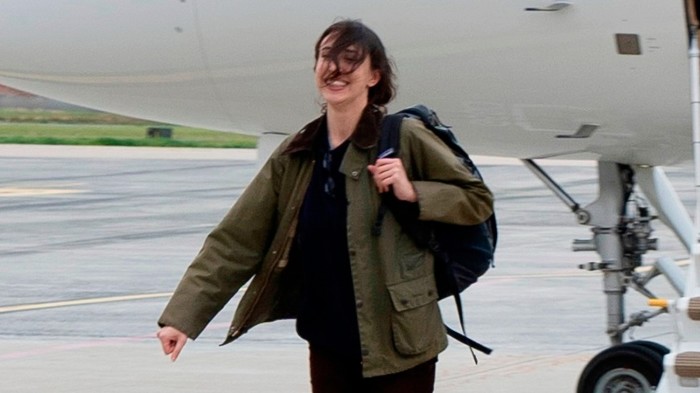
An Italian journalist arrested in Iran last month and held in Tehran’s notorious Evin prison has arrived home after being freed following weeks of diplomatic wrangling and pressure on Prime Minister Giorgia Meloni.
Cecilia Sala, 29, was arrested on December 19, days after Italian authorities detained an Iranian man wanted in the US for allegedly providing Iran with sensitive technology for drones that were used to kill three American soldiers in Jordan.
The journalist’s return to Italy comes just days after Meloni made an emergency visit to Mar-a-Lago in Florida to have dinner with US president-elect Donald Trump, with whom she is believed to have discussed the sensitive case.
Outgoing US President Joe Biden is also arriving in Rome late on Thursday night for his final overseas trip before leaving office and will hold talks with Meloni on Saturday.
Meloni — who was under intense domestic pressure to secure Sala’s freedom — called her return the result of “intense work on diplomatic and intelligence channels”.
Iranian authorities gave no official explanation for Sala’s sudden release. Earlier, Iranian officials said she had been detained for “violating the laws of the Islamic republic” without details, though they denied “retaliatory” intentions. Sala had been in Tehran on a valid journalist visa.
 Prime Minister Giorgia Meloni, right, was under intense domestic pressure to secure Cecilia Sala’s freedom © Filippo Attili/Italian Government Office/AP
 Cecilia Sala hugs her parents. Her father said: ‘I think our government has done an extraordinary job’ © Filippo Attili/Italian Government Office/Reuters
Italian security analysts speculated that Rome had probably reached a deal with Tehran over the fate of jailed Iranian engineer, Mohammad Abedini, who has been indicted in the US for his alleged export of “sophisticated electronic components from the US to Iran”.
Abedini, who was arrested at Milan’s Malpensa airport last month, is currently in a Milan jail awaiting extradition proceedings. Tehran has repeatedly demanded he be freed, with its embassy in Rome calling his incarceration “a form of hostage-taking”.
“I’m assuming that some sort of promises have been made to the Iranians concerning Abedini, and I’m assuming that Trump has greenlighted them,” said Nathalie Tocci, director of Rome’s Institute for International Affairs. “Hostages are not released without a deal — that’s how these things go.”
Italy’s intelligence chief Giovanni Caravelli travelled to Tehran in an Air Force plane to collect Sala, whose confinement in Evin had created a national public outcry. In a call home from prison, she complained of being held in solitary confinement, and forced to sleep on the floor with a light on over her head 24 hours a day.
“I think our government has done an extraordinary job,” Sala’s father, Renato Sala, told Italy’s state news agency, Ansa, describing himself as overcome with emotion.
The journalist’s return further boosts the domestic political prestige of the popular Meloni, whose diplomatic efforts on Sala’s behalf were widely hailed, including by normally hostile opposition parties.
“Domestically, it’s a massive win for Meloni,” said Tocci. “She is being praised by everyone . . . because the liberation of a citizen goes above party politics.”
Rome and Tehran have engaged in bitter diplomatic exchanges in recent weeks over the two prisoners. Italy complained about the treatment of Sala while Iranian authorities warned of serious consequences to relations with Italy if Rome extradited Abedini to the US.
The Iranian citizen is due to appear next week in an Italian court, where his lawyer will plead for him to be taken out of jail and placed under house arrest. Until now, Italian prosecutors have opposed Abedini’s potential release into house arrest, citing the likely flight risk.
The US justice department has also written to Italy to oppose Abedini’s potential release from jail, noting that various individuals sought by the US had subsequently disappeared after being placed under house arrest in Italy.
In one particularly high-profile case last year, Artem Uss, a prominent Russian politician’s son wanted in the US to stand trial for sanctions violations, managed to escape house arrest and make his way back to his homeland.
However, Italy’s foreign minister Antonio Tajani — a friend of Sala’s father — denied that Abedini’s case had any link to Sala’s arrest. “The Iranians themselves have separated the two cases,” he said. “Let’s enjoy Cecilia Sala’s return to Italy.”
Additional reporting by Giuliana Ricozzi in Rome and Bita Ghaffari in Tehran