Unlock the Editor’s Digest for free
Roula Khalaf, Editor of the FT, selects her favourite stories in this weekly newsletter.
Poland may stop granting passports to relatives of Poles deported to the former Soviet Union in the 1940s, ending a historic repatriation programme partly over fears it could be infiltrated by Russian spies.
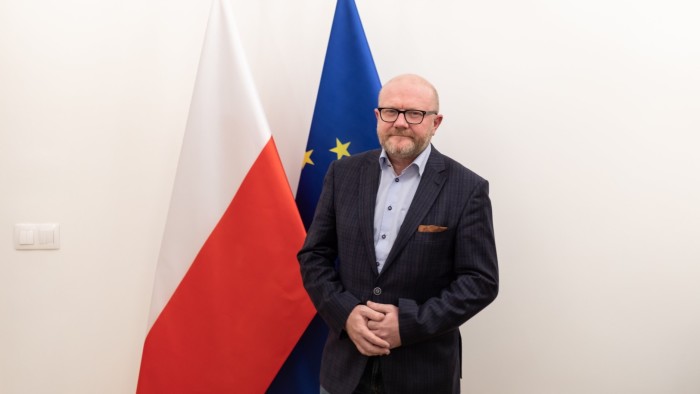
Maciej Duszczyk, Poland’s deputy minister for migration, said the flagship scheme was under review to assess security risks from keeping it open since Warsaw had met its “moral obligation” to generations of exiles.
While no final decision had been taken, “it may be that we’re going to close this programme during the next two years”, he said.
“We have to avoid a situation where, for example, we have a Russian citizen who has a Polish grandmother and we don’t know if he is part of the Russian KGB,” he said. “We need to know if these [applicants] are really people who are interested in repatriation.”
In 2000, the Polish parliament voted to introduce a law of repatriation to address one of the tragic chapters of Soviet control over Poland. After agreeing with Nazi Germany to invade and carve up Poland in September 1939, the Kremlin organised several rounds of mass deportations of Poles to remote parts of the Soviet Union, including labour camps in Siberia, where many of them died.
While a large part of those who survived Soviet deportation managed to make their own way home to Poland, 17,000 have applied for repatriation since 2020, of whom 7,500 are still under review. The Polish authorities estimate about 50,000 more people are eligible and could apply, about three-quarters of whom now live in Kazakhstan, but some also in Russia.
The scheme allows repatriates to acquire Polish citizenship on the day they enter the country. But many of the recent applicants did not speak Polish and were born long after their relatives were deported, Duszczyk said. “If it is the fourth generation, the roots with Poland are not so strong as for the first generation.”
To qualify for repatriation, applicants must have at least one Polish parent or grandparent, or two Polish great-grandparents, and be able to prove their affiliation to Poland.
Polish Prime Minister Donald Tusk has stepped up the fight against Russian aggression since taking office in December 2023. Besides spying, Warsaw has accused Moscow of cyber attacks, as well as orchestrating acts of sabotage including a fire at Warsaw’s largest shopping centre last May.
In October, Polish foreign minister Radosław Sikorski ordered the closure of the Russian consulate in the city of Poznań and warned other Russian diplomats stationed in Poland that they would also face expulsion if they got involved in “hybrid warfare against Poland”.
Recommended

But the Tusk government has also been presenting illegal migration as a security risk because Moscow and its proxy regime in Minsk have been helping migrants to enter Poland by crossing the border with Belarus since 2021.
Among other measures, the government recently tightened the rules for student visas, as well as those to get a so-called Pole’s card, under another programme designed to help foreigners with Polish connections to secure residency. Most of these cards were granted to Belarusians and Ukrainians whose families lived in eastern Poland until the second world war, after which Poland lost that territory to the Soviet Union.
The closure of the repatriation programme could lead to a last-minute rush of applicants, Duszczyk acknowledged, but he added “it would also be very good information for us to know if we have 50,000 people who are interested in repatriation”, rather than relying on rough estimates.