Unlock the Editor’s Digest for free
Roula Khalaf, Editor of the FT, selects her favourite stories in this weekly newsletter.
In the aftermath of Syria’s 2011 revolution I got a tattoo on my left foot that read “jannah jannah jannah” — Arabic for “heaven heaven heaven”. As the year passed I became increasingly afraid of this tattoo — or rather, of the life-ending ramifications if the wrong person saw it.
For the past 13 years, uttering the word “heaven” thrice has been a death wish in Syria. It hearkens back to the early days of the revolution, when football star-turned-revolutionary icon Abdel Basset al-Sarout would sing a protest song to tens of thousands gathered in his hometown Homs:
“Heaven heaven heaven,
I swear our homeland is.”
That revolution was crushed. President Bashar al-Assad’s grip on the country faltered but he never lost the capital Damascus, where his sophisticated intelligence system operated best and could be used to shut down any and all forms of dissent. I had left for college overseas just a few months earlier. I did not return until Assad’s regime collapsed at the end of last year.
I used to wonder what would happen if I was detained by Syrian intelligence and they saw the tattoo on my foot. Even though I was not in the country, I grew up believing the intelligence, or mukhabarat, could find you wherever you were. They were everywhere and nowhere. Everyone is mukhabarat: the popcorn guy outside your neighbourhood park; the men that run the kiosks peppered across the city; each and every cab driver.
As children, before we would enter the hair salon, my mother would stand me and my sister outside and make us repeat our promises: not to share information about our family, not to say whose wedding we’re going to, not to give details about who we know abroad.
The Syria I grew up in was a factory of fear. Any act of rebellion or discontent, even something as small as complaining about the state of the roads, had to be in hushed tones. The Assad family ruled Syria with an iron grip for over 50 years and setting up a vast intelligence network to monitor its countrymen and women was central to its power. Its security apparatus crushed any and all forms of dissent.
In 1984, George Orwell’s Big Brother was always watching. I grew up believing that was true. And this fear has ebbed and flowed over the years.
Sometimes, I would look up the route from my house in Beirut back to Damascus and wonder if it was worth the risk of returning. Then I’d look down at my foot tattoo and picture the horrors I had spent years reporting on — gruesome punishments that former prisoners described to me often involved feet. I would imagine being forced to skin off my own flesh.
In my nightmares, my foot took me to places like the Mezzeh air force intelligence base and Tishreen military hospital, a terrible fate for Syrian prisoners. Dread of these places was the strongest weapon Assad could use against his people, including his own followers. The fear of retribution lived with them, like a hostile pet they had to learn to placate.
Last month I entered all of these places, tattoo intact.
These are words I never thought I would type. All over the country, Syrians are saying things they have not dared to speak in years: dollars (formerly talked about in code as “the green” or “parsley”); prison (“your aunt’s house”); Assad (“them”). I have asked Syrian after Syrian if it took them time to adapt to this newfound freedom. They all arch their eyebrows in surprise, say no, and then look doubly surprised by their own answer.
 © Raya Jalabi/FT
The pace of change is remarkable.
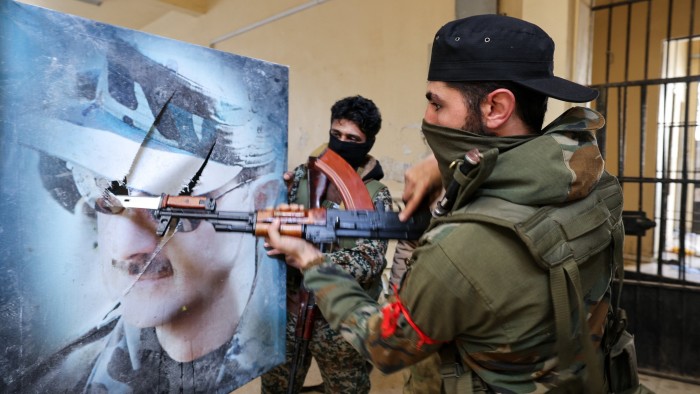
Assad left Syria on Sunday, December 8. By the time I drove into the country the following day, almost every one of the posters lining the highway showing his face were ripped down. Instead of the President’s Bridge we now have Saroot’s Bridge. The famous Assad Library is now just the Library.
One week after Assad’s fall I went into a bar in Damascus that buzzed with patrons. “Jannah jannah jannah” began to play and a hush fell on the crowd. Then everyone raised their glasses and belted out the song. They held each other and wept for those they’d lost, whose ghosts filled the empty spaces. Their grief hung thick in the air. But they did not look afraid.