
in January
This is driven by a price premium to Europe
versus Asia for closer US cargoes; TTF up on
supply risks and LNG reliance
It is expected that Europe could draw more
diversions this week
LONDON (ICIS)–Over LNG 10 cargoes have been
diverted from a heading to Asia instead to
Europe so far in 2025, driven by premium prices
in Europe that could cause further cargoes to
be redirected, according to traders.
ICIS data has so far recorded five US LNG
cargoes switching direction towards European
markets, and one to Turkey, while on the water
in the past two weeks, with several more deals
meaning more are expected to come.
Others may have made the decision to switch to
Europe at the point of loading and not show a
change in direction while on the water.
A source said in the first week of January that
seven diversions were already taking place or
planned, including from Singapore and
Japan-based traders.

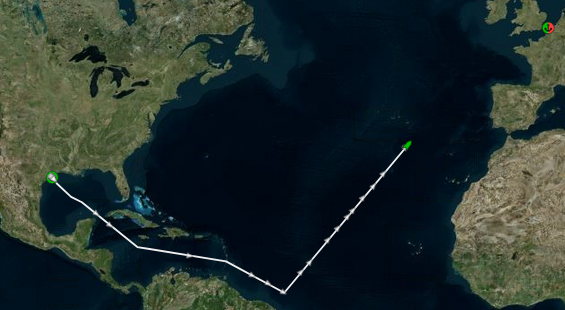
The latest cargo to be diverted on 13 January
was the 174,000cbm Flex Vigilant.
The vessel, with a US Freeport cargo, was
heading towards Asia, signaling for Thailand
for 9 February, but turned north and updated
its ETA to 23 January, suggesting a nearer
destination in Europe instead.
Other recent diversions include Diamond Gas’
Diamond Gas Crystal from the Cameron plant in
the US, after earlier signaling a destination
of Japan, the Bushu Maru, the Grace Dahlia and
the Maran Gas Sparta.
“Diversions even started when Asian spot LNG
was still at a premium to TTF of $0.45/MMBtu,”
said one Europe-based trader this week,
estimating over 10 cargoes diverted for loaded
and soon-to-be loaded cargoes. “Now cargoes
have been diverted and the spread widened again
for February.”
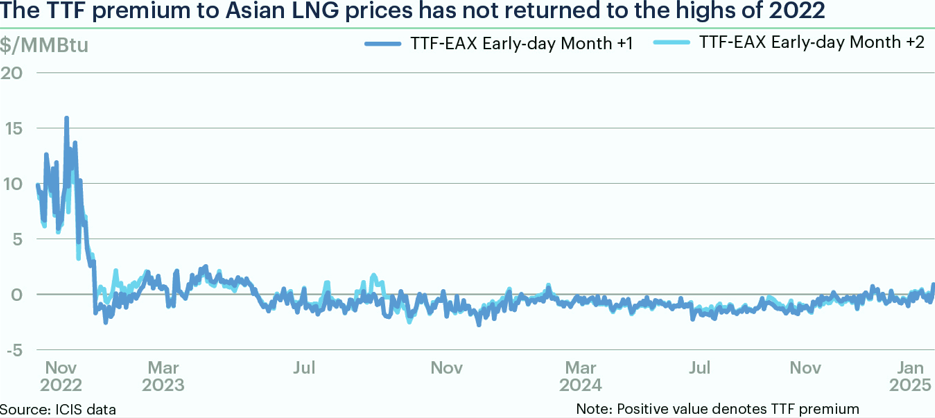
ICIS has recorded an average TTF discount to
the ICIS East Asian LNG index between 1-13
January of -$0.11/MMBtu, rising on 13 January
to a TTF premium of $0.898/MMBtu – the highest
since 2023.
This could trigger further diversions.
discount does not consider the longer journey
time and chartering costs to send US LNG
cargoes to Asia.
Many of the cargoes may have been sold to
European buyers on a prompt basis.
In the future, more US LNG sellers are likely
to hold European regas capacity and be able to
place cargoes directly into the market.
Any TTF premium to Asia would make for clearly
higher margins sending US LNG to Europe if the
seller can find a buyer or has its own
regasification position.
Sources pointed to weak demand in Asia as a key
driver for the diversions, particularly as
China prepares for its annual Spring Festival
and markets there slow down in response.
This has fed into the changing price spread,
where US LNG sellers will constantly be
monitoring European and Asian netbacks and
adjusting positions.
TTF prices have received relatively more
support from falling stocks, comparatively
colder weather and short-term signs of lower
feedgas nominations to US LNG plants.
Europe may well need to maintain parity, or a
small premium, to Asian markets into the
storage injection season later in the year.
HOW DIVERSIONS ARE AGREED
To ensure that a TTF premium is captured, “the
most straightforward way would be on the paper
side …to hedge your price risk exposure on the
physical side,” with costs factored in.
The diversions in this market can also favor
shipowners and operators.
“Right now it is hard to see how an owner would
complain being given a short ballast back to
the US Gulf instead of a long ballast back from
the Far East, when rates are so low and the
eastern freight market is so weak,” said a
trader.
The source added if the vessel diverting to
Europe from Asia was intended for further trade
or dry-dock in the east, an “agreement would
need to be struck to compensate the longer
ballast voyage and costs incurred to the owner
from diverting into Europe”.
Diversions can be arranged for spot and some
contractual volumes.
The destination-free structure of US FOB
contracts is perfect for these kind of
short-term diversions.
DES contracts can be more problematic, and in
general must have consent from the seller as
they bear the risk of the cargo until after it
has been delivered.
Additional reporting by Lars Kjoellesdal