[OC] Plates stay empty – and taps run dry:
Germany’s Hospitality Industry Faces a Staffing Crisis
Posted by DataPulseResearch
![[OC] Plates stay empty – and taps run dry:
Germany’s Hospitality Industry Faces a Staffing Crisis](https://www.europesays.com/wp-content/uploads/2025/01/ijmb38d066de1-1920x1024.png)
[OC] Plates stay empty – and taps run dry:
Germany’s Hospitality Industry Faces a Staffing Crisis
Posted by DataPulseResearch
11 comments
**Article:** [**https://www.datapulse.de/en/hospitality-crisis/**](https://www.datapulse.de/en/hospitality-crisis/)
**Main data source:** [**www.kofa.de**](https://www.kofa.de/daten-und-fakten/studien/fachkraeftereport-juni-2024)
**Data:** [Google Sheets](https://docs.google.com/spreadsheets/d/1F1S3im7tIWi_F9BHS6Fls1Qvu2M_zm-VpXxT-W8oODs/edit?usp=sharing)
**Tool:** Adobe Illustrator
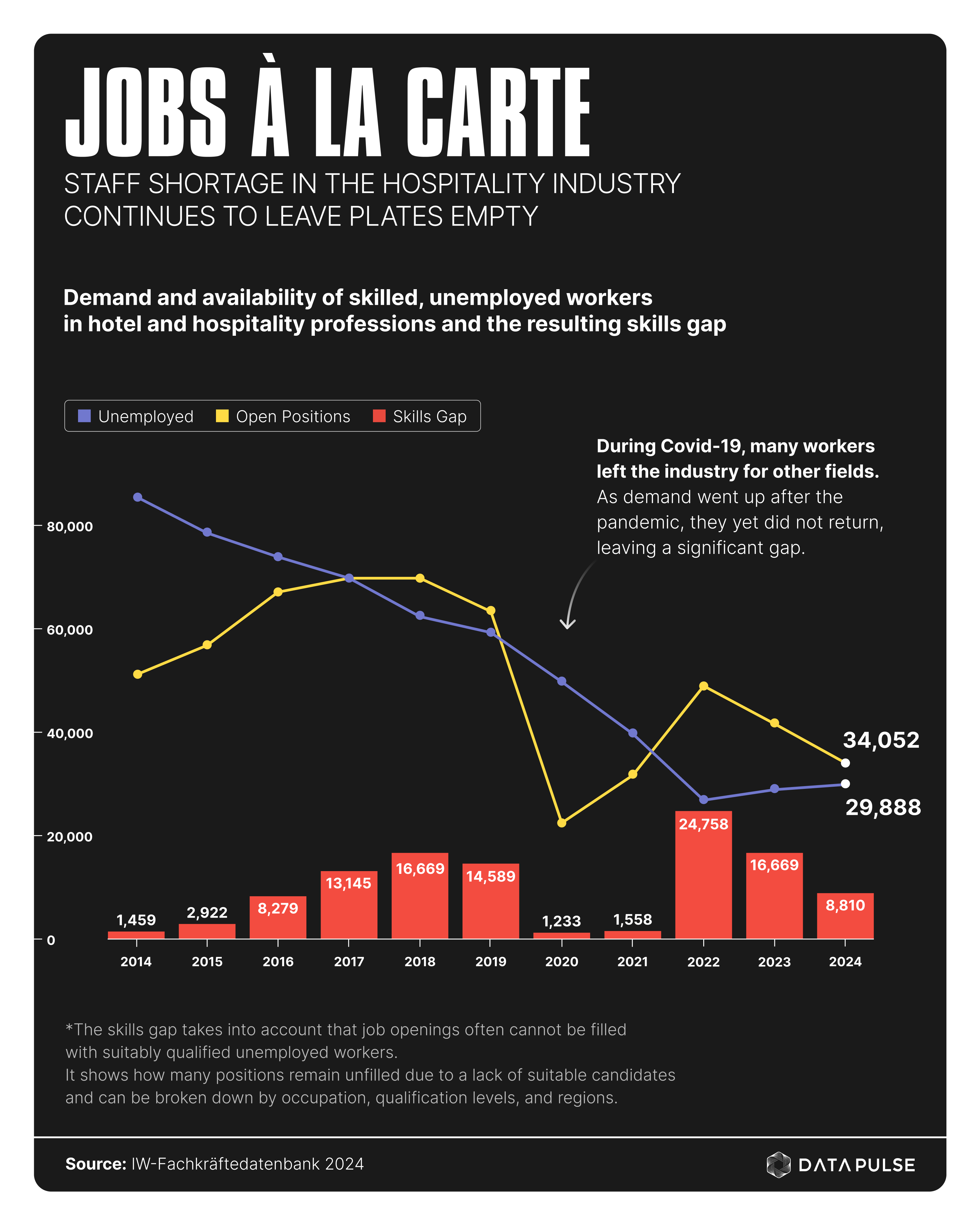
In 2023, *10%* of German restaurants shut their doors for good, highlighting a critical shortage of skilled workers that began during the pandemic. The numbers from Tagesschau.de tell a stark story:
* 2021: 1,558 missing hospitality professionals.
* 2022: A peak of 24,758 missing workers.
* 2024: 8,810 still unfilled positions – a drop that reflects fewer establishments, not fewer problems.
Unattractive working hours, dwindling tips, and ongoing closures are reshaping the future of the industry.
The working conditions are just awful.
As server its hard but the tips make it bearable in locations where tipping is common at least.
If you don’t get tips most jobs are just better. There is the argument to be made that raising compensation would lead to prices where nobody would eat out anymore but I am of the opinion that if a business can’t pay a living wage it just shouldn’t exist.
Gotta wonder what it’ll take to lure people back though… free drinks?
People realizing they don’t wanna deal with Karen tables anymore…
I have a friend who had a Restaurant in Germany. Since Covid he was always understaffed. He couldn’t find enough people even when he is paying way more in wages for each position than pre Covid.
He had to increase prices to make up for the higher food and employee cost. But that drove some people away who are saying it is getting too expensive.
Ultimately he closed this former good running restaurant.
Given the volatility and the trends that still stand out, this doesn’t seem like a particularly good time to draw any conclusions about this industry. And considering that a large part of hospitality workers are completely unskilled, calculating the gap based on skilled unemployed workers vs unfilled positions seems questionable as well. The whole article seems rather superficial and cherry-picked, to be honest. Are you certain, for example, that the drop in demand actually “reflects fewer establishments” – as in, did you check that looking at the number of filled positions?
That’s to be expected, there are better jobs available so people look for them. Happens in all economies, like when oil disrupts a whole economy because it pays so much more and the country becomes a petrostate. Also why the privileged classes and ethnicities of a country won’t work in shit underemployment jobs, they put the underclasses who don’t have a choice.
If of equal access (like in cases of an abundance of jobs), people will go to work in the one that pays more with better conditions.
Food work is notoriously hard and low pay. Many people were only doing it because it is available and once they were laid off after covid and assuming they did what it took to get skills to get a better job or just decided not to settle on the usually easy to get food jobs, yeah, they aren’t going back into food. I can’t imagine many other fields have as many drawbacks.
The “skills gap” metric is absolute bullshit. The problem isn’t available candidates, its employers unnecessary expectations for the specific jobs. They want someone with 10 years experience for an entry level job that pays peanuts and then report it as a gap in available candidate talent when nobody takes their bullshit job.
This is more or less what’s happened in most countries with robust hospitality industries. The only restaurants doing well are either destination restaurants or cheap and fast restaurants. There’s very little money to be made in the middle.
‘Staff shortage’ is an impossible statement in a market economy.
There is a wage and benefits shortage. If every employer increased wages to the point of full staffing, then wages would increase until the least profitable businesses ran out of businesses and the supply/demand ratio equalized.
Comments are closed.