
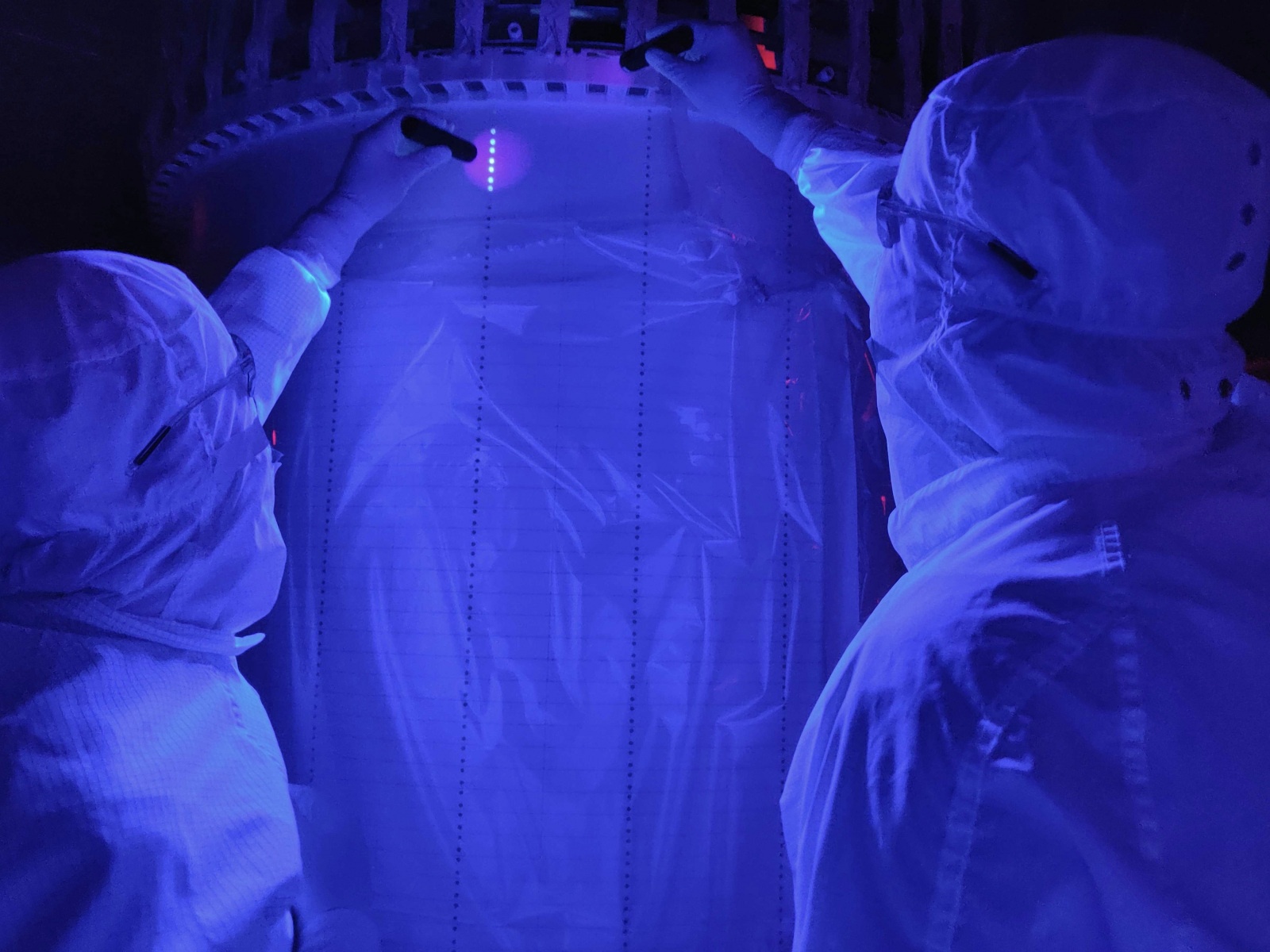
Technicians scanning for dust on the LUX-ZEPLIN (LZ) Dark Matter Detector. Credit: LZ Experiment
Dark matter may have to go on a diet, according to new research.

According to new research, the earliest seeds of structures may have been laid down by gravitational waves sloshing around in the infant universe.

An illustration of the Gateway’s Power and Propulsion Element and Habitation and Logistics Outpost in orbit around the Moon. Credits: NASA
Researchers have discovered how to make a new kind of metamaterial reconfigure itself without tangling itself up in knots, opening up the possibility of a broad array of space applications.

SpaceX’s Starship Super Heavy booster comes in for a launch-tower catch at the Starbase launch site. (SpaceX via X)
SpaceX’s seventh flight test of its massive Starship launch system brought good news as well as not-so-great news.
The good news? The Super Heavy booster successfully flew itself back to the Texas launch site and was caught above the ground by the launch tower’s chopstick-style mechanical arms. That’s only the second “Mechazilla” catch to be done during the Starship test program. The bad news is that the upper stage, known as Ship 33, was lost during its ascent.
“Starship experienced a rapid unscheduled disassembly during its ascent burn. Teams will continue to review data from today’s flight test to better understand root cause,” SpaceX said in a post-mission posting to X. “With a test like this, success comes from what we learn, and today’s flight will help us improve Starship’s reliability.”
Continue reading “SpaceX Catches Booster But Loses Ship in Starship Test Flight”

Gaia showed us that our galaxy’s disk, the dark brown horizontal spanning from one side to the other, has a bit of a wave to it. Gaia also showed us that the Milky Way has more than two spiral arms and that they aren’t as pronounced as we thought. Image Credit: ESA/Gaia/DPAC, Stefan Payne-Wardenaar CC BY-SA 3.0 IGO
We can judge the value of any scientific endeavour based on how much of our knowledge it overturns or transforms. By that metric, the ESA’s Gaia mission is a resounding success. The spacecraft gave us a precise, 3D map of our Milky Way galaxy and has forced us to abandon old ideas and replace them with compelling new ones.

The radio telescope array ALMA has pin-pointed the exact cosmic age of a distant JWST-identified galaxy, GHZ2/GLASS-z12, at 367 million years after the Big Bang. Image Credit: NASA/ESA/CSA/T. Treu, UCLA/NAOJ/T. Bakx, Nagoya U.
One of the most exciting developments in modern astronomy is how astronomers can now observe and study the earliest galaxies in the Universe. This is due to next-generation observatories like the James Webb Space Telescope (JWST), with its sophisticated suite of infrared instruments and spectrometers, and advances in interferometry – a technique that combines multiple sources of light to get a clearer picture of astronomical objects. Thanks to these observations, astronomers can learn more about how the earliest galaxies in the Universe evolved to become what we see today.
Using Webb and the Atacama Large Millimeter/submillimeter Array (ALMA), an international team led by researchers from the National Astronomical Observatory of Japan (NAOJ) successfully detected atomic transitions coming from galaxy GHZ2 (aka. GLASS-z12), located 13.4 billion light-years away. Their study not only set a new record for the farthest detection of these elements This is the first time such emissions have been detected in galaxies more than 13 billion light-years away and offers the first direct insights into the properties of the earliest galaxies in the Universe.
Continue reading “Webb and ALMA Team Up to Study Primeval Galaxy”

Triple star systems are more common than might be imagined – about one in ten of every Sun-like star is part of a system with two other stars. However, the dynamics of such a system are complex, and understanding the history of how they came to be even more so. Science took a step towards doing so with a recent paper by Emily Leiner from the Illinois Institute of Technology and her team.

Artist’s impression of a white dwarf embedded in the disk of a giant black hole. Credit: NASA/Sonoma State University, Aurore Simonnet
Black holes are among the most mysterious and powerful objects in the Universe. These behemoths form when sufficiently massive stars reach the end of their life cycle and experience gravitational collapse, shedding their outer layers in a supernova. Their existence was illustrated by the work of German astronomer Karl Schwarzschild and Indian-American physicist Subrahmanyan Chandrasekhar as a consequence of Einstein’s Theory of General Relativity. By the 1970s, astronomers confirmed that supermassive black holes (SMBHs) reside at the center of massive galaxies and play a vital role in their evolution.
However, only in recent years were the first images of black holes acquired by the Event Horizon Telescope (EHT). These and other observations have revealed things about black holes that have challenged preconceived notions. In a recent study led by a team from MIT, astronomers observed oscillations that suggested an SMBH in a neighboring galaxy was consuming a white dwarf. But instead of pulling it apart, as astronomical models predict, their observations suggest the white dwarf was slowing down as it descended into the black hole – something astronomers have never seen before!
Continue reading “Recent Observations Challenge our Understanding of Giant Black Holes”

One of the Daya Bay detectors.
Roy Kaltschmidt, Lawrence Berkeley National Laboratory
Strange “right-handed” neutrinos may be responsible for all the matter in the universe, according to new research.
Continue reading “An Even Ghostlier Neutrino May Rule the Universe”

ESA’s Milky Way-mapper Gaia has completed the sky-scanning phase of its mission, racking up more than three trillion observations of about two billion stars and other objects over the last decade to revolutionise our view of our home galaxy and cosmic neighbourhood.
The ESA has announced that Gaia’s primary mission is coming to an end. The spacecraft’s fuel is running low, and the sky-scanning phase of its mission is over. The ground-breaking mission has taken more than three trillion observations of two billion objects, mostly stars.
Continue reading “The Gaia Mission’s Science Operations are Over”