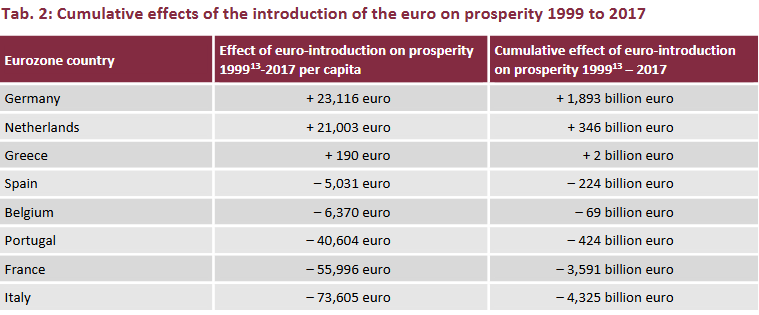
> Table 2 shows the effects of the introduction of the euro on prosperity, per capita (column 2) and overall (column 3), for the entire period since the year of introduction – 1999 in all countries except Greece, for Greece 2001 – until 2017. The effects on prosperity are determined by adding the annual per-capita figures and multiplying the resulting amounts by the average national consumption rate11of the relevant eurozone country in the pre-intervention period.12
>
> There is still a lack of reliable empirical data about which eurozone countries have gained from the introduction of the euro and which ones have lost out. Although there have been studies of whether the euro has promoted trade between eurozone countries,2 the results are not clear-cut. In addition, focussing on trade only throws light on a small aspect of the introduction of the euro. Disadvantages of introducing the euro arising from the fact that eurozone countries can no longer devalue their currencies, remain unaccounted for. One meaningful indicator of whether, for individual eurozone countries, the euro has on balance led to a growth or a fall in prosperity, is the trend in gross domestic product per head of population (GDP per-capita). This therefore forms the basis of the following empirical examination in which the synthetic control method is used on selected eurozone countries to determine how per-capita GDP would have developed if they had not joined the eurozone. Comparing this with the actual trend in per-capita GDP indicates the impact that accession to the euro has had on prosperity. The analysis can only be carried out on eurozone countries in which there was a long gap between EU accession and introduction of the euro as this is the only way to ensure that the result of the analysis has not been distorted by accession to the EU and its internal market.
>
Avant d’acheter le lien de cause à effet on m’expliquerai juste (parce que j’ai pas compris l’explication associée), en quoi on sait que c’est lié l’effet de l’introduction de l’euro et pas le reflet de… tout ce qui s’est passé en france depuis 20 ans, politique économique, contexte, prix du camembert, tout ça? Bref comment on isole le lien de causalité ?
La méthode: extrapolation à partir d’un groupe de pays de contrôle hors euro similaire au pays en question.
Ça ne prend donc pas en compte tout ce qui se passe après l’introduction de l’euro, les pays similaires peuvent avoir eu des politiques tout à fait différentes .
C’est à mon avis aussi assez variable si on décompose en sous périodes (la crise de 2008 a affecté les pays de manières très différente).
Je me demande si ils ont appliqué le même calcul aux pays hors zone euro pour voir si leur méthode tient la route. Genre il faudrait voir si ils trouvent des effets du même ordre ou pas de l’introduction de l’euro sur le Nicaragua ou le Pakistan.
4 comments
Source: 20 Years of the Euro: Winners and Losers
https://www.cep.eu/Studien/20_Jahre_Euro_-_Gewinner_und_Verlierer/cepStudy_20_years_Euro_-_Winners_and_Losers.pdf
> Table 2 shows the effects of the introduction of the euro on prosperity, per capita (column 2) and overall (column 3), for the entire period since the year of introduction – 1999 in all countries except Greece, for Greece 2001 – until 2017. The effects on prosperity are determined by adding the annual per-capita figures and multiplying the resulting amounts by the average national consumption rate11of the relevant eurozone country in the pre-intervention period.12
>
> There is still a lack of reliable empirical data about which eurozone countries have gained from the introduction of the euro and which ones have lost out. Although there have been studies of whether the euro has promoted trade between eurozone countries,2 the results are not clear-cut. In addition, focussing on trade only throws light on a small aspect of the introduction of the euro. Disadvantages of introducing the euro arising from the fact that eurozone countries can no longer devalue their currencies, remain unaccounted for. One meaningful indicator of whether, for individual eurozone countries, the euro has on balance led to a growth or a fall in prosperity, is the trend in gross domestic product per head of population (GDP per-capita). This therefore forms the basis of the following empirical examination in which the synthetic control method is used on selected eurozone countries to determine how per-capita GDP would have developed if they had not joined the eurozone. Comparing this with the actual trend in per-capita GDP indicates the impact that accession to the euro has had on prosperity. The analysis can only be carried out on eurozone countries in which there was a long gap between EU accession and introduction of the euro as this is the only way to ensure that the result of the analysis has not been distorted by accession to the EU and its internal market.
>
Avant d’acheter le lien de cause à effet on m’expliquerai juste (parce que j’ai pas compris l’explication associée), en quoi on sait que c’est lié l’effet de l’introduction de l’euro et pas le reflet de… tout ce qui s’est passé en france depuis 20 ans, politique économique, contexte, prix du camembert, tout ça? Bref comment on isole le lien de causalité ?
La méthode: extrapolation à partir d’un groupe de pays de contrôle hors euro similaire au pays en question.
Ça ne prend donc pas en compte tout ce qui se passe après l’introduction de l’euro, les pays similaires peuvent avoir eu des politiques tout à fait différentes .
C’est à mon avis aussi assez variable si on décompose en sous périodes (la crise de 2008 a affecté les pays de manières très différente).
Je me demande si ils ont appliqué le même calcul aux pays hors zone euro pour voir si leur méthode tient la route. Genre il faudrait voir si ils trouvent des effets du même ordre ou pas de l’introduction de l’euro sur le Nicaragua ou le Pakistan.