
CHARLOTTE, North Carolina (ICIS)–There is
uncertainty about the extent that stated US
policy goals on tariffs will be achieved and
their impact on the economy this year and
beyond. Yet for now, the US economy remains on
solid ground.
An extension of the 2017 tax cuts would be
positive, as would deregulation and higher
defense spending. On the other hand,
immigration restrictions and tariff increases
would take away from growth and could foster
inflationary pressures. It is possible that new
tariffs will be measured.
Higher inflationary pressures of late have
raised interest rates, which could subtract
from US growth.
It is clear from looking at year-earlier
comparisons that the US economy is slowing. The
US remains in the late stage of the business
cycle, but there is likely more room for the
economy to run.
December featured a solid employment report.
There are 1.1 job openings per unemployed
person, a level back to pre-pandemic levels.
With a balanced labor market, incomes are
holding up for consumers and providing support
for the US economy.
The headline December Consumer Price Index
(CPI) was up 2.9% year on year, a
third month of higher comparisons. Economists
expect inflation to average 2.5% this year,
down from 2.9% in 2024, 4.1% in 2023 and 8.0%
in 2022. This is still above the Fed’s target.
CPI inflation is expected to stabilize at 2.5%
in 2026 and soften to 2.3% in 2027. That said,
expectations of stronger growth and higher
inflation have pushed up interest rates, as
measured by the 10-year Treasury yield.
US MANUFACTURING PMI
IMPROVES
Turning to the
production side of the economy, the December
ISM US Manufacturing PMI registered 49.3, an
improvement from November’s reading.
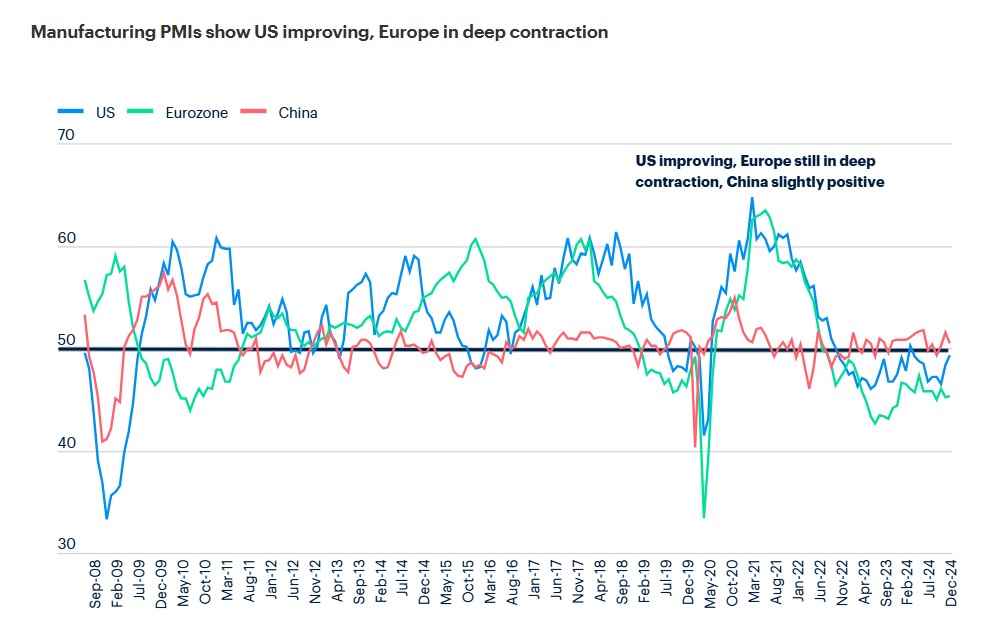
Overall manufacturing production contraction
moved into positive territory, and new orders
strengthened further. Order backlogs and
inventories moved closer to breakeven,
suggesting the start of a restocking cycle.
Seven of the 18 industries surveyed expanded.
The ISM US Services PMI rose 2.0 points to
54.1, a good expansionary reading.
The Manufacturing PMI for Canada was in
positive territory for a fourth month while
that for Mexico contracted again slightly.
Brazil’s manufacturing PMI expanded for a
twelfth month, but at a slower pace.
Euro area manufacturing has been in contraction
for 30 months. The UK PMI remains in
contraction. China’s manufacturing PMI was
slightly positive for a third month, indicative
of a stalling recovery.
AUTO AND HOUSING
OUTLOOK
Turning to the demand
side of the economy, light vehicle sales
improved again in December, and although
inventories have moved up this past year, they
remain low. Affordability continues to be the
issue and is providing headwinds, although the
year ended on a solid note.
We expect light vehicle sales of 16.31 million
in 2025, before improving to 16.53 million in
2026 and 16.95 million in 2027. This would
bring activity back to the last peak in 2018.
Housing activity continues to be muted amid
affordability issues as 30-year mortgage rates
returned to over 7%, along with low builder
confidence.
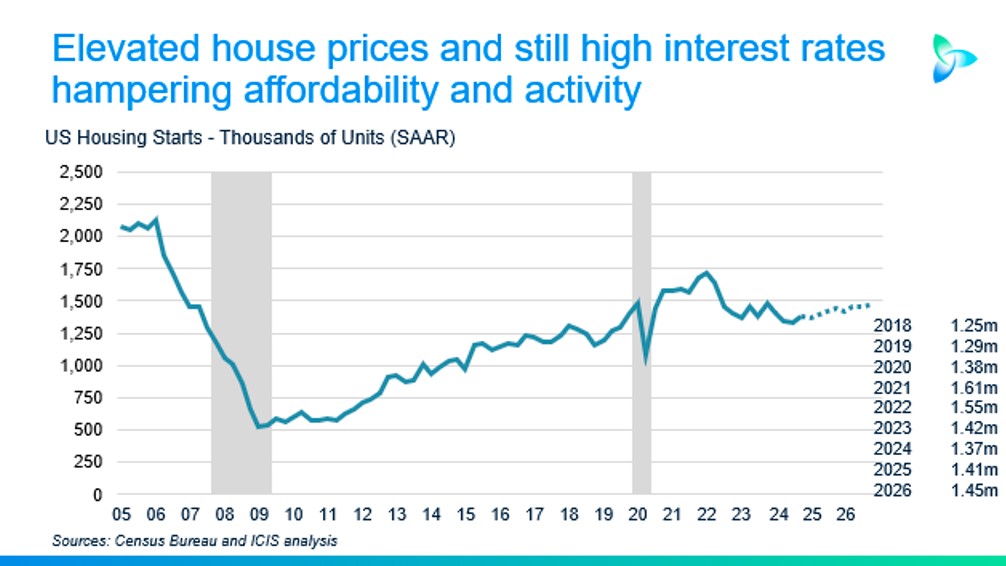
We expect housing starts will average 1.41
million in 2025 and improve to 1.45 million in
2026 and to 1.59 million in 2027. Demographic
factors will support activity through the end
of the decade. There is significant pent-up
demand for housing and a shortage of inventory.
RETAIL SALES PICK
UP
Retail sales were lackluster
for much of this year, but Q4 results were
robust. Sales at food services and drinking
places also remained positive. Overall consumer
spending continues to improve but may be
slowing.
Business fixed investment has been languid of
late, but led by a need to boost productivity
and by reshoring initiatives, this will take
over from consumer spending as a driver of the
US economy. This is typical in the late-stage
of the business cycle.
US GDP FORECAST
US GDP
rebounded 6.1% in 2021 and then slowed to a
2.5% gain in 2022. The much-anticipated
recession failed to emerge for a variety of
reasons, and in 2023, the economy expanded 2.9%
followed by an estimated 2.7% in 2024. This
pace is well above long-term growth potential.
Q4 2024 economic growth will be strong, but a
slowdown in quarterly economic gains towards
long-term growth potential suggests that in
2025 the economy could rise 2.2%, followed by
another 2.2% gain in 2026 and 2.0% growth in
2027.
Deregulation, energy and tax reform as well as
other initiatives could aid economic growth.
The US continues to outpace other advanced
nations. Recent results suggest that Europe’s
economic prospects appear stagnant amid many
structural and competitiveness headwinds.
China appears to be attempting to export its
way out of a soft economy. The stimulus
provided will likely have only a modest effect
on improving growth prospects and rising trade
tensions may hinder growth.