
Filter by article type:
In-brief analysis
In-depth analysis
In-brief analysis
Jan 30, 2025

In 2023, U.S. nuclear generators used 32 million pounds of imported uranium concentrate (U3O8) and only 0.05 million pounds of domestically produced U3O8. Imports accounted for 99% of the U3O8 they used in 2023 to make nuclear fuel. Foreign producers predominantly supply the U.S. front-end nuclear fuel cycle, but federal policies have been implemented recently to build out the domestic U.S. nuclear fuel supply chain. The U.S. Department of Energy (DOE) recently received $2.7 billion in congressional funding to help revive domestic fuel production for commercial nuclear power plants.
In-brief analysis
Jan 29, 2025

Natural gas-fired electric power generation has increased in Pennsylvania since 2013 as the state has shifted toward natural gas as its main fuel source for electric power generation. In October 2024, natural gas-fired generation accounted for 57% of the electricity generated in Pennsylvania, more than twice the share in October 2013 (26%). Over the past decade, natural gas has become the primary fuel source for electricity generation in the state, surpassing coal-fired generation in 2016 on an annual basis and nuclear-powered generation in 2019. Natural gas-fired generation reached an all-time monthly peak in Pennsylvania of 15.3 million megawatthours (MWh) in July 2024, as hourly electricity demand peaked across multiple regions of the Lower 48 states due to widespread heatwaves.
In-brief analysis
Jan 28, 2025

Data source: U.S. Energy Information Administration, State Heating Oil and Propane Program; Bloomberg, L.P.
Note: Wholesale prices are U.S. benchmark spot prices from Mont Belvieu, Texas.
U.S. wholesale and retail propane prices have been higher so far this winter heating season (October–March) than during the same period a year ago, largely because of colder weather in January and higher exports, according to data from our State Heating Oil and Propane Program. Prices have been higher despite relatively strong propane inventories heading into this winter heating season.
In-brief analysis
Jan 27, 2025

In our January Short-Term Energy Outlook (STEO), we expect that U.S. wholesale power prices will average slightly higher in 2025 in most U.S. regions than last year, except in Texas and in the Northwest. We forecast that the 11 wholesale prices we track in STEO will average $40 per megawatthour (MWh) in 2025 (weighted by demand), up 7% from 2024. We expect the 2025 average U.S. residential electricity price will be 2% higher than the 2024 average, though after accounting for inflation, our forecast for U.S. residential prices remains relatively unchanged from 2024.
In-brief analysis
Jan 24, 2025

Data source: U.S. Energy Information Administration, Short-Term Energy Outlook (STEO), January 2025
Note: Capacity values represent the amount of generating capacity at utility-scale power plants (greater than 1 megawatt). Other renewables include geothermal, waste biomass, wood biomass, and pumped storage hydropower.
In our latest Short-Term Energy Outlook (STEO), we expect that U.S. renewable capacity additions—especially solar—will continue to drive the growth of U.S. power generation over the next two years. We expect U.S. utilities and independent power producers will add 26 gigawatts (GW) of solar capacity to the U.S. electric power sector in 2025 and 22 GW in 2026. Last year, the electric power sector added a record 37 GW of solar power capacity to the electric power sector, almost double 2023 solar capacity additions. We forecast wind capacity additions will increase by around 8 GW in 2025 and 9 GW in 2026, slight increases from the 7 GW added in 2024.
In-depth analysis
Jan 23, 2025

We expect increases in the Henry Hub natural gas price in 2025 and 2026 as demand for natural gas grows faster than supply, driven mainly by more demand from U.S. liquefied natural gas (LNG) export facilities, reducing the natural gas in storage compared with the last two years. In our January Short-Term Energy Outlook (STEO), we forecast the U.S. benchmark Henry Hub natural gas spot price to increase in 2025 to average $3.10 per million British thermal units (MMBtu) and in 2026 to average $4.00/MMBtu from the record low set in 2024.
In-brief analysis
Jan 22, 2025

In our January Short-Term Energy Outlook, we now forecast U.S. retail gasoline prices through the end of 2026. We estimate U.S. average gasoline prices in 2025 will decrease by 11 cents per gallon (gal), or about 3%, compared with 2024. In 2026, we forecast a further decrease of about 18 cents/gal, or an additional 6%. The lower U.S. gasoline prices are primarily a result of lower crude oil prices, as well as decreasing gasoline consumption in 2026 because of increasing fleetwide fuel economy. Decreasing U.S. refinery capacity over the forecast period may offset some of the downward pressure of lower crude oil prices on gasoline prices.
In-depth analysis
Jan 21, 2025

We forecast benchmark Brent crude oil prices will fall from an average of $81 per barrel (b) in 2024 to $74/b in 2025 and $66/b in 2026, as strong global growth in production of petroleum and other liquids and slower demand growth put downward pressure on prices and help offset heightened geopolitical risks and voluntary production restraint from OPEC+ members. This forecast was completed before the United States issued additional sanctions targeting Russia’s oil sector on January 10, which have the potential to reduce Russia’s oil exports to the global market.
In-brief analysis
Jan 17, 2025
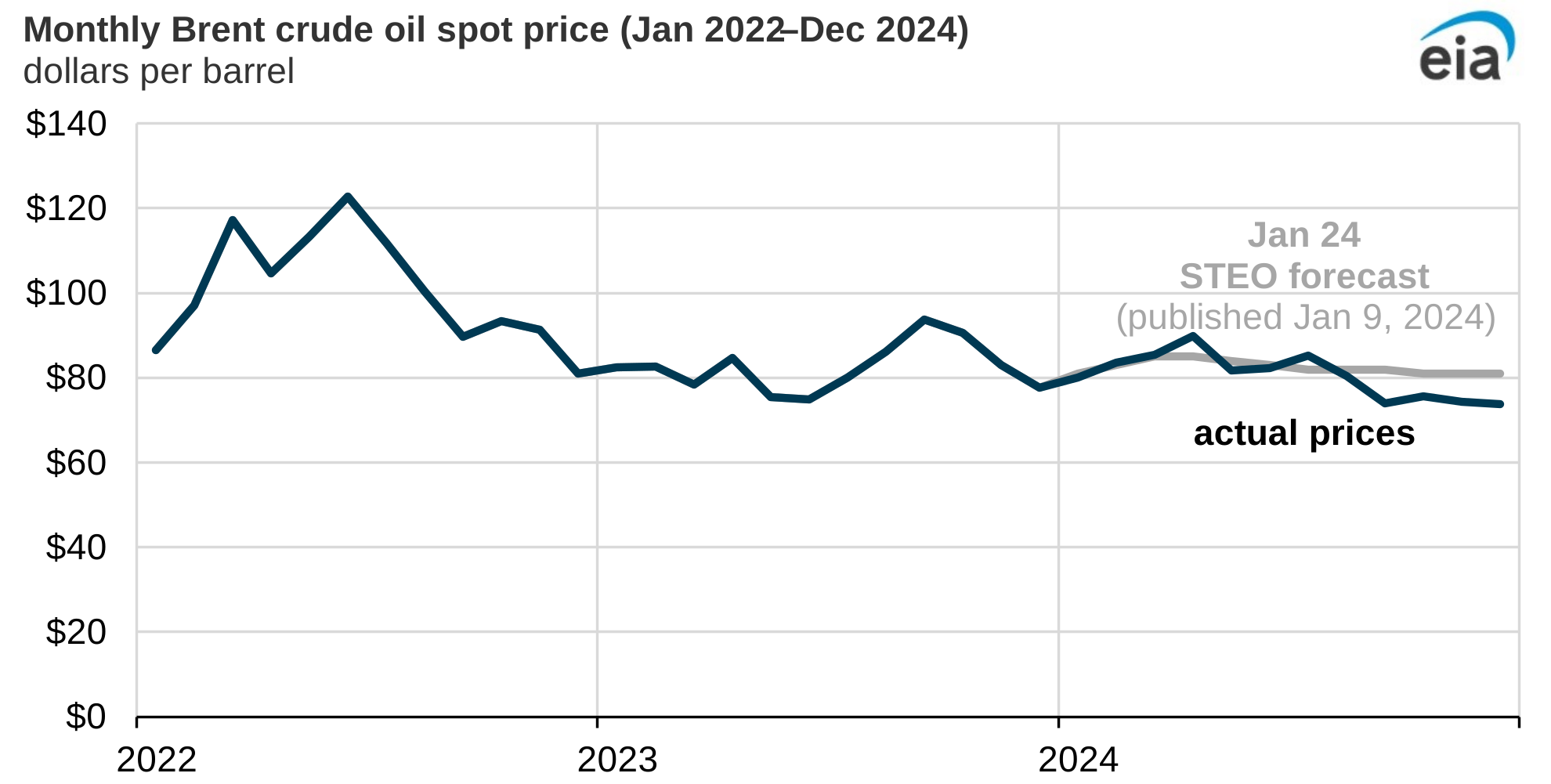
Benchmark Brent crude oil prices averaged $81 per barrel (b) in 2024, in line with the $82/b for the year that we had forecast in our January 2024 Short-Term Energy Outlook (STEO) and more in-depth analysis. In the January 2024 STEO, we forecast that markets would be relatively balanced in 2024, changing little from the 2023 average Brent price of $82/b. On an annual basis, our forecast for balanced markets was relatively accurate, as global inventories showed only a slight drawdown of 0.18 million barrels per day in 2024.
In-brief analysis
Jan 16, 2025

Data source: S&P Capital IQ
Average wholesale electricity prices at major trading hubs in the Lower 48 states were lower in 2024 than in 2023. In addition, prices were much less volatile than they have been over the last few years. Lower and more stable electricity prices in 2024 were mostly driven by low natural gas prices, as well as increases in generation for some lower cost renewable energy sources and new battery storage capacity.
In-brief analysis
Jan 15, 2025

In our January 2024 Short-Term Energy Outlook, which includes data and forecasts through December 2026, we forecast five key energy trends that we expect will help shape markets over the next two years.
In-brief analysis
Jan 14, 2025

Data source: U.S. Energy Information Administration, State Energy Data System
Note: Real prices are adjusted for inflation with the Consumer Price Index from the U.S. Bureau of Labor Statistics.
After a decade of nearly flat prices from 2011 to 2021, inflation-adjusted fuel prices for natural gas vehicles increased in 37 states from 2021 to 2023, according to new estimates in our State Energy Data System (SEDS). Real U.S. natural gas prices for vehicle fuel remained 25% below their peak in 2008.
In-brief analysis
Jan 13, 2025

Data source: U.S. Energy Information Administration, Liquefaction Capacity File; trade press
Note: Bcf/d=billion cubic feet per day; LNG=liquefied natural gas
On December 26, 2024, Plaquemines LNG—the eighth liquefied natural gas (LNG) export terminal in the United States—shipped its first cargo after achieving first LNG production in mid-December. Plaquemines LNG is one of two U.S. LNG export terminals that started LNG production in 2024. Corpus Christi Stage 3 (an expansion of the existing Corpus Christi LNG export terminal) also began LNG production in December 2024.
In-brief analysis
Jan 10, 2025

Data source: Japan Nuclear Regulation Authority
Japanese utilities restarted two additional nuclear reactors in 2024 that had been suspended from operations in response to the 2011 Fukushima Daiichi accident, taking the total number of restarted reactors to 14 since the accident. In November, Tohoku Electric Power Co. restarted its 796-megawatt (MW) Onagawa Unit 2 reactor, and in December Chugoku Electric Power Co. restarted its Shimane Unit 2 (789 MW). Onagawa is the nuclear power plant located closest to the epicenter of the March 2011 earthquake and tsunami.
In-brief analysis
Jan 8, 2025

In 2024, the U.S. benchmark Henry Hub natural gas spot price averaged $2.21 per million British thermal units (MMBtu), the lowest average annual price in inflation-adjusted dollars ever reported. The annual average Henry Hub natural gas spot price in 2024 decreased by 16% from its 2023 average and 68% from its 2022 average, the largest two-year decline on record. The monthly average Henry Hub spot natural gas price in 2024 ranged from $3.25/MMBtu in January to an all-time low of $1.51/MMBtu in March, reflecting a narrower $1.74/MMBtu range of monthly prices across the year than the average range of $2.32/MMBtu over the prior five years.