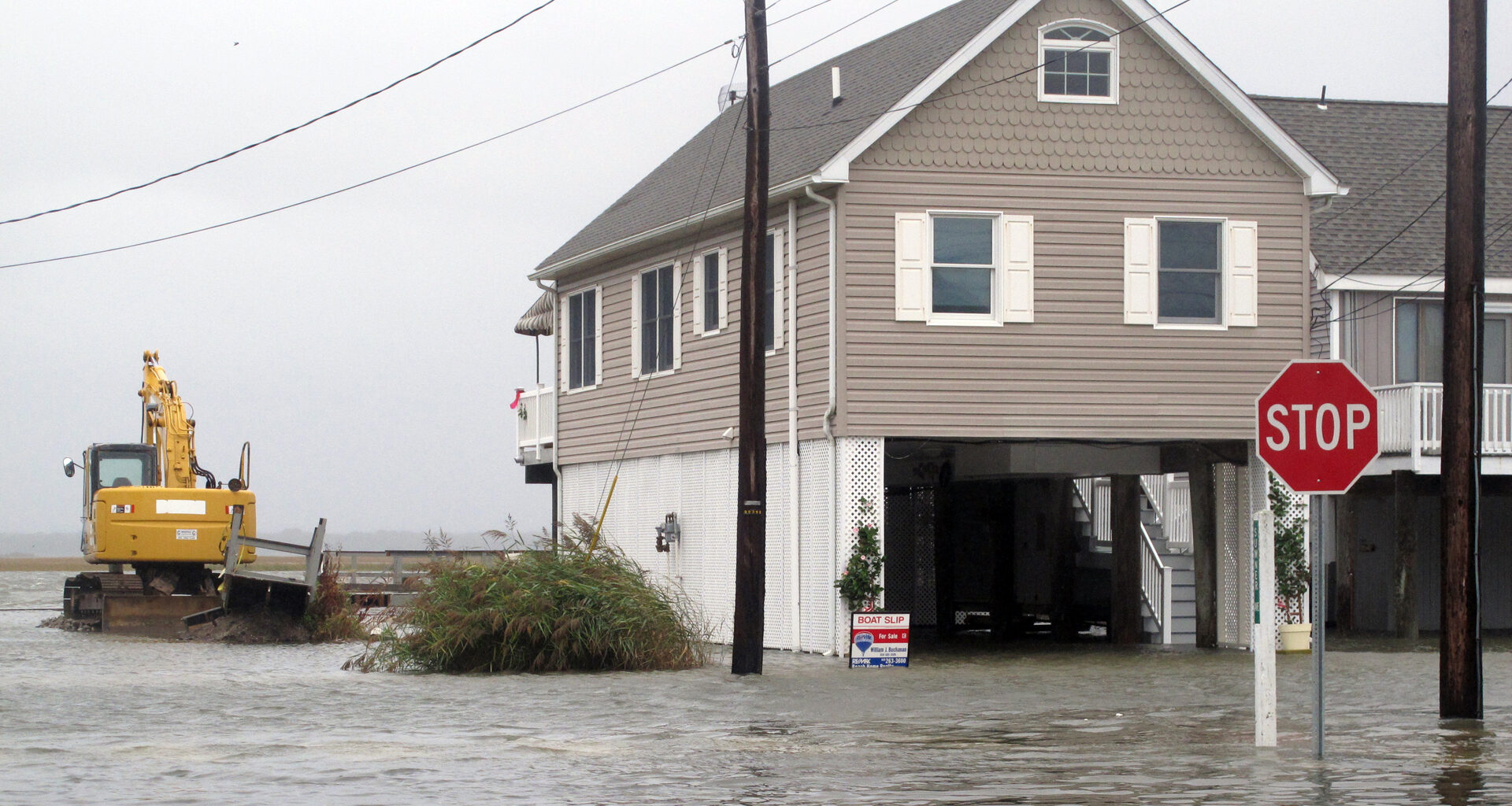
 Credit: (AP Photo/Wayne Parry)
Oct. 2, 2015: A house in the Strathmere section of Upper Township where the neighborhood was enveloped in floodwaters
This article was originally published in South Jersey Climate News, a partner in a collaborative of news organizations working together to provide comprehensive climate change coverage for New Jersey.
Live along the New Jersey coast? Your home could be under floodwaters in the next 75 years.
New Jersey’s Department of Environmental Protection published its proposed New Jersey Protecting Against Climate Threat’s (NJPACT) regulations last August, outlining its policy plan for dealing with climate change in the next 75 years. With the rising issue of sea level rise and extreme weather, the DEP hopes to prepare for worsening climate effects in the future by creating regulations in certain areas today.
The Resilient Environments and Landscapes (REAL) rules, part of NJPACT, would make sweeping changes to current environmental regulations, changing how stormwater is managed, expanding the area of flood-prone zones, requiring higher building elevations and impacting the process of construction approval.
The proposal was applauded by environmental groups for its comprehensive plan of adjustment for climate change in New Jersey, one of the first states in the country to have regulations based on current climate projections.
“NJPACT regulations are focused on looking forward rather than backward,” said Association of New Jersey Environmental Commissions executive director Jennifer Coffey, who served in chief advisory groups throughout the creation of the NJPACT regulations.
“We have been using data from the past to try to predict storm impacts and flooding impacts of the future,” she said. “That doesn’t work anymore because with climate change, the past is no longer a predictor of the future.”
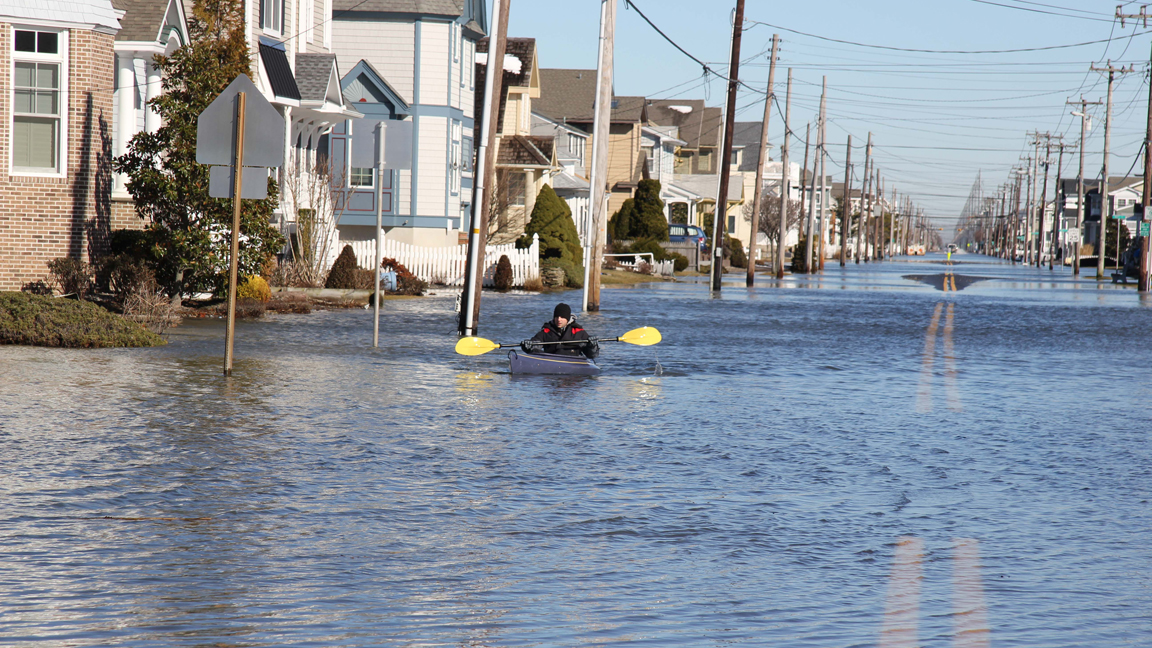 Credit: (AP Photo/Ted Shaffrey)
Jan. 24, 2016: Max Sorensen paddled through his neighborhood in Stone Harbor after flooding caused by a major storm.
While lauded on one side, the proposal also faced opposition, with some residents and business owners arguing that the proposed rules would harm home values, make it difficult to build, and make it harder for new homeowners to find affordable housing. They say a more incremental approach to climate change would be more plausible.
“We applaud the department for wanting to address the very real issue of sea level rise, but what DEP is doing is an extreme position,” said Ray Cantor, vice president of government affairs for the New Jersey Business & Industry Association.
“It’s going to have tremendous impacts on residents everywhere in the state, especially along our water bodies. We think they need to rethink the proposal.”
Cantor was previously chief adviser to the former commissioner of DEP Bob Martin, and leads environmental advocacy efforts for NJBIA, the largest business association in New Jersey.
Significant provisions
While the entire proposal is more than 1,000 pages long, it includes a few key provisions that brought concern to homeowners and developers. The creation of inundated risk zones (IRZs) in flood-prone areas would require these zones to be assessed for flood risk and wetland interference before development can start, which developers say would slow down their ability to construct new buildings. NJPACT would also expand what areas are considered at risk for flooding, including in more inland areas.
“It’s very exciting, because it expands the floodplain maps in a way that is reflective of reality,” Coffey said. “You can no longer say, ‘Oh there’s a probability analysis of a billion-dollar storm happening 1 percent of the time every year.’ It’s now where these storms are going to be happening more, those floodplains have gotten bigger.”
In these zones, a 3% impervious cover standard would be mandated. An impervious cover standard is the amount of space in an area that is not able to absorb rainfall, such as buildings, roads and concrete. This means only 3% of the proposed building area could have impervious cover, and developers must find a way to infiltrate that rainfall back into the ground. Opponents of the rule say having only 3% of a lot would create “no-build zones” in many areas, which DEP has denied.
“We’re not at a point, nor do we think it’s our role, to tell people: ‘Don’t build here, you shouldn’t build there, you can’t do that,’” said DEP Commissioner Shawn LaTourette in an interview with NJ Spotlight News. “It is about making folks assess their risk and recognize the risk they are taking on.” Coffey says these IRZ rules are necessary to control stormwater runoff and minimize future flood damage.
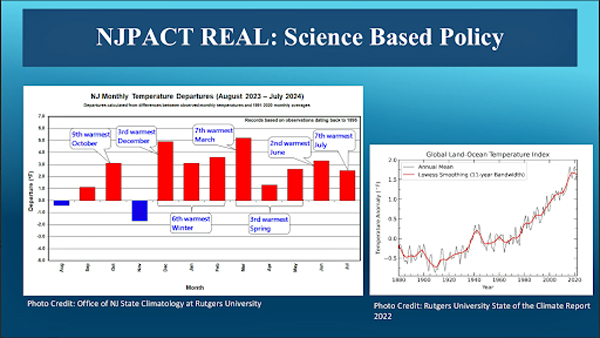
“If you’re in an area that you know is flooding or will flood, you shouldn’t put impervious cover in that area because you’re displacing water and pushing it off to somebody else,” Coffey said. “If you have a glass that’s full of water and you drop a rock in it, which is impervious, you’re displacing water and it’s flowing over onto the table. Same thing happens in a floodplain. So the idea is you’ve got to limit the amount that you are building in an area that is flooding.”
Elevation standards
Another point of contention in the proposed rules is the high elevation standards new buildings in the IRZ would need to adhere to in order to be “floodproof.” Under the new regulations, newly constructed homes and buildings in hazardous areas would need to be raised 5 feet, which some say is an overestimation of the climate predictions the regulations were based on.
The changes in elevation standards were based on predictions by Rutgers University’s Science and Technical Advisory Panel Report in 2019, which states there is a “17% probability that sea level rise will exceed 5.1 feet in New Jersey by the year 2100.” NJBIA says these predictions are overexaggerated and not in line with other environmental groups’ predictions. In a 2022 NOAA report, it was predicted that the sea level in New Jersey would rise between about 2.5 to 3.5 feet by 2100.
“We believe that two feet is a reasonable number. It’s protective, it’s in line with existing science, and we think that’s where DEP should be,” Cantor said.
On the other hand, the DEP and advisers for NJPACT say these projections are quite accurate about future sea level rise, and these provisions are the best way to keep the state safe in the future. The 17% figure represents the chance that sea level will rise more than 5 feet, but an 83% chance the sea will rise at least 5 feet.
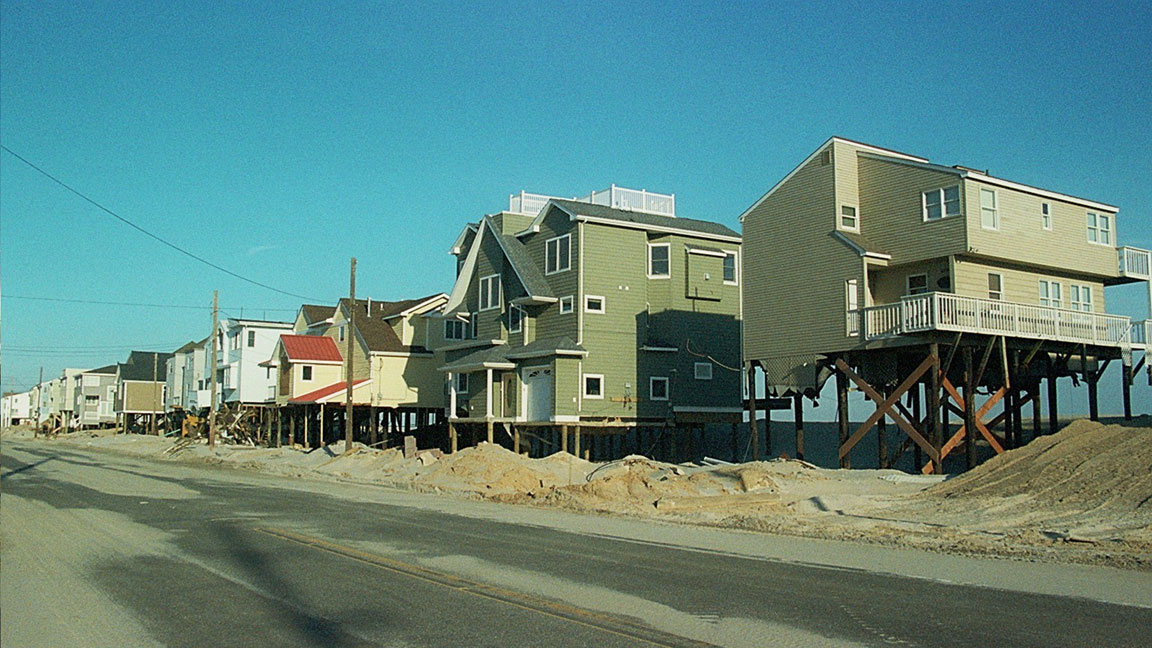 Credit: (inafreeland [Dan] from Flickr)
Houses in Holgate, N.J. were elevated after Superstorm Sandy.
“These projections of 83% of chance that we are going to see at least five feet of sea level rise are based on moderate emission scenarios, which means that we would have to have less greenhouse gas emissions than we’re emitting today,” Coffey said.
Mark Greco, a real estate developer and founder of MLG Realty, recently had to raise a newly purchased property, Ventnor Plaza, after discovering it was built with flood standards of the 1970s, with the pavement in the area only 1 foot above sea level.
“You know, everybody should do it, but I can tell you firsthand, it was enormously expensive,” he said.
Before and after video of Ventnor Plaza lot, which was raised to current flood provisions by 5 feet to add additional businesses like Starbucks; the new construction was built by Roesly General Contracting. Before video courtesy of Mark Greco; after video courtesy of Roesly General Contracting.
While it may be more difficult to raise these larger properties, Greco says it is reasonable for homeowners to raise their homes if need be.
“It’s very realistic. For an average residential home, you’re looking at 100 to $120,000 to pick up your home,” he said. “And there’s several different companies that do that. It’s becoming very common now along the coastline.”
Homeowner concerns
Opponents of the legislation raised concerns about future home values for homeowners, as well as the cost of raising existing homes if the homeowners want to renovate. Any renovation done to a property that would increase a home’s value by 50% or more must adhere to the new elevation standards, with such as roof repairs or replacing windows.
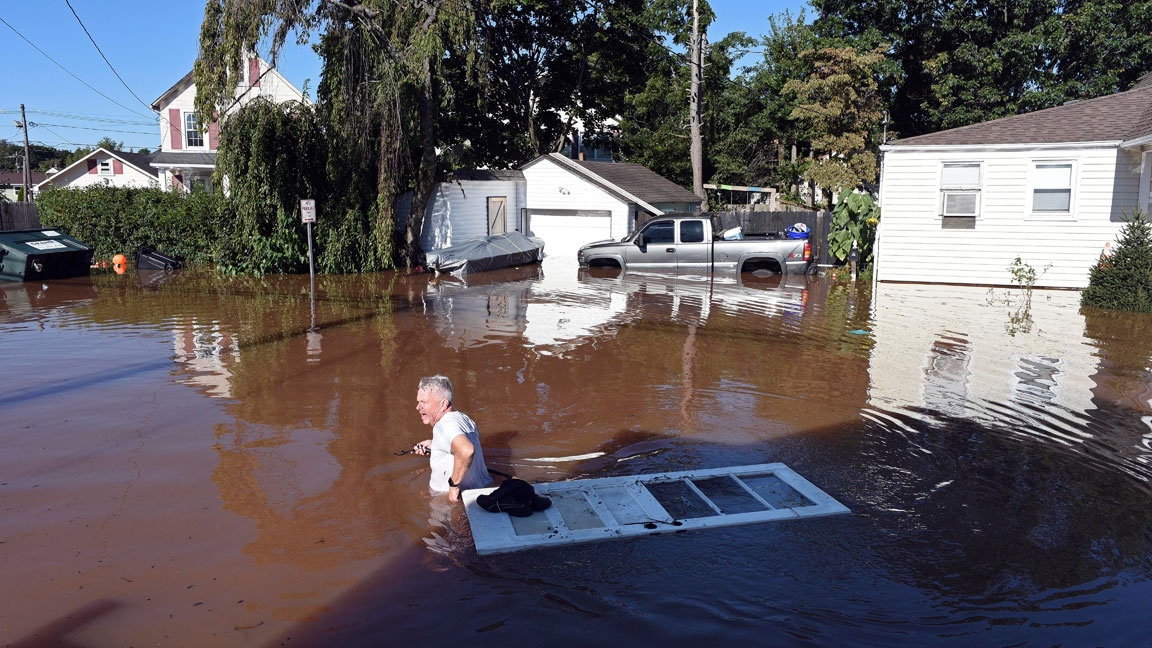 Credit: (AP Photo/Carlos Gonzalez)
Sept. 2, 2021: A man walks in floodwaters in Manville, NJ., in the aftermath of Tropical Storm Ida.
“There are construction exemptions for replacing your roof, replacing your siding, or replacing your windows,” Coffey said. “Say your home is only worth $60,000 or $80,000 and you want to replace the roof or because you’ve got a leak and that would be more than 50% of the value of your home, you have an exemption because those are maintenance.”
Developers are also concerned the new rules will make it difficult to create new housing, which according to New Jersey’s Department of Community Affairs, is necessary for the future. It released calculations earlier this year detailing New Jersey’s need for 146,000 affordable homes, and delaying construction will only make this problem more difficult to deal with.
A better plan?
Associations such as NJBIA have suggested a more incremental plan to deal with these issues and are hopeful that DEP will reconsider.
“A more realistic and likely standard of sea level rise would be a good place to start. I don’t think the 3% [impervious cover standard] makes any sense whatsoever,” said Cantor. “They need to really pull it back and talk to people and basically start from scratch.”
For Coffey, these rules are the only way to ensure New Jersey’s safety in future weather events and to ensure preparedness for the future.
“The status quo is no longer okay. People are losing their lives, they are losing their livelihoods, they are losing their homes,” she said. “We know better, so it’s the time for us to do better.”
The rules have not yet been adopted; the public comment period ended on Nov. 7 after three public hearings. The DEP is now in the process of reviewing public comments as part of the rule adoption and will provide responses to comments submitted by the public as part of the rule adoption. It is expected it will come to a decision by Aug. 5 of next year.