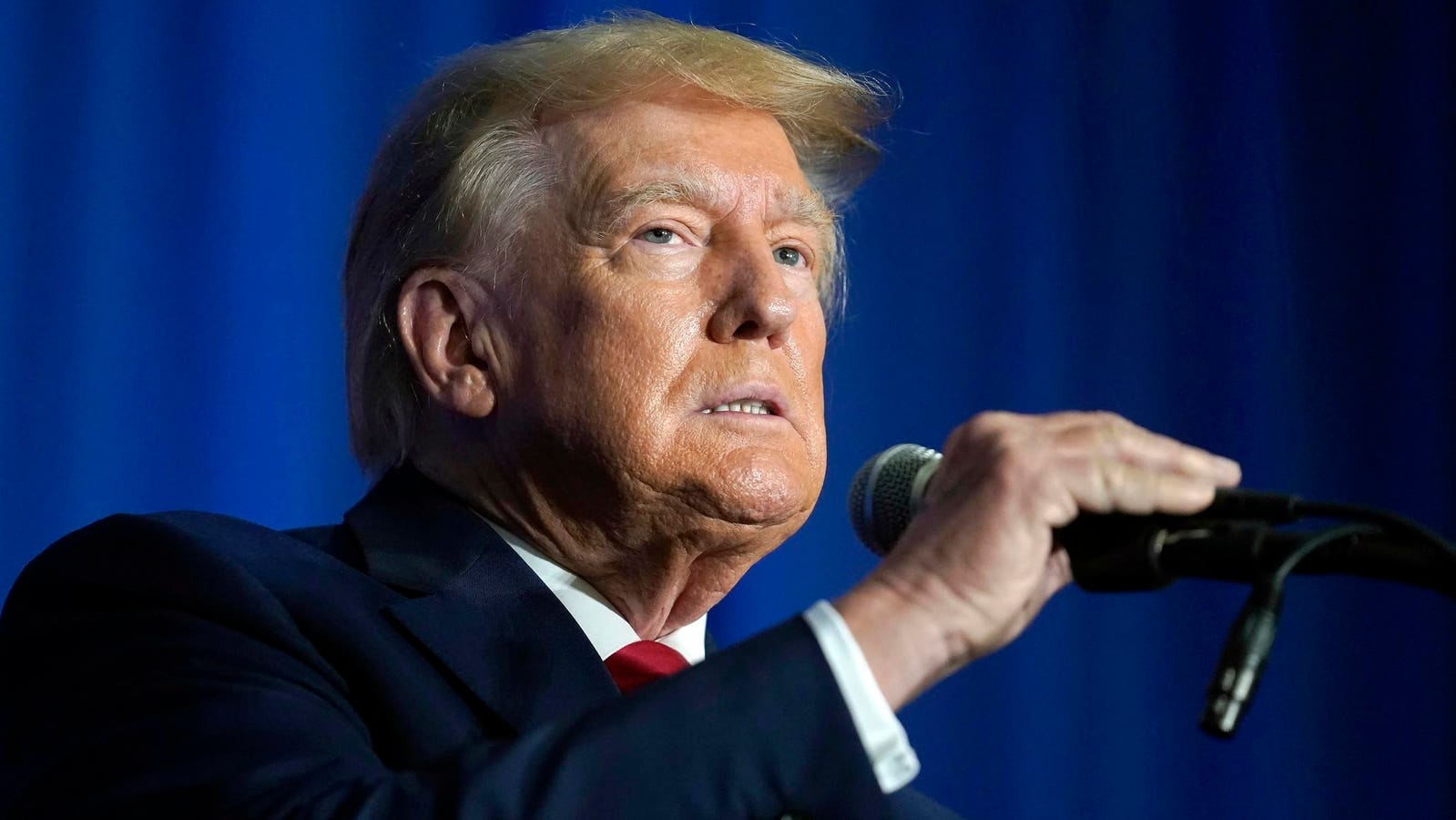
Homeland Security Secretary Kristi Noem did not rule out Sunday that the Trump administration could try to send undocumented immigrants who have committed non-violent crimes like shoplifting to Guantanamo Bay, amid the administration expanding its facilities at the prison complex, as the U.S. carries out what President Donald Trump said would be the “largest deportation operation” in its history.
The White House said the “largest deportation operation” in U.S. history was underway.
Copyright 2023 The Associated Press. All rights reserved
Timeline
Feb. 9When asked on CNN if the Trump administration could send undocumented immigrants found guilty of non-violent offenses—like theft or shoplifting—to Guantanamo Bay, Noem did not rule out the possibility, saying she “doesn’t know what the president will decide” in terms of utilizing the facility for immigration detention and indicating it will have “different levels of incarceration.”
Feb. 7Noem visited Guantanamo Bay as the Trump administration expands its use of the complex to detain undocumented immigrants, creating what The New York Times describes as a “tent city” on the U.S. Navy base, with Noem’s visit coming as more than 30 immigrants, whom the Trump administration said belonged to a Venezuelan gang, were transported to the facility.
Feb. 6The Justice Department filed a lawsuit in the Northern District of Illinois alleging immigration policies in Illinois and Chicago are “designed to and interfere with” the Trump administration’s immigration efforts, as prosecutors requested those policies—including Chicago’s “Welcoming City” ordinance—to be blocked.
Feb. 4Secretary of State Marco Rubio said El Salvador’s President Nayib Bukele proposal to jail deportees, including American convicts, was “a very generous offer,” but added: “There are obviously legalities involved … We’ll have to study it and see how something like that can even be applied,” The New York Times reported.
Feb. 4Leavitt confirmed the first flights of migrants to Guantánamo Bay—where Trump said the U.S. is building a massive facility to house up to 30,000 deported migrants—were underway while speaking on Fox Business, though she did not specify how many people were flown to the naval base or where they will go after that.
Feb. 4In addition to El Salvador agreeing to hold deportees in its prisons, Leavitt said Venezuela “agreed to repatriation flights” and Colombia “agreed to cooperate with the repatriation of illegal Colombian nationals that we have found” in our country.
Feb. 3 Bukele agreed to take in deportees from the U.S. of any nationality, including American criminals, and hold them in the country’s infamous and controversial mega-prison, CECOT, in exchange for a fee that Bukele said “would be relatively low for the U.S. but significant for” El Salvador as part of a way for the U.S. to “outsource part of its prison system.”
Feb 3 Homeland Security Secretary Kristi Noem released an order set to be published in the Federal Register on Wednesday that will remove the temporary protected status designation of an estimated 348,202 Venezuelans, giving them 60 days from when the order is published until they lose the right to work in the U.S.
Jan. 29Defense Department officials said Immigration and Customs Enforcement will house arrested migrants at the Buckley Space Force Base near Aurora, Colorado, as the Denver metro area is reportedly among the initial target areas for ICE arrests.
Jan. 29Trump said he will sign an executive order instructing the Departments of Defense and Homeland Security to construct a facility capable of holding 30,000 deported migrants at Guantánamo Bay naval base as immigration officials have made approximately 6,000 arrests since Trump took office, including 1,016 on Jan. 29, straining Homeland Security’s network of detention facilities that were already nearing capacity before the Trump administration ramped up arrests.
Jan. 27Immigration and Customs Enforcement said it arrested 1,179 people, the largest figure since Trump took office—compared to 308 arrests on Trump’s first full day in office, and 282 arrests per day in September before Trump took over.
Jan. 27Trump, at a conference for House Republicans in Miami, said he wants people who have been arrested “many, many times” to get “the hell out of our country,” suggesting he could pay foreign countries a “small fee” for them to maintain American prisoners so the United States could cut spending on government-owned and private prisons.
Jan. 27Several Quaker groups filed a lawsuit against the Department of Homeland Security over Trump’s decision to end ICE’s prohibition on operating in churches, alleging Trump’s policy “deters congregants from attending services” and “is a violation of every individual’s constitutional right to worship and associate freely,” Skye Perryman, president and CEO of the nonprofit Democracy Forward, which is facilitating legal representation for the plaintiffs, told NBC.
Jan. 26The administration said arrests could pick up quickly: The Washington Post reports ICE officials have been told to aim for 1,200 to 1,500 daily arrests, including at least 75 arrests by each of the agency’s roughly two dozen field offices.
Jan. 26ICE said it launched “enhanced targeted operations” in Chicago in partnership with the FBI and other federal agencies, while immigration enforcement actions were also reported in Atlanta, Puerto Rico, Colorado, Los Angeles and Austin, Texas, according to CNN.
Jan. 26White House Border Czar Tom Homan, who was on the ground in Chicago alongside Acting Deputy Attorney General Emil Bove, told CNN ICE would initially prioritize “criminal aliens” and “as many public safety and national security threats as possible.”
Jan. 26The White House said Colombia backed down from its promise to block military deportation flights, after Trump threatened tariffs and economic sanctions against the country if it did not accept U.S. military planes carrying deported migrants.
Jan. 25Brazil’s Ministry of Foreign Affairs demanded answers over what it said was “degrading treatment” of deportees on a U.S. military flight that arrived there on Jan. 24 carrying 88 passengers, some of whom arrived in handcuffs.
Jan. 21ICE and Border Patrol agents have been ordered to deport people who cross the border without authorization immediately and conduct “expedited removals” for people found within the interior of the United States, CBS reported, while major raids are expected in various cities.
Jan. 20Trump signed a string of executive orders targeting immigration shortly after he was sworn in: The military was ordered to the border, migrants can no longer make advance appointments with border officials, parole programs were suspended and migrants must wait in Mexico while their asylum cases play out.
When Did The Mass Arrests And Deportations Start?
Deportation flights began on Jan. 23 as the “largest deportation operation” in U.S. history was underway, according to the White House. It remains to be seen whether the number of deportations surpass the number under Biden—which was greater than the number under the first Trump administration.
Where Will The Deportations Happen?
The Trump administration is reportedly aiming to make examples of sanctuary cities—which have policies not to cooperate with the federal government on immigration enforcement—by conducting mass arrests there first, according to the Wall Street Journal. NBC lists Chicago, New York, Los Angeles, Denver and D.C. as possible early targets, citing unnamed sources. Cities with large immigration shelter systems, including Los Angeles, Denver and Miami, are also targets, the Journal reported. ICE said it conducted operations in Chicago and Newark, New Jersey, in late January, though it’s not immediately clear whether the operations were linked to the agency’s larger deportation efforts.
Who Is Being Targeted?
Trump has repeatedly emphasized that migrants accused of crimes will be the initial targets for deportation, but he’s also said all migrants in the U.S. illegally could be subject to deportations—and many arrestees reportedly didn’t have criminal records. Homan has said ICE could arrest more undocumented immigrants who aren’t suspected of crimes but were found near people who were ICE targets, a practice known as “collateral arrests.” Meanwhile, the Trump administration expanded a policy that allows federal officials to expedite deportations for migrants who can not prove they have applied for asylum and have been in the U.S. for less than two years. Previously, officials were only allowed to process migrants for expedited removal who were apprehended within 100 miles of the border and could prove they had been in the U.S. for at least two weeks, but the expanded policy applies to the entire U.S. The American Civil Liberties Union has challenged the expanded expedited removal rule in court.
Why Are ‘mass Deportations’ Difficult?
While Trump has said the deportations would begin “very quickly,” some of the operations will likely require Congress to approve additional funding, as ICE already faces a budget shortfall to maintain existing deportation levels in the current spending plan that expires on March 14, according to NBC. There are also a limited number of beds to hold people in pre-deportation and planes to use for deportation flights, though Trump ordered the military to assist with aircraft and detention space—and removals are only possible if countries are willing to accept deportees, posing a challenge as some countries like Colombia push back.
How Are Local Officials Preparing?
Leaders in sanctuary cities are taking a mixed approach. Some, including in New York City and Philadelphia, have softened their rhetoric against Trump’s hardline immigration policies, apparently aware that criticizing the initiatives could make them targets for raids. Philadelphia Mayor Cherelle Parker and District Attorney Larry Krasner did not answer directly when asked by NBC in recent days whether the city was a sanctuary city, for example. New York City Mayor Eric Adams has continued to own the label, but he has criticized the Biden administration as the city has dealt with an influx of migrants over the past year. Other local leaders in sanctuary cities, including in Chicago and Denver, have doubled down on their vows to protect migrants in the wake of Trump’s election. Denver Mayor Mike Johnston suggested that citizens and local police could team together to physically prevent ICE arrests, he told the Denverite.
Have Citizens Been Caught Up In Raids?
Newark Mayor Ras Baraka said on Jan. 23 that ICE agents raided a “local establishment” without a warrant and detained “undocumented residents” as well as some U.S. citizens. Among the detainees was a U.S. military veteran, who Baras said “suffered the indignity of having the legitimacy of his military documentation questioned.” ICE reportedly said the agency may encounter U.S. citizens while conducting operations and may request identification to “establish an individual’s identity,” citing the Newark raid.
Do Churches Provide Cover For Mass Deportations?
No. The Trump administration announced on Jan. 21 it was cancelling a policy preventing ICE from making arrests in schools, churches and hospitals. The administration has also indicated it could conduct raids at workplaces, a tactic the Biden administration typically avoided.
How Does The Laken Riley Act Impact Deportations?
It subjects more people to immediate deportations by instructing federal officials to detain and deport undocumented migrants accused of minor crimes, such as shoplifting, before they’re actually convicted. It’s unclear how quickly ICE can begin implementing the law, which passed Congress on Jan. 22, as the agency has said it needs an additional $27 billion in funding to carry out the new measures.
What Special Powers Has Trump Given Law Enforcement To Deport People?
In addition to empowering ICE to raid previously protected venues, Trump ordered the FBI, DEA, ATF, U.S. Marshals and the Bureau of Prisons to scan their databases for information on the possible whereabouts and identities of undocumented migrants in the U.S. The president also instructed federal officials to investigate local authorities that interfere with the new anti-immigration measures, according to a Justice Department memo sent Jan. 21 and obtained by NBC News.
How Is Mexico Preparing For Mass Deportations?
Border towns have begun to erect tents where migrants who travel to the border and realize they can not cross under the new Trump-era restrictions can take refuge, The Associated Press reported. The Mexican government is building shelters in nine border cities to receive deportees and will bus some people to their home cities, according to the AP. Mexico also initially refused to take a deportation flight—along with Colombia—though administration officials say it was later cleared up, according to multiple reports.
How Much Will Mass Deportations Cost?
The pro-immigration American Immigration Council estimates a one-time push to deport all 11 million undocumented immigrants would cost $315 billion, while deporting one million people a year would cost $88 million annually. The operation could also have economic impacts, the group notes, including lost tax revenue, less consumer spending and labor shortages—especially in industries like agriculture and construction. Trump has defended the costs, saying there is “no price tag” for his mass deportation plans and “we have no choice.”
Further Reading
House Passes Laken Riley Act—Likely First Bill Trump Signs Into Law (Forbes)
Can Trump End Birthright Citizenship? What To Know After Judge Blocks Executive Order (Forbes)