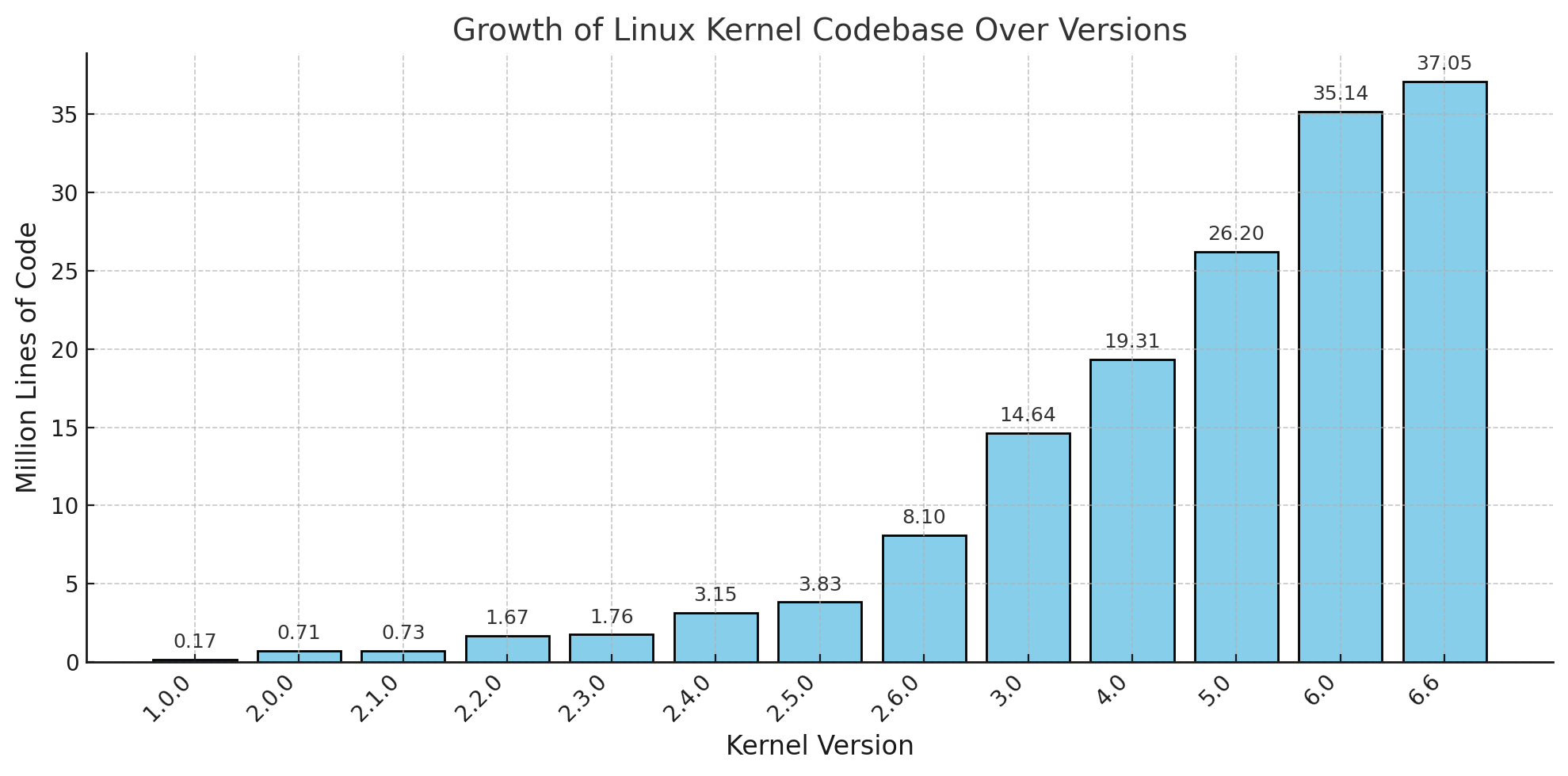
Simple graph I made to replace a graph that was broken on a wikipedia page.
“If I Had More Time, I Would Have Written a Shorter Letter”
This follows Moores law better than Intel’s chips.
Most of that is drivers that are only loaded if the hardware is detected.
I wonder how much of this is actually executed on any specific installation. My understanding is a very large portion of the kernel code now is drivers
2.2 to 2.4 was WILD TIMES. Things got serious real quick, and a whole bunch of hardware became functional due to driver development. It was quite a big deal. Back then, the ‘odd minor releases’ (e.g. 2.5.x) were development while evens (2.6.x) were production, and there would be YEARS of anticipation waiting for a new stable minor (bugfix releases like 2.6.10 -> 2.6.11 were common).
There was also a big schism around that time when the main compiler forked between GCC and EGCS, and EGCS ended up ‘winning’ and becoming GCC 2.95 and onwards (if I recall correctly).
Thangs have come such a long way, but back then it would be really weird and special if someone was contributing to the kernel using their official work email address, Linux was an upstart threat to entrenched enterprise operating systems, and most for-profit companies were outright hostile to it.
![[OC] Linux Kernel sizes in millions of lines of code](https://www.europesays.com/wp-content/uploads/2025/02/fwhl4wzwvlie1-1920x980.png)
7 comments
Source data: [https://en.wikipedia.org/wiki/Linux_kernel](https://en.wikipedia.org/wiki/Linux_kernel)
Made by me, using matplotlib, was my first time, used a tutorial.
Simple graph I made to replace a graph that was broken on a wikipedia page.
“If I Had More Time, I Would Have Written a Shorter Letter”
This follows Moores law better than Intel’s chips.
Most of that is drivers that are only loaded if the hardware is detected.
I wonder how much of this is actually executed on any specific installation. My understanding is a very large portion of the kernel code now is drivers
2.2 to 2.4 was WILD TIMES. Things got serious real quick, and a whole bunch of hardware became functional due to driver development. It was quite a big deal. Back then, the ‘odd minor releases’ (e.g. 2.5.x) were development while evens (2.6.x) were production, and there would be YEARS of anticipation waiting for a new stable minor (bugfix releases like 2.6.10 -> 2.6.11 were common).
There was also a big schism around that time when the main compiler forked between GCC and EGCS, and EGCS ended up ‘winning’ and becoming GCC 2.95 and onwards (if I recall correctly).
Thangs have come such a long way, but back then it would be really weird and special if someone was contributing to the kernel using their official work email address, Linux was an upstart threat to entrenched enterprise operating systems, and most for-profit companies were outright hostile to it.
Comments are closed.