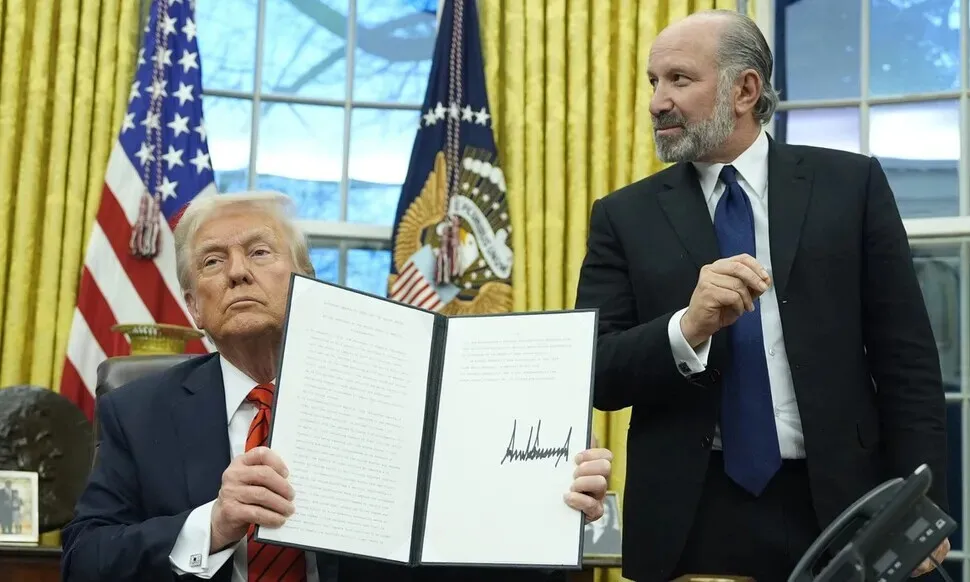
On Feb. 10, 2025 (local time), US President Donald Trump holds up an order adjusting tariffs on steel imports to the US as Commerce Secretary Howard Lutnick looks on. (AP/Yonhap)
After US President Donald Trump pledged to levy a 25% tariff on steel and aluminum imports starting March 12, American trade partners have been jostling to get an exemption.
As China — the main target of Trump’s trade war — mulls its options, some think this could lead to a wholesale transformation of the international trade order, which is currently oriented on free trade.
While only a month remains before the tariffs on steel products go into effect, Korean diplomats remain hobbled in the aftermath of President Yoon Suk-yeol’s short-lived martial law declaration on Dec. 3, leaving Koreans even more frustrated and anxious.
Japanese Chief Cabinet Secretary Yoshimasa Hayashi announced Wednesday that the Japanese government had “asked the US to exempt Japan” from the new tariffs. European Commission President Ursula von der Leyen expressed deep regret Tuesday for the US’ decision to impose tariffs and promised “firm and proportionate countermeasures.” But she also met with US Vice President JD Vance, indicating that the EU is seeking a negotiated solution. This flurry of moves from governments around the world was prompted by reports that Trump is looking into giving Australia a tariff waver.
The top priority for Korea is to gain an exemption through negotiations as it did during Trump’s first term in office.
Korea’s acting president, Choi Sang-mok (deputy prime minister and minister of finance and economy), said in a Tuesday meeting about international economic issues that the government would pursue deliberations with the US. “Concerns about changes in the US’ tariffs policy are being borne out,” Choi remarked.
But given the protracted political vacuum resulting from Yoon’s martial law declaration and subsequent impeachment, Trump’s preferred summit diplomacy is currently out of the question.
“For Korea to get an exemption or deferral for sanctions through negotiations with the US, it needs to have meaningful chips to put on the table. But there also needs to be a social consensus about what chips it can play. That kind of comprehensive deal is impossible and must not be attempted,” said Jee Man-soo, a senior analyst at the Korea Institute of Finance.
Under the current circumstances, Korea is inevitably a low priority for Trump’s foreign policy.
Korean Foreign Minister Cho Tae-yul had intended to visit Washington early in February but was unable to arrange a meeting with US Secretary of State Marco Rubio. Instead, the two are coordinating a face-to-face meeting during the Munich Security Conference, which will be held in Germany this weekend.
Trump hasn’t even had a phone call with Korea’s acting president — a sharp contrast with Trump’s chummy in-person summit with Japanese Prime Minister Shigeru Ishiba on Feb. 7.
Some see a silver lining in Korea being temporarily off Trump’s radar screen in his first weeks in office. But since the timeframe for imposing tariffs on steel imports has been set as March 12, more people are expressing concern.
“While summit diplomacy isn’t feasible, we have at least until March 12. Working-level officials will do their best to negotiate with the US and work on a response. When Cho and Rubio have their meeting in Munich, the foreign minister will focus on negotiating the tariff issue in the time that remains after a discussion about the North Korean nuclear issue,” an official from the Ministry of Foreign Affairs said.
And since China is the chief target of Trump’s tariffs, it’s also critical for South Korea to figure out exactly what strategy China means to adopt.
The question of how China will respond to Trump’s onslaught is a major factor that will determine the course of international trade. But there’s little chance of Kim Dae-ki’s nomination as ambassador to China being approved during Yoon’s impeachment trial. Seoul’s current ambassador to Beijing, Chung Jae-ho, who studied with Yoon at Choongam High School, returned to Korea on Jan. 31.
Experts warn that Trump’s steel and aluminum tariffs might be just the prelude of a massive and ferocious trade war that Korea will have to brave going forward. The “America First Trade Policy” memo that Trump sent out on the day of his inauguration, on Jan. 20, requires a variety of reports about trade to be submitted by April 1. Those reports could lead to even harsher demands being placed on Korea, Europe and Japan.
“The US and China are still in an exploratory phase. If the US launches a full-fledged trade war against China’s overproduction of electric vehicles or state-owned enterprises, that could disrupt the entire international trading system and could lead the US to treat the whole world like China. We need to adequately prepare for that kind of contingency,” said Jee, the finance analyst.
By Park Min-hee, senior staff writer
Please direct questions or comments to [english@hani.co.kr]