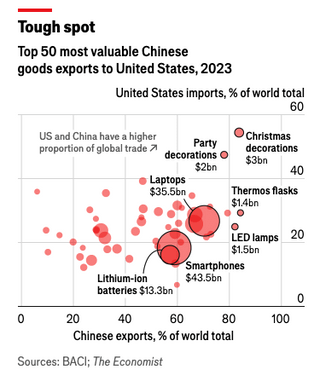
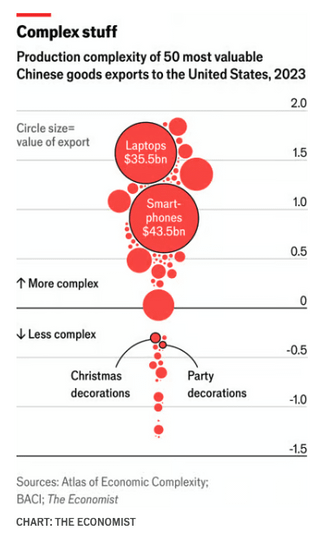
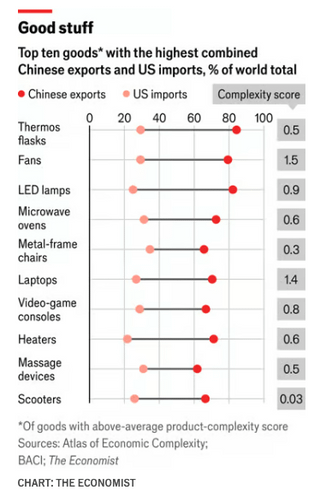
[OC] With his additional 10% tariff on all Chinese goods, President Donald Trump has reignited the trade war between the world’s two largest economies. The impact on trade will be far-reaching, but not uniform. Our charts below show which goods are likely to be the most affected by the opening salvo.
In brief, prices depend on alternatives: and our chart suggest where such alternatives outside China are more or less likely to be available. When China and America both represent a large portion of world exports / imports, they are harder to find, especially when goods are more complex to make (countries other than China may more easily pick up production of Christmas decorations — that is harder to do for laptops and smartphones).
(Even when alternatives are found, they are likely to be worse in terms of price or quality (as they were not preferred before the tariff).)
Tools used: R, Illustrator
Sources: BACI, Atlas of Economic Complexity
Have you noticed any price changes recently for these goods? Let me know and I might look into it.
Oh so now there’s a real war on Christmas
Huh, I wonder if this means that jobs will move from China to Vietnam (which is already happening to some degree with smartphones) or another part of South East Asia as the cost of manufacturing these parts increase. They certainly aren’t coming back to the USA.
Christmas decorations about to get a whole lot more expensive.
Do smartphones include iPhones after being made in China?
Massage devices????!!! Hmmm.
let’s not talk about soy and how US farmers were fucked by tariffs last time and in the end were bailed out with billions of tax dollars
Anything production can be set up somewhere else. The real big risk is that China will restrict the supply of rare elements.
8 comments
[OC] With his additional 10% tariff on all Chinese goods, President Donald Trump has reignited the trade war between the world’s two largest economies. The impact on trade will be far-reaching, but not uniform. Our charts below show which goods are likely to be the most affected by the opening salvo.
In brief, prices depend on alternatives: and our chart suggest where such alternatives outside China are more or less likely to be available. When China and America both represent a large portion of world exports / imports, they are harder to find, especially when goods are more complex to make (countries other than China may more easily pick up production of Christmas decorations — that is harder to do for laptops and smartphones).
(Even when alternatives are found, they are likely to be worse in terms of price or quality (as they were not preferred before the tariff).)
Tools used: R, Illustrator
Sources: BACI, Atlas of Economic Complexity
Free to read here: [https://econ.st/4gHRDU9](https://econ.st/4gHRDU9) & [https://econ.st/3CODSFg](https://econ.st/3CODSFg) & [https://econ.st/42VTDVw](https://econ.st/42VTDVw)
Permanent link here: [https://www.economist.com/graphic-detail/2025/02/12/which-goods-are-most-vulnerable-to-american-tariffs-on-china](https://www.economist.com/graphic-detail/2025/02/12/which-goods-are-most-vulnerable-to-american-tariffs-on-china)
Have you noticed any price changes recently for these goods? Let me know and I might look into it.
Oh so now there’s a real war on Christmas
Huh, I wonder if this means that jobs will move from China to Vietnam (which is already happening to some degree with smartphones) or another part of South East Asia as the cost of manufacturing these parts increase. They certainly aren’t coming back to the USA.
Christmas decorations about to get a whole lot more expensive.
Do smartphones include iPhones after being made in China?
Massage devices????!!! Hmmm.
let’s not talk about soy and how US farmers were fucked by tariffs last time and in the end were bailed out with billions of tax dollars
Anything production can be set up somewhere else. The real big risk is that China will restrict the supply of rare elements.
Comments are closed.