
My maternal grandparents immigrated from a small town in Southern Italy called Alife. It’s located in the Province of Caserta (Campania), a beautiful place that sits in a valley surrounded by the Matese Mountains. I have been blessed to visit the town of my ancestors many times. While I am eager to share stories of my first visit in 1988, at the age of 24, this article focuses on an amazing discovery I believe is divine in nature.
This article appeared in the February 2025 edition of La Nostra Voce, ISDA’s monthly newspaper that chronicles Italian American news, history, culture and tradition. Subscribe today
This past fall I was taking Italian lessons, and for an assignment, I decided to report on Alife. The town is surrounded by a Roman wall with four gates — Porta Napoli, Porta Piemonte, Porta Roma, and Porta Fiume — that remain intact to this day. While researching these structures, I stumbled upon an article titled The Alife Arch App. To my astonishment, it discussed an ancient archivolt, a decorative carving from the 1100s, housed at the Nasher Museum of Art at Duke University in North Carolina.
What made this discovery extraordinary was the archivolt’s origin: it once adorned the Cathedral of Santa Maria Assunta in Alife, the very church where my grandparents were married. Built in 1132, the cathedral originally housed two archivolts; however, in the early 1920s, one was removed and eventually became part of the Brummer Collection, purchased by Duke University in 1966, to establish what is now the Nasher Museum of Art.
 Marla Monzo-Holmes’ grandchildren pose beneath the archivolt at the Nasher Museum of Art at Duke University, an artifact that was housed for centuries in the Cathedral of Santa Maria Assunta in Alife, Italy.
The realization that this artifact, tied to my family’s history, was housed just two hours from my home in North Carolina left me awestruck. I immediately contacted Professor Caroline Bruzelius, an art historian and medieval architecture expert at Duke. She responded enthusiastically, calling Alife “a charming place that still preserves the Roman city grid from its foundation.”
Shortly after this discovery, I traveled to Alife and experienced an unforgettable moment. Attending Mass with my Zia Rosa at the Cathedral of Santa Maria Assunta, I stood beneath the remaining archivolt, marveling at its intricate craftsmanship and nearly 1,000-year history. Knowing its twin rested in North Carolina deepened the emotional significance of the experience.
As we exited the church, fate had another surprise in store. My Zia introduced me to a distant cousin who remembered my grandmother, Elisa Angellio DiCaprio. He shared how, during the hardships of post-war Southern Italy, my grandmother would send letters with a few dollars enclosed. Those few dollars, worth much more at the time, made all the difference for his family. Hearing this story brought tears to my eyes. My grandmother’s kindness and sacrifice left a lasting impact that transcended time.
But the surprises didn’t end there. I also met Mr. Gianni Parisi, founder of the Archeo Club of Alife, an organization dedicated to preserving the town’s archaeological treasures. When I shared a photo of the archivolt at Duke, he was stunned. Through my cousin Vittorio, who translated for us, I learned that Mr. Parisi had been trying unsuccessfully to contact Duke about the archivolt’s journey from Alife to North Carolina. Seeing the photo, which included my grandchildren standing under the artifact, brought him immense joy.
Mr. Parisi invited my husband and me to the Archeo Club headquarters, where he presented us with gifts and took several photos to commemorate the moment. He later contacted Professor Bruzelius, hoping to collaborate on creating a replica of the archivolt to return to Alife. If this project comes to fruition, it will be a momentous occasion for the town — an event I would be honored to attend.
Upon returning to North Carolina, I visited the Nasher Art Museum with my husband and mother. Seeing the archivolt in person was a deeply emotional experience. Standing before it, I reflected on its odyssey from the Cathedral of Santa Maria Assunta to Duke University and the incredible connection it symbolized between my two homes.
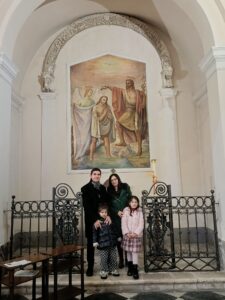 Marla Monzo-Holmes’ cousin Vittorio with his wife, Angela, and their two daughters standing under the Archivolt that remains at Santa Maria Assunta in Alife.
Each time I visit Alife, I uncover new stories and connections that deepen my bond with this remarkable town. My relationships with my Zia Rosa, my cousins, and the broader Alife community remind me that family and history transcend physical distance.
The archivolt discovery reaffirmed what I have always felt: my heart belongs to two places. Alife is where my roots run deep, and North Carolina is where I now call home. The ties that bind these two places feel divinely inspired, and they continue to remind me of the enduring legacy of my ancestors.