Since I’m from Texas, I know that state-wide statistics can hide variation between different regions in Texas. I found data from the Texas Department of State Health Services on county-level vaccination coverage for the 2023-2024 school year.
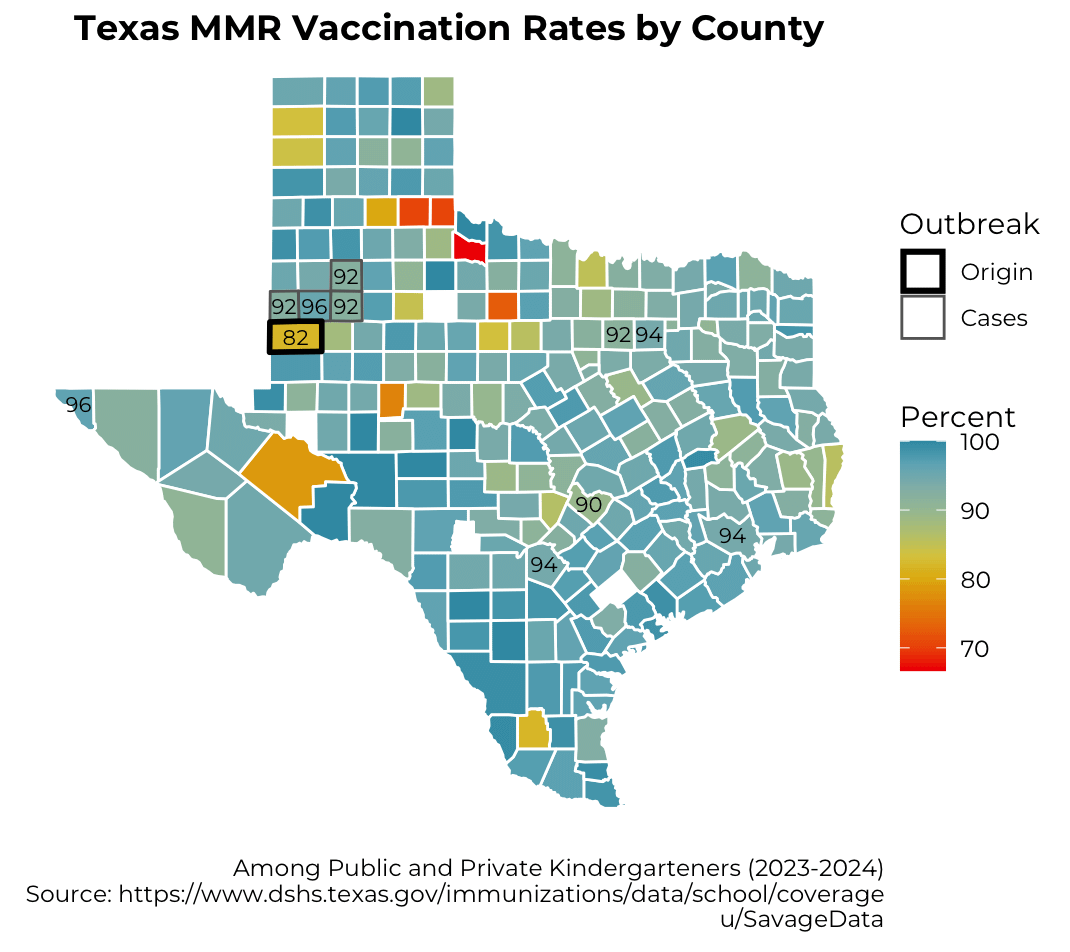
My graph shows MMR (Measles, Mumps, and Rubella) vaccination percentages for children who attended public or private kindergarten. Homeschooled children were not included.
Gaines County, outlined in black, is the center of the Measles outbreak with 45 cases. The surrounding counties of Terry, Yoakum, Lynn, and Lubbock, outlined in grey, have an additional 13 cases combined.
I’ve overlayed the MMR vaccination percent over the counties involved in the outbreak, as well as several major Texas cities for comparison. Counties that are filled in white did not report data.
Surprises:
* I did not realize that Gaines County, the center of the outbreak, had such a drastically lower vaccination rate, at only 82% compared to the state average of 94%. It has the 10th worst rate out of 250 reporting counties.
* Shoutout to Terry, Yoakum, Lynn, and Lubbock counties whose vaccination rate was actually 92-96% (higher than Austin). I’m sorry I doubted you because you’re in West Texas. It does show how an outbreak can spread to vaccinated regions.
* I expected more contrast between urban and rural counties, but the big cities only had average vaccination rates, except for El Paso at 96%.
* There’s a hotspot with even lower vaccination rates in the Texas panhandle, southeast of Amarillo. Foard county leads the pack at only 67%.
So what’s the deal with Hall, Childress, and Foard counties? Just extremely small populations?
great work! if would be interesting if the 100% vaccination rate areas had some different color all together, e.g. purple
Weird, IIRC enrolling in the local ISD and in Texas daycares I needed proof of vaccination and records sent to registrar. Not sure what exceptions were given in these West TXT counties.
On one hand, I’m surprised the low end of the scale is still ~70%. My fear was that it would have been much much lower.
On the other, is 70% enough for herd immunity to work? Maybe someone who knows more about this could shed some light.
Can you compare this to the population of Mennonites in these counties.
Houston ISD has about 36K kids around kindergarten age. They also have a high MMR coverage of 93%. But that 7%… That’s over 2500 kids who are not protected. They’re probably all in pockets around the city (church, parent belief, etc). They get hit, we’re talking AT LEAST two or three dead, AT LEAST 2 or 3 with SPSS later in life, and dozens hospitalized.
So, while you may have 82% in that one county, which is worrying, the absolute population of kids at risk there might not be as big as in an urban area.
I made this map in R using school district level data (kindergarten age and first grade age) for a policymaker looking at risk modeling. (Lots of school districts and private schools do not report their vaccine coverage.) See that square district just south of where the cases are right now? That’s Ector County ISD. MMR coverage there is 91%, but they have a lot of students, making that 9% unprotected from measles a prime target in this epidemic.
Disclaimer: I’m an epidemiologist, not a cartographer, so sorry for the map.
7 comments
I was inspired by the post [Childhood vaccination trends in the US](https://www.reddit.com/r/dataisbeautiful/comments/1italu2/childhood_vaccination_trends_in_the_us_oc/) which showed that Texas has a slightly above-average vaccination rate.
Since I’m from Texas, I know that state-wide statistics can hide variation between different regions in Texas. I found data from the Texas Department of State Health Services on county-level vaccination coverage for the 2023-2024 school year.
My graph shows MMR (Measles, Mumps, and Rubella) vaccination percentages for children who attended public or private kindergarten. Homeschooled children were not included.
Gaines County, outlined in black, is the center of the Measles outbreak with 45 cases. The surrounding counties of Terry, Yoakum, Lynn, and Lubbock, outlined in grey, have an additional 13 cases combined.
I’ve overlayed the MMR vaccination percent over the counties involved in the outbreak, as well as several major Texas cities for comparison. Counties that are filled in white did not report data.
Surprises:
* I did not realize that Gaines County, the center of the outbreak, had such a drastically lower vaccination rate, at only 82% compared to the state average of 94%. It has the 10th worst rate out of 250 reporting counties.
* Shoutout to Terry, Yoakum, Lynn, and Lubbock counties whose vaccination rate was actually 92-96% (higher than Austin). I’m sorry I doubted you because you’re in West Texas. It does show how an outbreak can spread to vaccinated regions.
* I expected more contrast between urban and rural counties, but the big cities only had average vaccination rates, except for El Paso at 96%.
* There’s a hotspot with even lower vaccination rates in the Texas panhandle, southeast of Amarillo. Foard county leads the pack at only 67%.
Tools: R, ggplot
Data Source: [https://www.dshs.texas.gov/immunizations/data/school/coverage](https://www.dshs.texas.gov/immunizations/data/school/coverage)
So what’s the deal with Hall, Childress, and Foard counties? Just extremely small populations?
great work! if would be interesting if the 100% vaccination rate areas had some different color all together, e.g. purple
Weird, IIRC enrolling in the local ISD and in Texas daycares I needed proof of vaccination and records sent to registrar. Not sure what exceptions were given in these West TXT counties.
On one hand, I’m surprised the low end of the scale is still ~70%. My fear was that it would have been much much lower.
On the other, is 70% enough for herd immunity to work? Maybe someone who knows more about this could shed some light.
Can you compare this to the population of Mennonites in these counties.
Houston ISD has about 36K kids around kindergarten age. They also have a high MMR coverage of 93%. But that 7%… That’s over 2500 kids who are not protected. They’re probably all in pockets around the city (church, parent belief, etc). They get hit, we’re talking AT LEAST two or three dead, AT LEAST 2 or 3 with SPSS later in life, and dozens hospitalized.
So, while you may have 82% in that one county, which is worrying, the absolute population of kids at risk there might not be as big as in an urban area.
I made this map in R using school district level data (kindergarten age and first grade age) for a policymaker looking at risk modeling. (Lots of school districts and private schools do not report their vaccine coverage.) See that square district just south of where the cases are right now? That’s Ector County ISD. MMR coverage there is 91%, but they have a lot of students, making that 9% unprotected from measles a prime target in this epidemic.
Disclaimer: I’m an epidemiologist, not a cartographer, so sorry for the map.
https://preview.redd.it/0oz4vw1a67ke1.png?width=1353&format=png&auto=webp&s=c427527fc281d21a6103eff12f672c52f3bb6055
Comments are closed.