 사진 확대
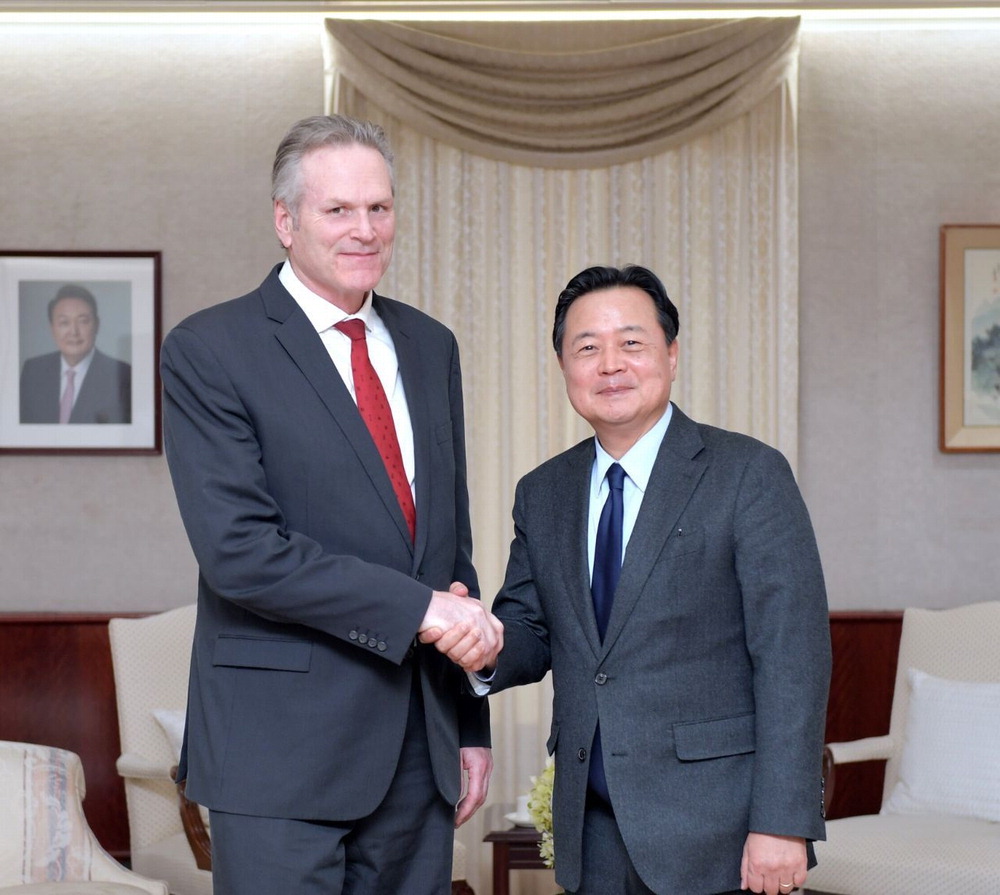
사진 확대 Ambassador to the United States Cho Hyun-dong (right) and Alaska Governor Mike Dunleavy met at the Korean Embassy in Washington, DC on the 19th (local time). Korean Embassy in the U.S.
Alaska’s liquefied natural gas (LNG) is emerging as an important “card” in future tariff negotiations between South Korea and the United States. Following a recent request for direct LNG investment by a senator from Alaska to South Korean lawmakers, the governor of Alaska met with the South Korean ambassador to the United States to discuss ways to cooperate.
Page A1 and 6 of February 21
On the 20th (local time), the Embassy of the United States announced that Ambassador Cho Hyun-dong met with Alaska Governor Mike Dunleavy on the 19th to discuss ways to cooperate with Alaska LNG. Ambassador Cho emphasized reciprocal trade relations between Korea and Alaska and discussed cooperation measures based on the Alaska LNG project, the embassy said on social network services (SNS).
The U.S. delegation, including Cho Kyung-tae, a member of the People’s Power, and Chung Dong-young, a member of the Democratic Party of Korea who visited Washington and New York from the 10th to the 16th, met with Senator Dan Sullivan (Republican) to discuss LNG investment. Sullivan asked South Korea to import more Alaskan LNG and participate in Alaska’s LNG gas pipeline installation project.
Sullivan said at a seminar on the 5th that the U.S. could reduce its trade deficit by $10 billion (about 14.4 trillion won) annually by exporting Alaskan LNG to South Korea, Japan, and Taiwan.
Attention is focusing on whether the government will present energy-related cooperation such as LNG as a future bargaining chip in addition to the shipbuilding industry to ease U.S. President Donald Trump’s trade pressure. U.S. energy imports are seen as a major alternative to South Korea, which has a trade surplus with the U.S., at a time when the U.S. has announced tariffs to address its trade deficit. The government is reportedly carefully reviewing the possibility of participating in the Alaska gas project. Japan, which, like Korea, has a trade surplus with the U.S., decided to expand imports of U.S.-Japan LNG at the U.S.-Japan summit in Washington, DC on the 7th to discuss joint ventures related to Alaska oil and LNG. Taiwan is also considering participating in the project.
[Washington correspondent Choi Seungjin / Seoul reporter Kim Sangjoon]