From reproductive rights to climate change to Big Tech, The Independent is on the ground when the story is developing. Whether it’s investigating the financials of Elon Musk’s pro-Trump PAC or producing our latest documentary, ‘The A Word’, which shines a light on the American women fighting for reproductive rights, we know how important it is to parse out the facts from the messaging.
At such a critical moment in US history, we need reporters on the ground. Your donation allows us to keep sending journalists to speak to both sides of the story.
The Independent is trusted by Americans across the entire political spectrum. And unlike many other quality news outlets, we choose not to lock Americans out of our reporting and analysis with paywalls. We believe quality journalism should be available to everyone, paid for by those who can afford it.
Your support makes all the difference.
Read more
Germany’s far-right AfD party looks set to make large gains when the country heads to the polls on Sunday.
The centre-right Christian Democrats (CDU/CSU) look set to once again become the largest party in the Bundestag with 220 seats, allowing them to reinstall their first chancellor since Angela Merkel stepped down in 2021.
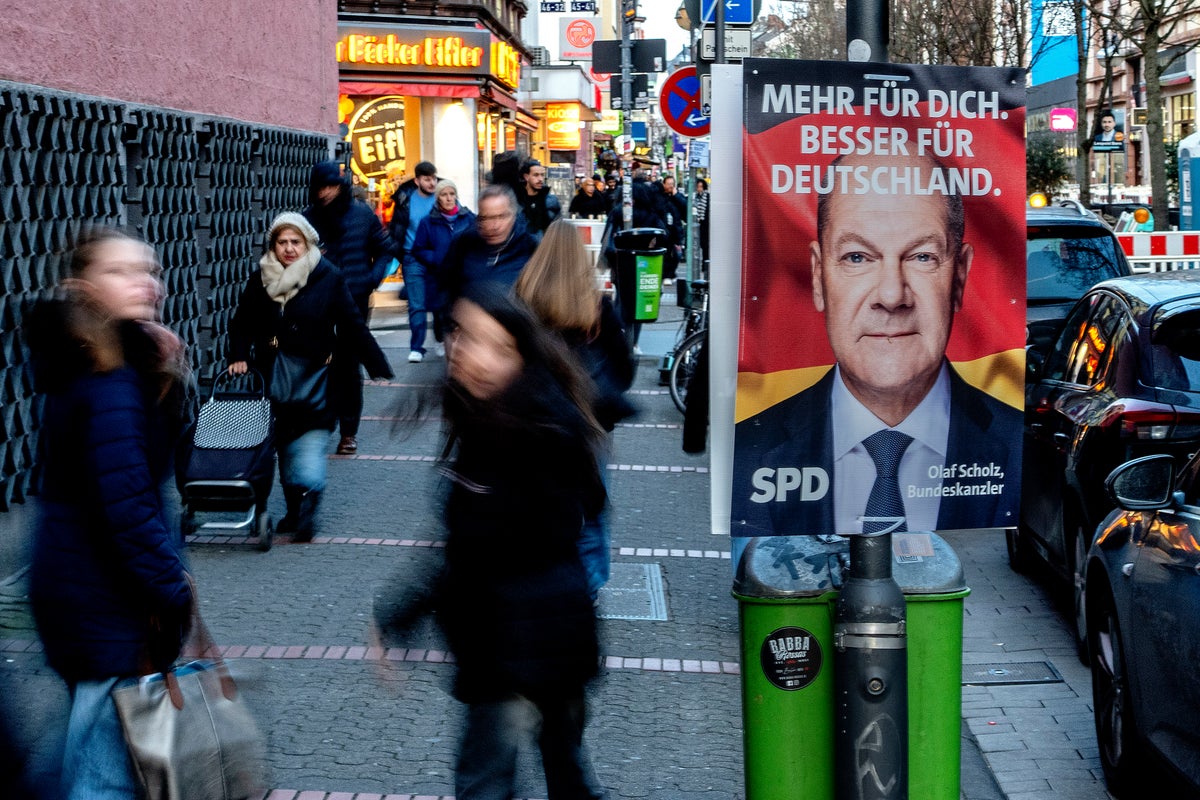
According to YouGov’s final MRP poll before the election, the far-right AfD’s 145 seats will surpass the 115 projected for the governing SPD, after its popularity has collapsed under chancellor Olaf Scholz.
The Greens, who partner the SPD in a coalition, are also projected to fall from their record 15 per cent vote share in 2021 to 13 per cent on Sunday.
German president Frank-Walter Steinmeier called the elections after Mr Scholz lost a vote of confidence in the German Bundestag on 15 January – after losing the support of his coalition when he fired finance minister Christian Lindner amid tensions over economic policy.
But the governing coalition had been falling in popularity long before the dispute within government, with the AfD having surged in federal elections in Thuringia and Saxony last September.
Chancellor Olaf Scholz has once again spoken out in favour of lowering the voting age to 16 for future federal elections.
“This is already the case in many states and in many local elections in Germany. It worked well,” he was quoted by Der Spiegel as saying during his final tour of Brandenburg. “All the prejudices about it were wrong.”
Andy Gregory22 February 2025 17:21
Campaigning for Sunday’s election has been marred by a series of high-profile attacks in which the suspects are from migrant backgrounds, shifting the focus away from Germany’s ailing economy and boosting support for the Alternative for Germany, which is on track to secure second place.
Prosecutors said on Sunday that the suspect in a stabbing at Berlin’s Holocaust Memorial two days before Germany’s election was a Syrian refugee who apparently wanted to kill Jews. The 19-year-old was arrested almost three hours after the knife attack on a Spanish tourist.
Police and prosecutors said the suspect, who approached officers with blood on his hands and clothes, arrived in Germany in 2023 as an unaccompanied minor and successfully applied for asylum. He lives in Leipzig. Evidence so far suggests the attack was linked to the ongoing conflict in the Middle East.
Prosecutors are working to establish if the suspect, who is under investigation on suspicion of attempted murder and bodily harm, suffers from any mental illness. They said he was not previously known to police or judicial authorities in Berlin.
Our crime correspondent Amy-Clare Martin reports:
Andy Gregory22 February 2025 16:26
Jörn Kaulhausen, 63, told The Independent that he is an AfD supporter because the country has “changed” and it needs strong leadership.
He references 2015, when former chancellor Angela Merkel opened the German borders to more than a million asylum seekers.
“Our lives have changed. Our women live in fear. They can’t move in the cities like before,” he claimed. “A lot of people try to attack us with knives. Everyday we have crimes here in Germany.
“We can’t accept it anymore.”
Tom Watling, in Erfurt22 February 2025 15:34
In the small city of Erfurt, central Germany, the local Alternative for Germany is about to kick off its election campaign finale before voters go to the polls nationwide tomorrow.
The city is in the Thuringia region where the AfD is particularly popular in Germany. It is also one of the regions where the AfD has been designated as a far-right extremist party.
At least two thousand people are expected at today’s rally.
Counter protesters decrying the Alternative for Germany as Nazis were marching through the city ahead of the rally.
In the city’s main square, the counter protesters were set to gather just twenty metres from the AfD rally. Dozens of police vans lined the square between them.
Tom Watling, in Erfurt22 February 2025 15:10
Germany’s reformed voting system aims to blend British or US-style single-member constituencies with the proportionality characteristic of most continental European countries.
Under the old system, proportionality was ensured by topping up parliament with extra seats after winners were found in each of 299 constituencies. This ensured parties held seats in line with their share of the vote, regardless of the distribution of constituency seats.
In 2021, that led to a parliament of 735 seats, one of the largest legislatures in the world.
A new law, introduced in 2023, fixes parliament at 630 seats – between Britain’s House of Commons and Turkey’s National Assembly in world rankings – and prioritises proportionality over individual member seats.
Now, if a party wins a share of seats that is greater in proportion to their share of the national vote, some constituencies will be left vacant, starting with those where the winning candidates have the narrowest margin of victory.
The change may hurt parties that are traditionally strong in single-member constituencies – in particular the Christian Social Union (CSU), the Bavarian sister party of the Christian Democrats (CDU) whose leader Friedrich Merz is tipped to become the next chancellor.
Andy Gregory22 February 2025 14:42
A German political scientist has suggested that increased polarisation in society will result in a higher voter turnout because people believe a lot is at stake – with many feeling that democracy itself is under threat.
While a high voter turnout is positive, Dr Sarah Strömel of the University of Regensburg told broadcaster ARD that in the long term the development towards more ideological polarisation of different opinions is not good for democracy.
“People think in black and white categories, in either-or categories and not in shades of gray”, which strengthens fringe parties and undermines tolerance, said Dr Strömel.
With European peace and security looming large in the minds of German voters, frontrunner Friedrich Merz warned at a campaign rally on Friday that Donald Trump’s administration could “completely reshape the map of the world”.
The CDU candidate has warned that Europe must be ready to take responsibility for its own defence without the help of the United States, and told the audience: “We are seeing a change of government in America that is not just another change of government but one that may completely reshape the map of the world.”
Mr Merz has also pledged to play a larger role in the EU, telling the Munich Security Conference: “I am hearing often that there is a lack of German leadership within the European Union. I fully agree with those who are demanding more leadership from Germany and frankly I’m willing to do that because Germany is in a strategic position at the centre of Europe and so many things depend on Germany that we are having to take a new role.”
Andy Gregory22 February 2025 13:19
Germany could face months of political uncertainty after Sunday’s election as the winning party will almost certainly have to form a coalition to secure a majority.
While Friedrich Merz is the frontrunner to become chancellor, he will need a partner, or possibly two. On a live TV debate on Sunday, Mr Merz said he would like to have two coalition options.
A so-called grand coalition of the two big centrist parties, the CDU/CSU and chancellor Olaf Scholz’s centre-left Social Democrats (SPD) is seen as the most likely outcome, with analysts at the Eurasia Group giving it a 60 per cent likelihood.
The SPD and CDU/CSU have already governed together four times since the Second World War – three of those under the leadership of former conservative chancellor Angela Merkel.
Mr Merz, however, has moved the bloc further to the right, taking a tougher stance on migration than Merkel and a more pro-market position on the economy. The CDU/CSU wants broad tax cuts while the SPD wants to raise taxes for high-income earners and revive a wealth tax. That means both could struggle to agree on deeper reforms, except a possible easing of the debt brake.
Andy Gregory22 February 2025 12:49
Protesters against the far right are taking to the streets in German cities ahead of tomorrow’s election.
Der Spiegel reports on the various demonstrations which have been organised, including one named “Clear stance against the right” in Hamburg, another called “Against the AfD and the shift to the right” in Erfurt, and “No vote for isolation and agitation” in Berlin.
Andy Gregory22 February 2025 12:14
The formation of the next German government could swing on just tenths of a percentage point, a newspaper has claimed, after it published a new poll.
In terms of the largest parties, the new Insa polling of just over 2,000 people was largely in line with YouGov’s final MRP poll – with Friedrich Merz’s centre-right CDU/CSU at 29.5 per cent, the far-right AfD party on 21 per cent, and Olaf Scholz’s incumbent SPD on just 15 per cent.
But Bild reports that the surprise winner would be the Left, which polled at 7.5 percent, with Insa chief Hermann Binkert saying: “The Left Party is the big winner of the election campaign. She has clearly fought her way over the five percent hurdle.”
Meanwhile, the Greens polled at 12.5 per cent, the leftist pro-Russian BSW at 5 per cent, and the liberal FDP at 4.5 per cent.
Although their chances of clearing the 5 per cent threshold for entering parliament hang in the balance, the FDP could still even enter into a government in the event that more than five parties manage to enter the Bundestag – which could mean that the CDU/CSU are forces to rely on both the SPD and the Greens for a parliamentary majority, Bild reports.
Andy Gregory22 February 2025 11:37