>In the US, correctional institutions include jails and prison facilities housing inmates under local, state, or federal jurisdiction. When a government agency signs a contract with a third party to run a prison, that’s known as a private or “for-profit” prison.
>As of 2022—the most recent federal data available—28 states used privately run prisons along with (or instead of) local jails and state-run facilities. That same year, 7.4% of prisoners were in a private facility.
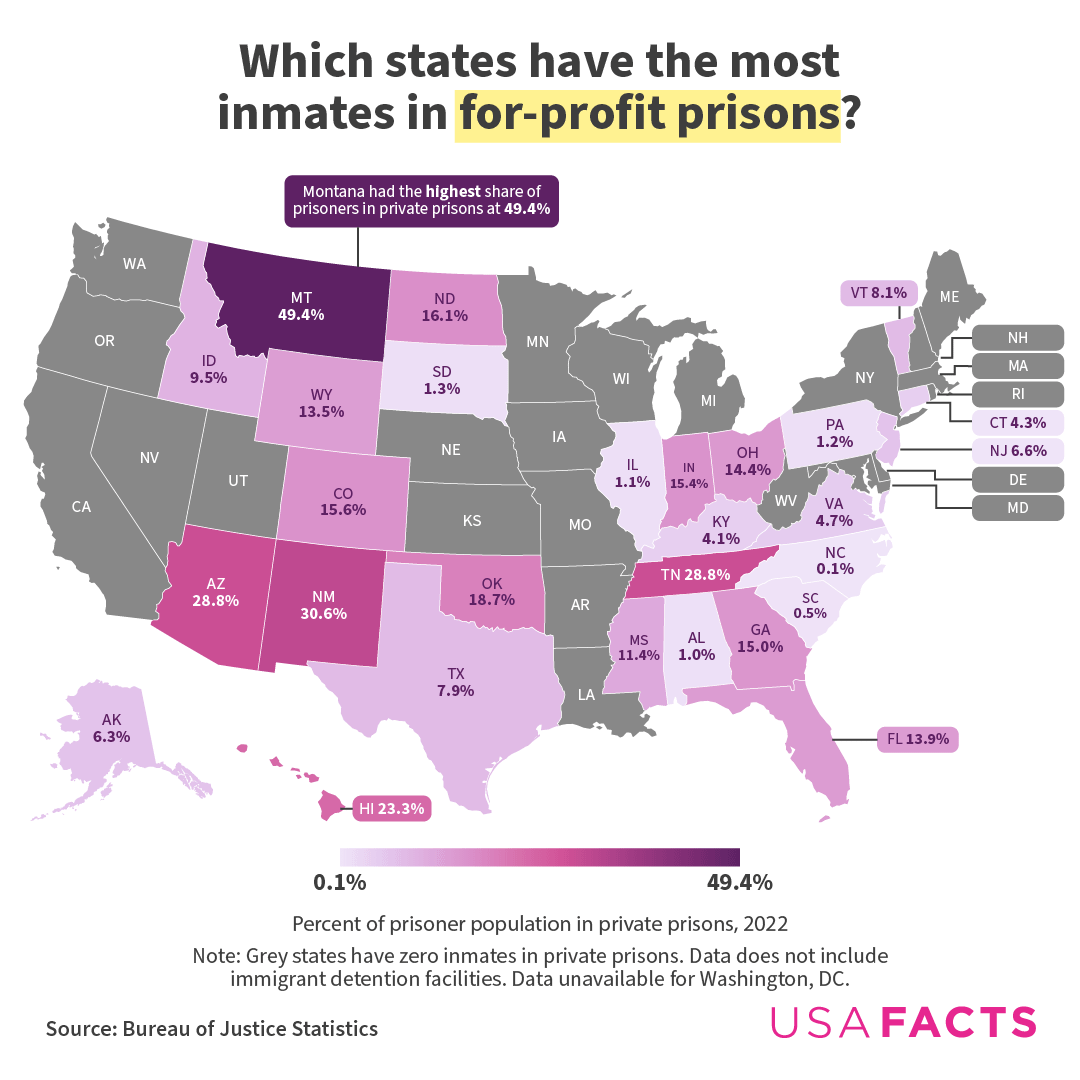
>As of 2022, the most recent year of federal data, Montana was most reliant on for-profit prisons. It housed nearly half of its prisoners (49.4%) in private facilities.
>But Montana was an outlier: percentages of the next-closest states were nearly 20 points behind. New Mexico housed 30.6% of its prison population in private facilities, while Arizona and Tennessee each housed 28.8%. Hawaii followed with 23.3%.
>In the remaining 23 states with private prisons, the percentage of inmates under private custody ranged from 0.1% to 18.7%.
A few more notes:
* There is little federal data on the number of private prisons in each state. The most recent federal report on the number of private prison facilities is from a Bureau of Justice Statistics report from 2019.
* Illinois banned private prisons in 1990 but housed 1.1% of prisoners in privately-run facilities as recently as 2022. The Bureau of Justice Statistics notes that Illinois data includes inmates who are part of a third-party work-release program, where people remain in custody as they transition back to life outside of the correctional system.
* Only some states have legislation banning private prisons. Not using private facilities does not imply a formal ban.
* As of 2025, there are zero federal inmates in private prisons. The Federal Bureau of Prisons ended the use of privately owned prisons on November 30, 2022.
Montana has a total population of 1.137 million, and a prison population of 2,953. So it probably has two prisons in the entire state and one is private. So while accurate, not really helpful.
7.4% total, right? Nice to see the number going down.
As a non American it confuses me how a for profit prison makes any sense at all? Doesn’t the state/country pay for it? Isn’t that profit just unnecessarily spent taxpayer money?
This does not include prisons that use prisoners for free labor. Louisiana does this. I would argue that is, for profit. Idk why have a “private” distinction.
Looks a little red versus blue.
Taking the 28 states together that were >0% and 54.1% of their Trump/Harris votes went to Trump.
The other 22 states (0%), 53.6% of their Trump/Harris votes went to Harris.
Break it into quarterss (targeting as close to 38M Trump/Harris votes per bucket), sorted by the %%s from the chart:
Top quarter, 55.4% for Trump
Next quarter, 52.2% for Trump
Next quarter, 52.2% for Harris
Bottom quarter, 52.2% for Harris
So, I guess remember that when you see these sorts of posts. It is the reddest of red states who are for such things.
As a Utah citizen, I’m shocked that we aren’t all up in that private prison business. We’re selling off our land to billionaires and excavation companies like a candy store the day after halloween. Glad we’ve somehow managed to stay out of private prisons, ie: for profit slavery centers.
I think the private prison anger is a bit of a distraction nowadays. In the age of neoliberalism and public-private partnerships, the tie between incarceration and the profit motive is not much different in public prisons. All the function of the prisons even public ones are contracted out to private companies who have an interest in maintaining mass incarceration. clothing and laundry, communication platforms, healthcare, commissary systems, other digital infrastructure, food, etc. It’s all contracts to profit driven corporations.
Finally something to be proud of Missouri about other than legal weed.
I can’t see if it’s linear or logarithmic
Let’s just call them what they are – prisoner work camps.
I can confirm it’s not really a thing in California Dept of Corrections
This seems to be disproportionately affecting red states (with some exceptions). Is there some correlation?
I’d be really interested to see this juxtaposed with recidivism rates by state.
![Percent of prisoner population in private "for-profit" prisons in the US [OC]](https://www.europesays.com/wp-content/uploads/2025/03/xu67z9tvoqme1-1080x1024.png)
15 comments
Source: [Bureau of Justice Statistics](https://bjs.ojp.gov/library/publications/prisoners-2022-statistical-tables)
Tools: Datawrapper, Illustrator
More data [here](https://usafacts.org/articles/how-many-states-use-private-prisons/)
I didn’t know until recently that slavery is still legal for prisoners convicted of a crime in the US. Slavery as penal labour
Here’s an excerpt from [this report](https://usafacts.org/articles/how-many-states-use-private-prisons/) on private prisons in the US:
>In the US, correctional institutions include jails and prison facilities housing inmates under local, state, or federal jurisdiction. When a government agency signs a contract with a third party to run a prison, that’s known as a private or “for-profit” prison.
>As of 2022—the most recent federal data available—28 states used privately run prisons along with (or instead of) local jails and state-run facilities. That same year, 7.4% of prisoners were in a private facility.
>As of 2022, the most recent year of federal data, Montana was most reliant on for-profit prisons. It housed nearly half of its prisoners (49.4%) in private facilities.
>But Montana was an outlier: percentages of the next-closest states were nearly 20 points behind. New Mexico housed 30.6% of its prison population in private facilities, while Arizona and Tennessee each housed 28.8%. Hawaii followed with 23.3%.
>In the remaining 23 states with private prisons, the percentage of inmates under private custody ranged from 0.1% to 18.7%.
A few more notes:
* There is little federal data on the number of private prisons in each state. The most recent federal report on the number of private prison facilities is from a Bureau of Justice Statistics report from 2019.
* Illinois banned private prisons in 1990 but housed 1.1% of prisoners in privately-run facilities as recently as 2022. The Bureau of Justice Statistics notes that Illinois data includes inmates who are part of a third-party work-release program, where people remain in custody as they transition back to life outside of the correctional system.
* Only some states have legislation banning private prisons. Not using private facilities does not imply a formal ban.
* As of 2025, there are zero federal inmates in private prisons. The Federal Bureau of Prisons ended the use of privately owned prisons on November 30, 2022.
Montana has a total population of 1.137 million, and a prison population of 2,953. So it probably has two prisons in the entire state and one is private. So while accurate, not really helpful.
7.4% total, right? Nice to see the number going down.
As a non American it confuses me how a for profit prison makes any sense at all? Doesn’t the state/country pay for it? Isn’t that profit just unnecessarily spent taxpayer money?
This does not include prisons that use prisoners for free labor. Louisiana does this. I would argue that is, for profit. Idk why have a “private” distinction.
Looks a little red versus blue.
Taking the 28 states together that were >0% and 54.1% of their Trump/Harris votes went to Trump.
The other 22 states (0%), 53.6% of their Trump/Harris votes went to Harris.
Break it into quarterss (targeting as close to 38M Trump/Harris votes per bucket), sorted by the %%s from the chart:
Top quarter, 55.4% for Trump
Next quarter, 52.2% for Trump
Next quarter, 52.2% for Harris
Bottom quarter, 52.2% for Harris
So, I guess remember that when you see these sorts of posts. It is the reddest of red states who are for such things.
As a Utah citizen, I’m shocked that we aren’t all up in that private prison business. We’re selling off our land to billionaires and excavation companies like a candy store the day after halloween. Glad we’ve somehow managed to stay out of private prisons, ie: for profit slavery centers.
I think the private prison anger is a bit of a distraction nowadays. In the age of neoliberalism and public-private partnerships, the tie between incarceration and the profit motive is not much different in public prisons. All the function of the prisons even public ones are contracted out to private companies who have an interest in maintaining mass incarceration. clothing and laundry, communication platforms, healthcare, commissary systems, other digital infrastructure, food, etc. It’s all contracts to profit driven corporations.
Finally something to be proud of Missouri about other than legal weed.
I can’t see if it’s linear or logarithmic
Let’s just call them what they are – prisoner work camps.
I can confirm it’s not really a thing in California Dept of Corrections
This seems to be disproportionately affecting red states (with some exceptions). Is there some correlation?
I’d be really interested to see this juxtaposed with recidivism rates by state.
Comments are closed.