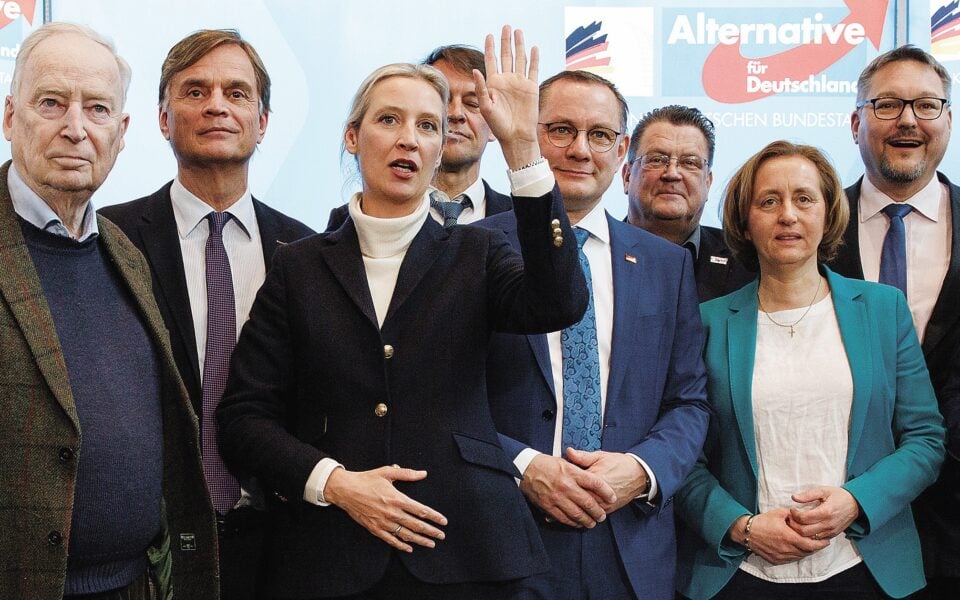
Alternative for Germany (AfD) party co-chairwoman Alice Weidel (center left) gestures to a photographer next to co-chairman Tino Chrupalla (center right) after attending a parliamentary group meeting at the German parliament in Berlin, Germany, on February 25, 2025. [Clemens Bilan/EPA]
The European Union is one of the most successful political “experiments” in the history of political science. Its demise has been predicted by many; its survival recognized by few.
So why exactly is the far-right rising in Europe? Why did anti-EU forces gain ground in the 2024 European Parliament elections? Why did the Euroskeptic AfD come in second in the recent German elections? And, now, the new elephant in the room: What to do with Donald Trump and his electoral sweep?
Europe needs to realize that there is a new global normalcy. And Europe needs to heed the warnings from both its own elections and the US elections
Despite the theoretical improvement in many important indicators – GDP per capita, life expectancy etc – populations in both Europe and the US alike simply feel disenfranchised by the political elites. They feel that decisions are taken by large, entrenched interests, that they are being taken for granted, that they are being left out, and that they cannot get ahead. In Europe, Brussels is viewed as a large bureaucracy that is far removed from the people. Indeed, the EU has made very few steps in promoting participatory democracy on a transnational level. Of course, there is no discussion of new initiatives that are needed to counter the end of the neoliberal globalization economic model as we have come to know it: initiatives such as EU-wide universal basic income and breaking down the tech giants to allow for redistributive policies.
The new anti-woke trend is simply a shortcut for those far-right political movements to call the government elites aloof and tone-deaf. I do not believe – or at least I refuse to believe – that people genuinely desire a rewinding of human rights. It is more likely they are demanding politicians pay attention to their daily realities; they want politicians to stop being cautious managers and to instead become grounded representatives, to represent them as the role implies.
There is no doubt Europe is falling behind: economically, demographically, technologically, geopolitically. The US is now competing on a completely different level, and it would be a grave mistake for European leaders to think of Trump’s second term as a transient break from Western norms, as something that will revert to “normalcy.” The Democratic Party is in an organizational and ideological abyss, and it will require a long time for it to come up with a viable alternative or a convincing narrative. The Republican Party is finished as we knew it – it is hard to imagine someone like Mitt Romney becoming head of the party again – but has factually evolved in a way that won the popular vote by a large margin despite the demographic headwinds that ought to have solidified Democrat domination for the long run.
Europe needs to realize that there is a new global normalcy. And Europe needs to heed the warnings from both its own elections and the US elections. In simplistic terms, the solution to counter the far-right wave is “More Europe, Europe First.” Engaging in a €800 billion arms race to address the illegal war in Ukraine is not what European peoples want – it is not putting Europe first even if it is portrayed as such. This might be difficult to digest, but European leaders need to listen to the people.
What might Europeans actually want to say to their leaders? Likely that we have massive issues inside our own countries and that we cannot resolve other countries’ issues for them. It is a crude worldview, but one that is hard to argue against.
It goes without saying that Europe can no longer count on NATO. The European Union needs to urgently create its own European NATO, with the policy that an attack on one is an attack on all. Maybe we should have an honest conversation and agree that Moldova, Ukraine, Georgia and Turkey will simply not be part of any future European expansion. That we should encourage Balkan countries to carry out their reforms so that they can become members, and that we will promote a more integrated European federation that will secure its borders and defend its territory, that will invest in innovation and new technologies, that will compete for natural resources on a global scale.
That we have a European Union that promotes participatory democracy inside its own self and that will demonstrate genuine solidarity among its members (from migration to investments).
We need a lot more Europe within the Union – but we also need that Europe to be competitive in the new normalcy that exists. We have an obligation to future generations that we stay ahead. It is high time we discussed how to put Europe first.
Stefanos Kasselakis is leader of the political party Movement for Democracy and former president of SYRIZA.