Good morning. Nato’s secretary-general has privately urged EU leaders to mend bridges with Turkey and increase co-operation in light of geopolitical shifts buffeting Europe, the Financial Times has learned, amid a scramble by European capitals to rethink how the continent’s security can be guaranteed.
Sticking to that same topic, today I reveal a co-ordinated push from an overwhelming majority of EU capitals to significantly deepen formal EU-UK defence co-operation. While our Nordic correspondent explains what to expect from today’s election in Greenland.
Crossing the Channel
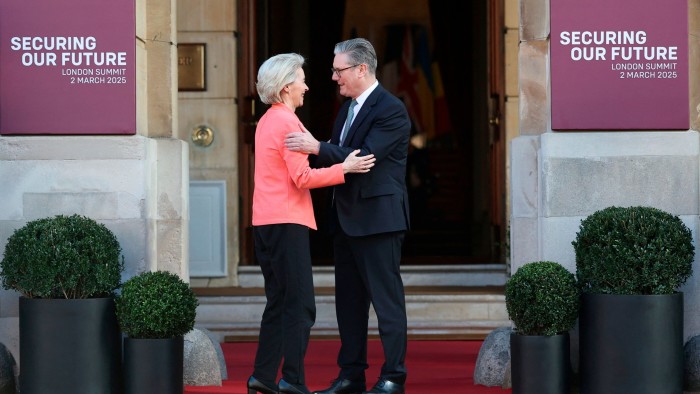
The EU should create “concrete” defence co-operation with the UK, including defence industry collaboration and initiatives such as possible joint military exercises, 20 of the EU’s 27 capitals have said, as the bloc scrambles to recalibrate its relations with London in light of Donald Trump’s presidency.
Context: Trump’s threats to withdraw security guarantees to European Nato allies and his move to stop support to Ukraine and reestablish ties with Russia have spooked the continent’s capitals, and forced intense discussions on a “coalition of the willing” — co-led by France and the UK — to aid Kyiv and increase European defence capabilities.
“The United Kingdom stands out as one of the EU’s key partners — as many of our priorities in foreign and security policy align — and in this severe security context closer co-operation is an imperative,” states a position paper written by the 20 countries including Germany, Italy, Spain and the Netherlands, and seen by the FT. “The EU and UK work together to strengthen transatlantic security.”
“A mutually beneficial partnership with the UK would be ambitious and should comprise concrete defence co-operation,” the non-paper states, adding that “additional benefits of a more substantial and legally binding agreement could be explored”.
They could include “dialogues on strategic stability and arms control with regard to weapons of mass destruction”, “strategic dialogue on Europe’s security environment influenced by Russia’s aggression” and “specific projects or missions, exercises and operations”.
“Defence industry co-operation should be an important element of such an arrangement,” it adds. That’s a key issue at the moment as Brussels debates whether non-EU countries should be able to benefit from EU-funded defence spending ideas such as a new €150bn loan initiative.
One country that wants less EU defence spending ending up outside the bloc is France, which has not co-signed the paper.
France has also spoken out against an ad hoc EU defence and security deal with the UK, arguing instead for a broader deal that also encompasses areas where Paris believes the UK should agree to other demands in areas such as fishing rights and migration.
“While it’s obvious that closer co-operation on security and defence between the EU and UK is imperative, a formalisation of that partnership can only go hand in hand with agreements on fisheries and energy,” said one EU diplomat.
The paper was also not supported by Greece, militarily neutral states Malta and Cyprus, the EU’s most pro-Russian governments in Hungary and Slovakia, and Poland, which holds the EU’s rotating presidency and thus must recuse itself from such initiatives.
Chart du jour: Rheinmetall’s moment
Armin Papperger, the German defence boss intent on re-arming Europe, tells the FT that transatlantic strains are “good for the business”.
Greenland’s choice
Rarely has an election in a country of just 57,000 people sparked as much attention as today’s ballot in Greenland, writes Richard Milne.
Context: US President Donald Trump’s repeated interest in taking control of the vast and geopolitically crucial Arctic island from Denmark has thrust Greenlanders into the spotlight.
There are few opinion polls but parties backing independence from Copenhagen are likely to do well in today’s election. Where they differ is on the pace to separate from Denmark.
Some such as Naleraq, a populist party that has garnered many headlines, wants to start the break straight away. Others such as the current coalition partners Inuit Ataqatigiit, and Siumut want to go at a slower pace to allow the economy to develop to pay for the split with Denmark, which provides much of the territory’s budget with a block grant. Sceptics say that could take decades.
Trump intervened again on Sunday night, saying to Greenlanders that the US was ready to invest billions of dollars to “MAKE YOU RICH”. That led to fury in Greenland for attempting to interfere with the election with the island’s prime minister saying Trump lacked respect.
One problem is the disconnect between Greenlanders’ desire for self-determination and running more things themselves, and the geopolitical great game being played increasingly by the US, Russia and China in the Arctic. Greenlanders will be hoping their next government is able to steer a steady course towards nationhood rather than getting swept away.
What to watch today
Ukrainian and US officials meet in Jeddah for peace talks.
The European Commission releases new proposals on medicine supplies and migration rules.
Nato secretary-general Mark Rutte and alliance ambassadors meet troops in Kosovo.
Now read these
Fiscal blockage: Germany’s Greens have vowed to block Friedrich Merz’s flagship €500bn infrastructure fund and change to debt borrowing rules.
Portugal teeters: Country’s government is on brink of collapse with premier Luís Montenegro likely to lose confidence vote today.
‘Nothing is sacred’: Société Générale’s chief executive is taking an axe to the French lender’s stubbornly high cost base as he attempts a turnaround.
Are you enjoying Europe Express? Sign up here to have it delivered straight to your inbox every workday at 7am CET and on Saturdays at noon CET. Do tell us what you think, we love to hear from you: europe.express@ft.com. Keep up with the latest European stories @FT Europe