Tools: R – Packages: ggplot2, dplyr, sf, usmap, ggfx, scales
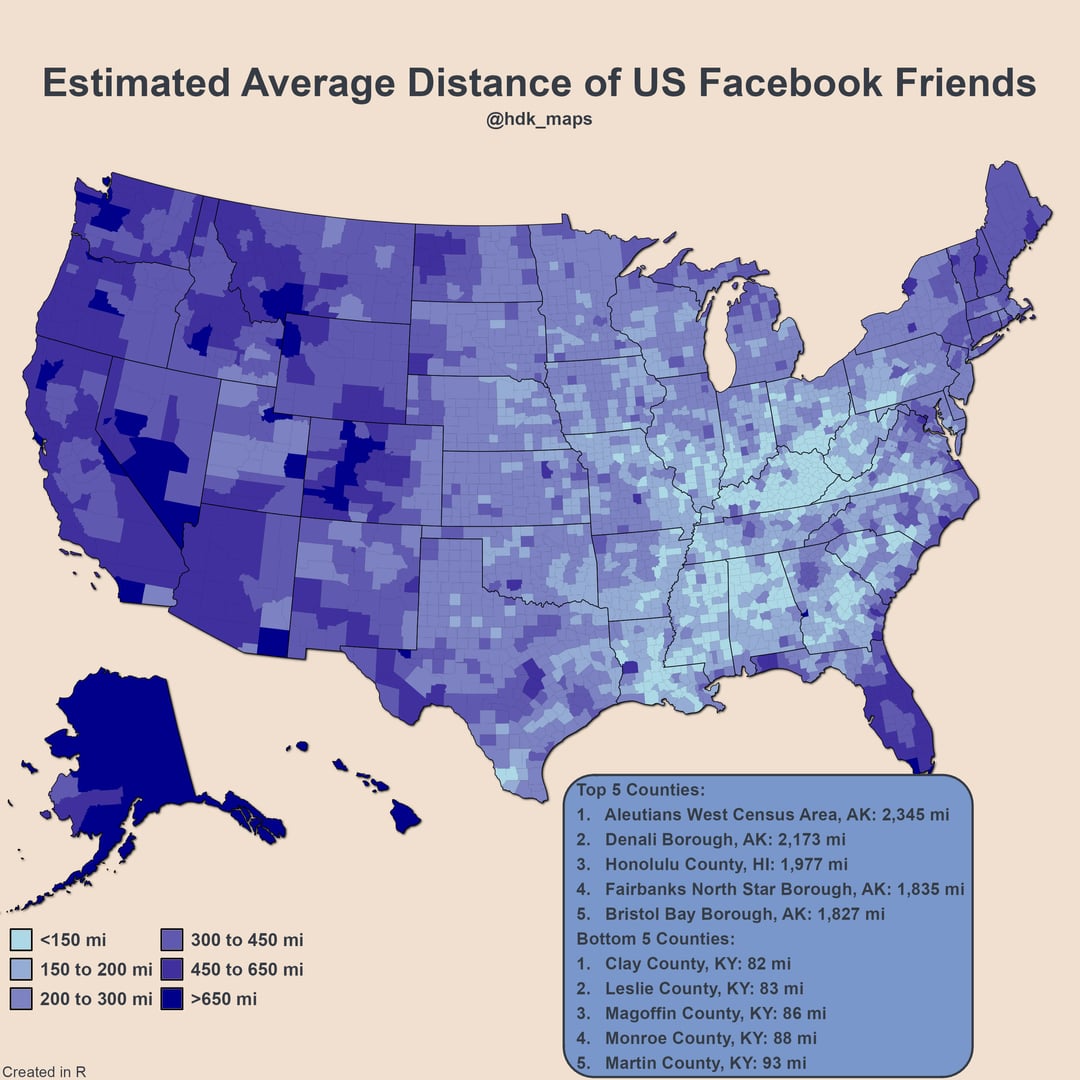
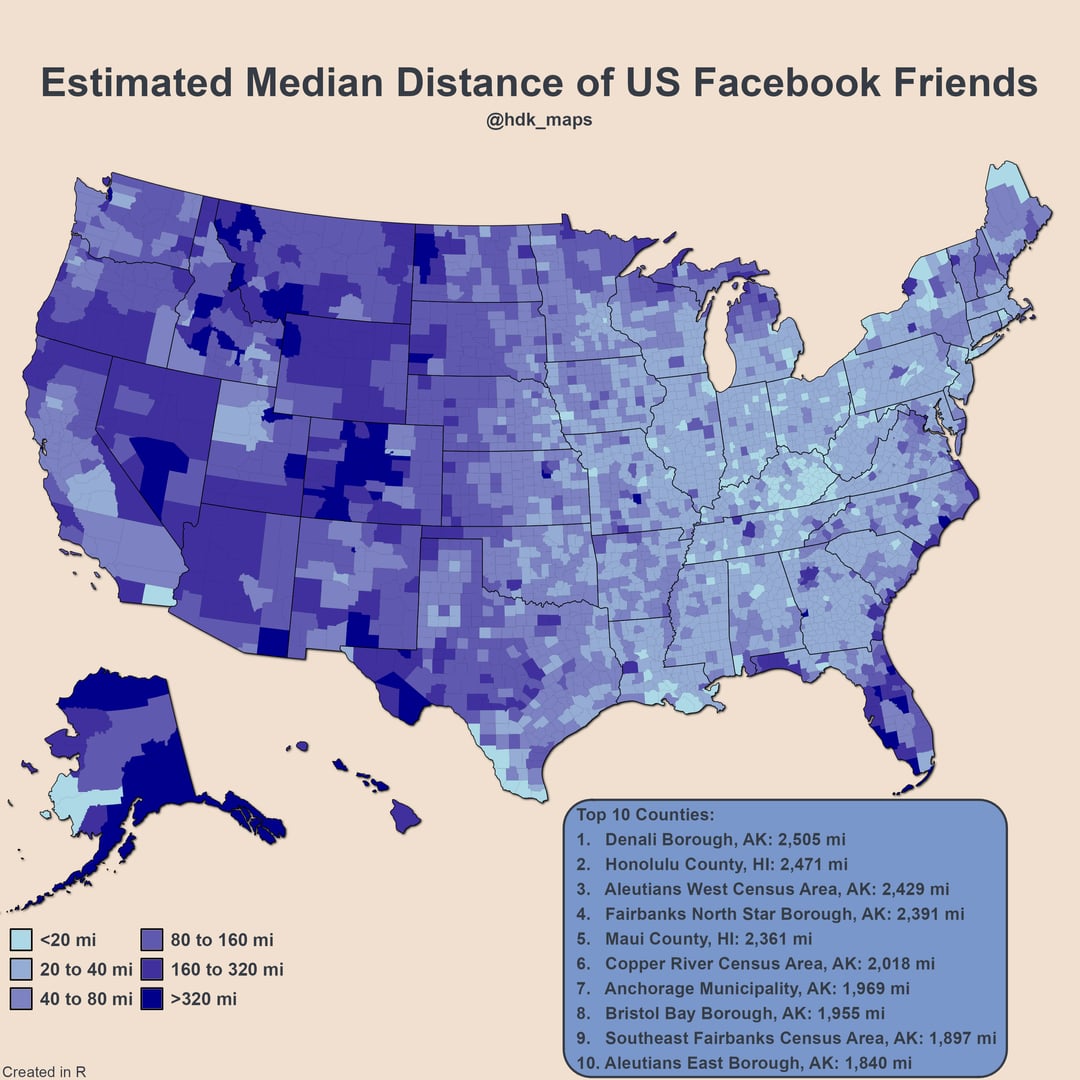
Facebook social connectedness data provides a scaled likelihood of friendship measure between each US county pair. It is calculated by dividing the total number of friendships between the counties by the number of Facebook users in each. Since I don’t have the number of Facebook users by county, I used 2020 county populations, assuming that Facebook use is even throughout the country. [68% of US adults use Facebook](https://www.pewresearch.org/short-reads/2024/02/02/5-facts-about-how-americans-use-facebook-two-decades-after-its-launch/). After this assumption, I can find the proportion of each county’s friends that live in each other county (including within-county) and from there calculate mean and median distances based on [county population centroids](https://www.census.gov/geographies/reference-files/time-series/geo/centers-population.html).
Kentuckians never leave Kentucky. It’s like Texas. 🤢
[deleted]
This is essentially a map of college towns.
Different places will have different explanations for the causes of this, but I wonder if there are identifiable similar effects.
Being physically distant from friends would tend to make a place less satisfying to live I think? Distance might make health outcomes worse (if you don’t have a friend to take you to the doctor)?
Mobility is probably both a cause and an effect. Because if you’ve moved from somewhere far away, you’re probably more likely to move somewhere far away again (because you’re less connected to the place).
Also your friend groups themselves are probably more spread out? Like if your average friend lives 1,000 miles away, your friends’ friends are also probably spread out from each other.
Appalachia is such a strange cultural blind spot.
We need a comparison to the expected results if everyone’s friends were randomly sampled from the population to know if there are significant deviations. The light spot in the East is over the Appalachians, but it’s also not too far from the center of population of the US, i.e. the mean location of a U.S. resident, which would be the lowest number even if there were no effects from mobility, etc.
The dark blue spot in Louisiana is Fort Polk.
The dark blue spot in Louisiana is Fort Polk.
Should remove Alaska and Hawaii from the top lists. Of course they are going to be on the top.
![[OC] Estimated Mean and Median Distances of US Facebook Friends](https://www.europesays.com/wp-content/uploads/2025/03/ialypfaosgpe1-1080x1024.jpg)
12 comments
Kentucky seems very isolationist. This is very interesting
Nevada and the utah basin seems to have interactions and i would play the phenomenon card.
Data: [https://dataforgood.facebook.com/dfg/tools/social-connectedness-index#accessdata](https://dataforgood.facebook.com/dfg/tools/social-connectedness-index#accessdata)
Tools: R – Packages: ggplot2, dplyr, sf, usmap, ggfx, scales
Facebook social connectedness data provides a scaled likelihood of friendship measure between each US county pair. It is calculated by dividing the total number of friendships between the counties by the number of Facebook users in each. Since I don’t have the number of Facebook users by county, I used 2020 county populations, assuming that Facebook use is even throughout the country. [68% of US adults use Facebook](https://www.pewresearch.org/short-reads/2024/02/02/5-facts-about-how-americans-use-facebook-two-decades-after-its-launch/). After this assumption, I can find the proportion of each county’s friends that live in each other county (including within-county) and from there calculate mean and median distances based on [county population centroids](https://www.census.gov/geographies/reference-files/time-series/geo/centers-population.html).
edit:
For reference, if people were equally likely to be friends with all Americans: [https://www.reddit.com/user/haydendking/comments/1je9vv3/how_far_away_does_the_meanmedian_american_live/](https://www.reddit.com/user/haydendking/comments/1je9vv3/how_far_away_does_the_meanmedian_american_live/)
Kentuckians never leave Kentucky. It’s like Texas. 🤢
[deleted]
This is essentially a map of college towns.
Different places will have different explanations for the causes of this, but I wonder if there are identifiable similar effects.
Being physically distant from friends would tend to make a place less satisfying to live I think? Distance might make health outcomes worse (if you don’t have a friend to take you to the doctor)?
Mobility is probably both a cause and an effect. Because if you’ve moved from somewhere far away, you’re probably more likely to move somewhere far away again (because you’re less connected to the place).
Also your friend groups themselves are probably more spread out? Like if your average friend lives 1,000 miles away, your friends’ friends are also probably spread out from each other.
Appalachia is such a strange cultural blind spot.
We need a comparison to the expected results if everyone’s friends were randomly sampled from the population to know if there are significant deviations. The light spot in the East is over the Appalachians, but it’s also not too far from the center of population of the US, i.e. the mean location of a U.S. resident, which would be the lowest number even if there were no effects from mobility, etc.
The dark blue spot in Louisiana is Fort Polk.
The dark blue spot in Louisiana is Fort Polk.
Should remove Alaska and Hawaii from the top lists. Of course they are going to be on the top.
Comments are closed.