
President Richard Nixon set a clear mission for the EPA when he created the agency in 1970: Establish and enforce standards for air and water quality, monitor the condition of the environment, and help states control pollution.
That began to change last week, from a mission safeguarding the environment and human health to one also promoting business and fossil fuels. From an agency that—through five fellow Republican presidents after Nixon, and four Democrats—remained grounded in science, to one now responsive to economic indicators.
The Environmental Protection Agency will “unleash” energy, “revitalize” the auto industry, and lower costs for Americans during President Donald Trump’s second administration, Administrator Lee Zeldin declared in a YouTube video. He pledged to slay climate change “religion” while rolling back more than 30 environmental regulations, some of them landmark national milestones.
“They want to turn the agency into an economic development organization,” said Geoff Gisler, program director for the Southern Environmental Law Center. “Companies will be allowed to contaminate people’s drinking water. Companies will be allowed to give kids asthma because of their air pollution.”
But Andrew Wheeler, partner at Holland & Hart LLP, who served as EPA administrator during the second half of the first Trump administration, called it a needed reset.
“What we’ve seen over the last four years is a strangle on American manufacturing and energy production that needs relief if we’re going to grow the American economy,” Wheeler said. “The laws are still in place. I’m confident that environmental quality will not suffer from these actions.”
‘A Long History’
Before the EPA was created and Congress crafted today’s environmental laws—the Clean Water Act, the Clean Air Act, the Safe Drinking Water Act, and others—many American cities were shrouded in a brown pall of pollution from car tailpipes, coal-fired power plants, and factory smokestacks.
The EPA’s reorientation toward industry “represents the abandonment of a long history” of prioritizing the environment, William K. Reilly, who led the EPA under Republican George H.W. Bush, said last week at a video conference with other former administrators hosted by the Environmental Protection Network.
The EPA now will consider rollbacks intended to allow more development in wetlands, lift environmental constraints on the oil and gas industry, promote coal-fired power plants, and among other things, undermine the legal basis for federal action on climate change, Zeldin said.
He labeled environmental regulations as tantamount to “hidden ‘taxes’ on US families.”
Zeldin said last month he’d like to see the EPA’s budget cut by at least 65%, in addition to layoffs of probationary employees at the agency, which are currently on hold by a federal judge. On Tuesday, documents reviewed by a congressional committee showed that EPA plans to fire more than 1,100 of its scientists and dismantle its primary scientific research office whose work underpins the agency’s environmental safeguards.
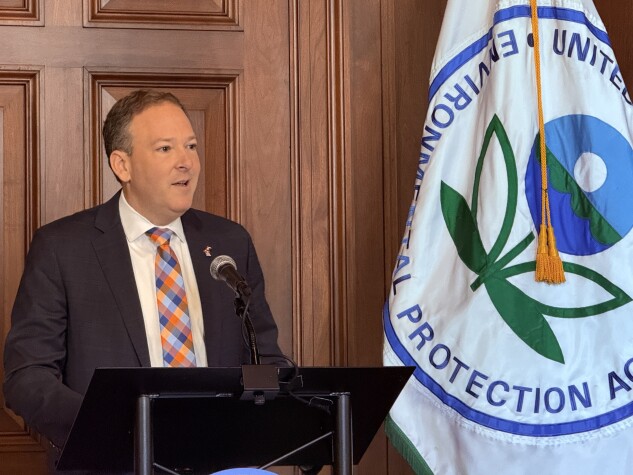
Environmental Protection Agency Administrator Lee Zeldin spoke in February at EPA headquarters in Washington.
Photographer: Bobby Magill/Bloomberg Law
Freeing Industry from Regulation
If it overcomes court challenges and other roadblocks, Zeldin’s sweeping remake of the EPA would go well beyond changes to the agency even in Trump’s first term, when he fought environmental rules and pulled the US out of the Paris climate pact.
The agency then cut staff, but it largely remained intact. It rolled back some environmental regulations, but it did so slowly, and judges often blocked those efforts. The agency’s pivot toward industry then emphasized regulatory certainty for companies.
Today, the agency doesn’t view environmental protections and growing the economy as a binary choice, an EPA spokesperson said in an unsigned email Monday.
Trump wants to restart shuttered coal plants that were among the country’s biggest sources of pollution, and which closed in recent years as the market moved to less polluting energy sources. On Monday, Trump used a Truth Social post to accuse “environmental extremists” and “lunatics” of holding coal-fired power plants captive.
“The intent of the administration is to promote business, promote industry—free from fear of regulatory scrutiny,” said Duke K. McCall III, partner at Morgan, Lewis & Bockius LLP, who represents clients in the energy and chemicals industries.
Wheeler, the former Trump EPA head, sees it a little differently.
Zeldin’s plans for EPA don’t represent a pivot toward industry, but instead they signal to manufacturers and miners that “America is back in business,” Wheeler said in an interview.
Environmental quality can only improve under Zeldin’s plans because, for example, mining will occur domestically instead of in other countries that have fewer pollution controls, Wheeler said.
‘A Gift and a Snare”
One of Nixon’s original purposes for the EPA was to provide industry with consistent standards to create regulatory certainty.
Now, some company and environmental lawyers say EPA’s reorientation toward industry is actually creating a sense of chaos for the businesses the agency intends to support.
McCall noted “tremendous uncertainty” right now because companies don’t know what the administration is going to do and how it’s going to do it.
It is a frustrating and risky time for anyone seeking predictability, especially infrastructure developers who use long planning and construction timelines, said Thomas Jensen, partner at Perkins Coie LLP, who represents clients involved with large energy and water pipelines and other infrastructure.
“We are advising developers to be alert to the difference between a gift and a snare,” he said.
Jensen said he’s telling his clients that it’s unclear if understaffed federal agencies will produce adequate administrative records. And since the US Supreme Court ruled last term that courts no longer need to defer to agencies’ interpretation of the law, it’s unclear if companies can be confident that judges will deem the EPA’s regulations the best interpretation of statutes.
The uncertainty “grips everybody,” said J. Michael Showalter, partner at ArentFox Schiff LLP.
The Courts
Many EPA veterans, past and present, say they’re baffled by the agency’s pledges to prop up certain industries.
“It’s a complete distortion of the purpose of the environmental laws to suggest that the goal is to lower car prices, or to increase energy production,” said David Uhlmann, who led the EPA’s enforcement team under President Joe Biden. “There’s nothing in any of the environmental laws that says that.”
Still, Zeldin’s announcements and Trump’s statements don’t equal the law.
The EPA hasn’t actually reversed regulations yet—a complicated and sometimes years-long process—and it’s unclear how successful the agency will be in dismantling its mission.
Zeldin announced only “reconsiderations” of regulations, and the agency “cannot prejudge the outcome” of that process because it must abide by federal law, the EPA spokesperson said.
Deregulation requires a sound scientific basis, and it must withstand court scrutiny, said Sam Sankar, senior vice president for programs at Earthjustice, a nonprofit environmental law firm.
Zeldin “can ignore the law and the science when he talks to Donald Trump,” Sankar said. “But he can’t do that in court when we sue him.”