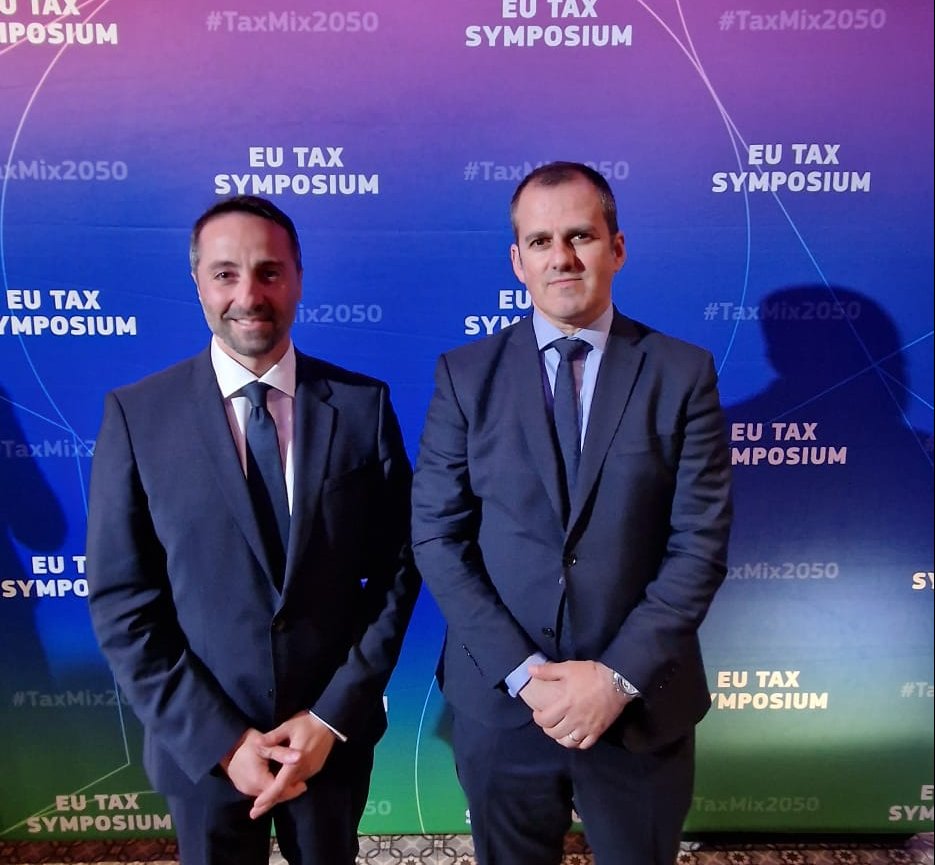
 Labour MP Alex Muscat and Nationalist MP Graham Bencini at the EU Tax Symposium 2025 (Photo: HOR)
Maltese MPs from both sides of the deep political divide presented a united front at the EU Tax Symposium 2025, defending Malta’s controversial tax system despite growing international criticism that it deprives other EU member states of billions in tax revenue.
Labour MP Alex Muscat and Nationalist MP Graham Bencini, who rarely find common ground on domestic issues, both emphasised the importance of “national flexibility in taxation policies” during the high-profile event themed “Strengthening Competitiveness and Fairness to Build Prosperity.”
The symposium, which brought together finance ministers, MEPs, policymakers, academics and civil society representatives, addressed pressing taxation issues including corporate tax reform and ensuring ultra-high-net-worth individuals contribute fairly to tax systems.
Defence of a tax haven
The Maltese delegation maintained that while acknowledging the benefits of EU-level cooperation, Malta “must protect its interests to remain competitive in an evolving global tax landscape,” according to the parliamentary press release.
Their stance comes despite mounting evidence that Malta’s corporate tax structure functions as what critics call a “tax haven” within the EU. While Malta officially imposes a 35% corporate tax rate—among the highest in Europe—foreign shareholders can claim refunds of up to six-sevenths of taxes paid, reducing the effective rate to approximately 5%.
Recent figures revealed by finance minister Clyde Caruana show that in 2022 alone Malta wiped out a staggering €1.3 billion in foreign tax revenue, which amounts to almost 8% of GDP.
Companies initially expected to contribute €1.5 billion in taxes ended up paying just €216.6 million after refunds. Since 2008, over €1 billion annually in taxed profits generated outside Malta has been erased from the tax records.

The Maltese representatives’ defence of their tax regime occurred against a backdrop of increasing pressure from both the EU and the OECD. A 2019 European Parliament report named Malta among “tax havens within the EU,” while the OECD’s Base Erosion and Profit Shifting framework has prompted scrutiny of Malta’s practices.
Malta’s system has attracted criticism for facilitating aggressive tax avoidance and undermining tax fairness. Approximately 8,000 active companies registered in Malta benefit from the tax reduction scheme, where the government refunds 85% of taxes paid.
The symposium provided a platform for discussion on corporate tax reform, with experts from the IMF, UN, and private sector exploring next steps. However, the Maltese delegation remained steadfast in their position that “maintaining fiscal stability and improving tax collection were paramount in ensuring sustainable economic growth.”
Changing global landscape
Despite the defensive stance, Malta faces significant challenges to its tax model. Malta has signed up to the OECD’s global minimum corporate tax pact, which introduces a 15% minimum rate for large multinationals.
Caruana disclosed last year that the government is in talks with the European Commission over Malta’s corporate tax regime. Under a proposed new system, Malta would retain its imputation system, but foreign companies would receive a lower rebate, resulting in an effective tax rate of 15%.
A key point of contention is Malta’s desire to provide Qualified Refundable Tax Credits to further reduce this rate, with the Commission reportedly wanting to limit this benefit.

The symposium highlighted the tension between national sovereignty in tax matters and the EU’s push for greater harmonisation. While Malta argues its tax system is essential for economic competitiveness, critics maintain it facilitates profit shifting at the expense of other member states.
The event featured addresses from key EU figures, including European Parliament Vice-President Esteban González Pons and European Commissioner Wopke Hoekstra, who outlined the tax priorities of the new European Commission.
The Maltese delegation’s insistence on preserving flexibility in taxation policies underscores the continuing challenge of balancing national economic interests with the broader EU goal of tax fairness.
Meanwhile, local businesses in Malta continue to face the full 35% corporate tax rate, contributing €470.9 million in 2022 alone—a stark contrast to the preferential treatment afforded to foreign companies.
Malta a tax haven over corporate loopholes and refund system
The Tax Justice Network (TJN) has ranked Malta 20th in its 2024 Corporate Tax Haven Index, describing the country as a significant enabler of global corporate tax abuse. Malta received a Haven Score of 77/100, reflecting the extent to which its legal framework facilitates tax avoidance by multinational corporations.
“Malta currently ranks 20 on the Corporate Tax Haven Index, which ranks the world’s biggest enablers of global corporate tax abuse” and it received a “Haven Score of 77 out of 100, measuring how much room for corporate tax abuse the jurisdiction’s laws and regulations provide, whether intentionally or not”
Central to TJN’s criticism is Malta’s full imputation tax system, which enables companies to reduce their effective tax rate from the statutory 35% to as little as 5% through shareholder refunds. Under this system, most of the tax paid by the distributing company is refunded to shareholders, creating a substantial gap between nominal and effective taxation.
The report also highlights Malta’s generous participation exemptions, which allow corporate income from dividends and capital gains, including from foreign and domestic sources, to be exempt under certain conditions. These mechanisms, coupled with lax requirements to prove foreign taxes paid, effectively create pathways for double non-taxation.
TJN further criticises Malta’s unilateral foreign tax credit system, which offers a 25% flat rate credit on foreign-sourced income without requiring proof of tax paid abroad. This, the group argues, can result in income being effectively untaxed or even subsidised, especially in the case of royalty payments.
Other loopholes noted include the absence of limits on loss carry-forwards, tax exemptions for certain sectors under the tonnage tax regime, and the non-taxation of capital gains from securities disposals. The availability of notional interest deductions and insufficient limits on intra-group interest, royalty, and service payment deductions also contribute to Malta’s classification as a tax haven.
TJN concludes that Malta’s tax framework enables base erosion and profit shifting (BEPS), undermining tax systems in other jurisdictions. It calls for reforms aligned with OECD recommendations and greater transparency in corporate disclosures.