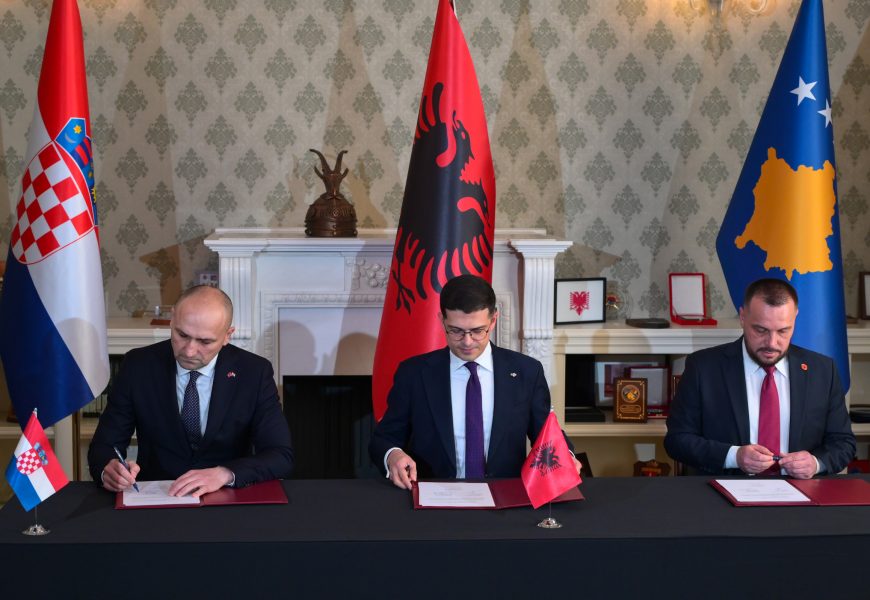
Albania, Croatia and Kosovo signed a joint declaration of cooperation on defence on 18 March in Tirana, which sparked anger among the Serbian officials, who interpreted such a move as a threat to both the country’s territorial integrity and regional stability. The document focuses on “strengthening the defence and security industry, increasing military interoperability through joint training and exercises, countering hybrid threats and strengthening strategic security, and supporting Euro-Atlantic integration”. It was also reported that the declaration “was open to other countries”, and that Bulgaria was invited to become part of the initiative.
Speaking at the signing ceremony in Tirana, Albanian Defense Minister Pirro Vengu stressed the importance of this cooperation in the face of ongoing security challenges.
“In a fragile security environment, we share a common assessment of threats. Our commitment to strengthening defence capabilities is stronger than ever”, Vengu said.
Similarly, Croatian Minister of Defence Ivan Anušić said that “the goal is to strengthen the political and defence cooperation of our countries and support Kosovo and Albania on their Euro-Atlantic path”.
“We are aware of the risks in Southeast Europe, especially in the context of Ukraine, and we have decided to strengthen our cooperation based on the experiences we have gained over the past 35 years of independence, but also as a member of NATO and the European Union”, Anušić underlined.
According to Kosovo’s Minister of Defence Ejup Maqedonci, the aim of the memorandum “is not to threaten anyone but to send a message to all those who dare to jeopardize security, peace, and stability in the Western Balkans, as well as the security of our countries that our three nations, which share common values and interests, are united in facing any danger aimed at destabilizing the region”.
On the other hand, Serbian Minister of Defence Bratislav Gašić said that the signing of a trilateral memorandum by Croatia, Albania, and the “so-called Kosovo” is “a provocative move that undermines efforts to strengthen regional security”.
In addition, the Ministry of Foreign Affairs of Serbia sent “an urgent request” to the Ministries of Foreign Affairs of Croatia and Albania for a detailed explanation regarding the signing of the trilateral memorandum.
“By taking steps that undermine regional stability, these two countries, together with the illegitimate representative of the provisional institutions of self-government in Pristina, have initiated actions that pose a serious risk to peace and security in the region”, the press release reads.
In a similar vein, the Serbian President Aleksandar Vučić said that the memorandum was a “violation of the Agreement on Sub-Regional Arms Control” (signed by BiH, Croatia, Montenegro and Serbia in 1996).
Also, the pro-government media outlets in Serbia report that Vučić and Hungarian Prime Minister Viktor Orbán have already entered into “serious talks about the military alliance between the two countries”.
Foreign Ministry of Kosovo stated that Serbia’s reaction to the memorandum of defence “is not only aggressive and threatening, but also represents a blatant violation of the Brussels agreement, which proves Serbia’s bad intention and unwillingness to engage in a genuine dialogue“.
Branka Latinović: The Declaration is aimed at strengthening the bonds between Kosovo and NATO
Commenting on Belgrade’s official response to the trilateral declaration, Branka Latinović, a former Serbian Ambassador to OSCE and a member of the Forum for International Relations of the European Movement in Serbia, underlines that the latest Declaration and the Agreement on Sub-Regional Arms Control cannot be equalized since they are “different types of documents.”
“The Declaration on strengthening defence co-operation, signed in Tirana, is a political document, while the Agreement on Sub-Regional Arms Control, adopted in accord with the obligations under Article IV of Annex 1-B of the Dayton-Paris Peace Agreement, is a legally binding document. The Declaration contains a statement of intentions and plans, of the issues which will be addressed, while the Agreement implies a set of obligations regarding establishing and controlling the agreed limits, which is binding on all parties”, Branka Latinović clarifies for EWB.
 Branka Latinović; Photo; N1
Latinović adds that “Albania did not sign the Agreement on Sub-Regional Arms Control so it cannot violate it, while Kosovo, by the Agreement, is treated as a part of the territory of Serbia”.
“Croatia, on the other hand, is one of the signatories of the Agreement on Sub-Regional Arms Control, and contributes to the successful implementation of it by meeting its obligations”, she notes.
However, Latinović remarks that the latest Declaration is a violation of Resolution 1244, “which states that KFOR should be the only military force in the territory of Kosovo and Metohija”.
According to Branka Latinović, the claims coming from Pristina that “Serbia is violating the Brussels Agreement” by the fierce reaction to the Declaration are unfounded.
“The security issues, related to the military domain, were not subject to the Brussels Agreement, except for the entry of Kosovo security forces into the north of Kosovo. This issue is treated by a separate act, not by the Brussels Agreement”, she explains.
In Latinović’s opinion, another important element is the way in which the Declaration was adopted.
“Judging by the reaction of Serbian MFA, Serbia had not been aware of it, which indicates that the trust was violated, and trust is necessary for making any progress in the region. And if there is no dialogue nor mutual trust, security in the region becomes fragile. Also, I cannot help but notice that the Declaration is, in the first place, aimed at strengthening the bonds between Kosovo and NATO”, she states.
Latinović underlines that Serbia should not react to the Declaration by forging a similar military alliance, but by initiating a region-wide cooperation in the domains which are related to the military assistance, as well as by continuing to implement the Agreement on Sub-Regional Arms Control.
Adelina Hasani: This military alliance is intended as a preventive measure against any actors aiming to destabilize the region
On the other hand, Adelina Hasani, a researcher at Kosovar Centre for Security Studies, says for EWB that the military alliance signed between Kosovo, Albania, and Croatia “appears to be a response to current geopolitical security uncertainties, driven by rapid global shifts that could destabilize the region, particularly due to Russia’s influence”.
“It aims to strengthen cooperation in developing defence capacities and the defence industry, increase interoperability through education, training, and exercises, counter hybrid threats, and bolster strategic resilience. It also provides full support for Euro-Atlantic integration and regional defence efforts”, Adelina Hasani states.
 Adelina Hasani; Photo: X /KCSS
Hasani cites Kosovo’s Minister of Defense, Ejup Maqedonci, who “emphasizes that this alliance is not intended as a threat to anyone, instead, it sends a message to those who might seek to destabilize the region, demonstrating that these countries stand united and are determined to maintain stability”.
“Meanwhile, Serbia has framed this alliance as a regional threat and a challenge to its own strategic interests, a narrative that some Russian-based media outlets have amplified, particularly highlighting Kosovo’s involvement, given that Serbia does not recognize Kosovo’s independence. However, the claim that this alliance poses a threat to Serbia is unfounded, rather, it is intended as a preventive measure against any actors aiming to destabilize the region. Moreover, since both Croatia and Albania are NATO members, their cooperation with Kosovo aligns with NATO standards and agreements”, Adelina Hasani stresses.