If this isn’t the premise to a Vsause video I don’t know what is.
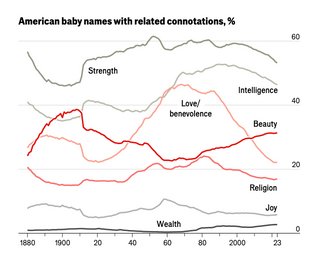
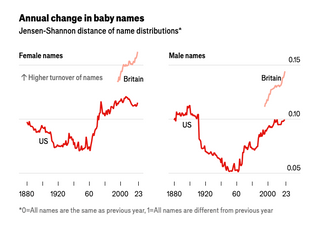
[OC] I analysed the first names of almost 400m people born in America and Britain in the past 143 years. I looked at which were popular and their connotations; considered how diverse the names were and the rate at which trends have come and gone. Our study revealed that the countries on both sides of the Atlantic are becoming more interested in money and power (see charts), as culture becomes more fragmented and dynamic.
The analysis, published in this week’s issue of *The Economist* also features a new “informant”. Historically, studying what a name evokes has been hard to quantify, but artificial intelligence offers a method of doing so. “What word follows…” is the problem large language models (LLMs) were made to solve. These models, trained on enormous corpora of text, can reveal clusters of associations. So I enlisted an LLM to provide the top five connotations of all popular names. My prompts—more than 30,000 of them—produced 7,439 unique descriptors, including “purity”, “warrior” and “socially awkward”. (Ironically the most popular description was “unique”, tied to 12,124 different names; for those worried about energy use–I used small input/output structures and an efficient model.)
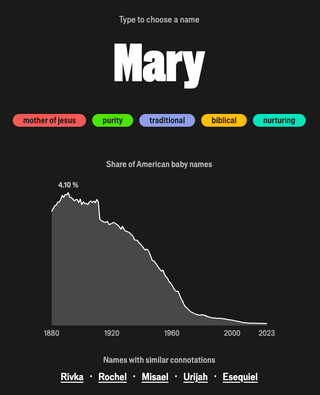
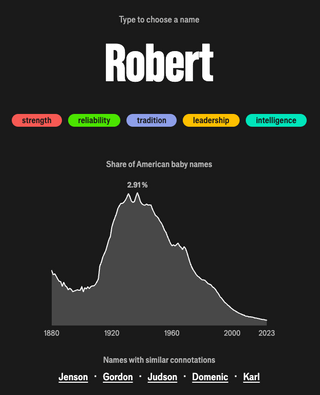
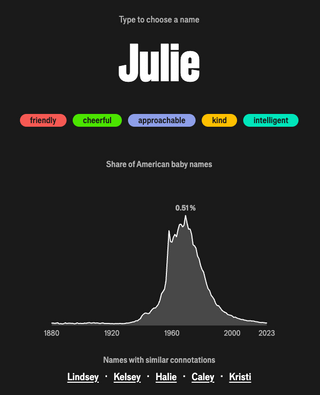
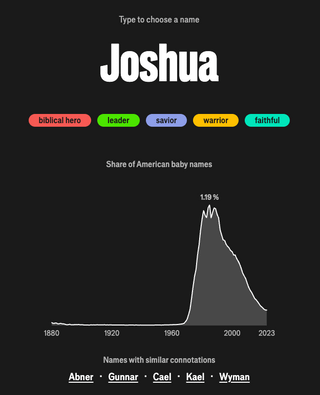
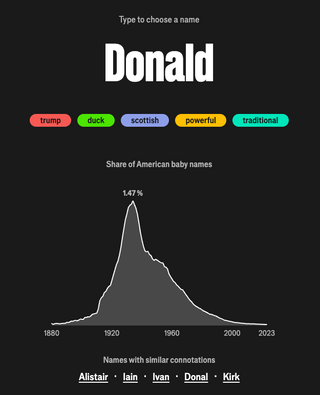
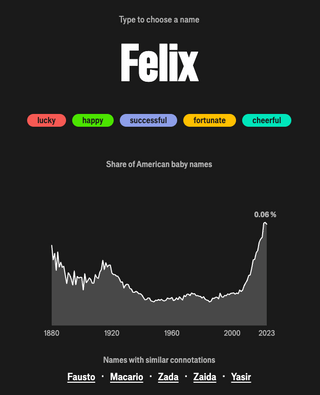
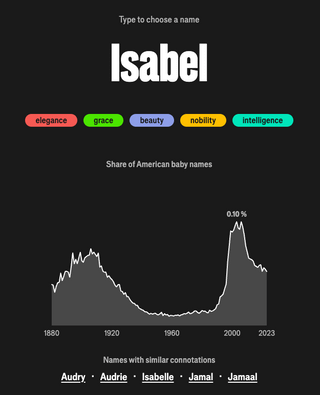
The first few plots show the top five connotations (as per the LLM), popularity (in the United States), as well as the closest five names (among a smaller set of popular names) in 300-dimensional semantic space, through the average position of names’ connotations.
You can look up your own name at the link, which is paywalled but free if you register (sorry if yours-like mine-is not popular enough to make the dataset). [https://www.economist.com/interactive/culture/2025/03/20/what-is-in-a-name](https://www.economist.com/interactive/culture/2025/03/20/what-is-in-a-name)
Did the connotations identified by the model make sense to you? My name is very rare, so not in this data, but I get these connotations: Nordic, calm, introspective, creative, strong
looks like names have bubbles too
I love when naming trends have very obvious connections with pop culture.
I don’t know anymore, at the kids soccer games it’s like everyone decided to name their kid Carson
It’s really interesting to see name trends rise and fall, especially if it’s tied to big events.
The name Katrina was fairly popular until 2005 when it very rapidly dwindled, for obvious reasons.
Name prevalence is interesting but the connotation “data” feels a little too pseudo-sciencey. LLM analysis of “name connotation” feels like a good example of “the LLM will give you an answer no matter what you ask, reliable/real or not”. One of the top connotations it gave was “Trump”? where does that fit into slide 11’s analysis?
I’m not sure how you can justify the claim “Our study revealed that the countries on both sides of the Atlantic are becoming more interested in money and power as culture becomes more fragmented and dynamic” when the study reveals absolutely nothing of the sort whatsoever. This is one step removed from having an LLM analyze horoscopes.
Slides 1-10 are interesting, even if I’m not fully on board with the LLM connotation analysis. Slide 12 is definitely interesting. Slide 11 is the questionable one.
This is a good project in terms of engagement on The Economist website, but the scientific validity and “what does it mean” claims don’t feel justified to me.
How do you determine connotations? Most of the connotations listed were totally unfamiliar to me, and didn’t include the most obvious ones like “biblical” or “catholic” etc.
Emma Watson did a lot.
Thanks for that presentation!
Being a millennial there were always like a dozen Michaels in school, we never called them Michael, we just ended up calling them by their last names.
I remember the wave of Caitlyn/Kaitlyn/Catelyn/Katelyn/Qatlyne/whateverlyn in the 90’s. In my wife’s brownie troop there were like 50% Katelyns (of various spellings).
What I wonder is… those girls should be about 40 now, but I never see them in the workforce. There should be like Katelyn Global Inc. or something. I guess they all go by middle names now.
The popular boys names hardly changed for 500 years.
Top boys names in 1250: William Richard John Robert Hugo
1377: John, William, Thomas, Richard, Robert
1560 to 1650 John, Thomas, William, Richard, Robert
1700 John William Thomas Richard James
1800 William John Thomas James George
Now they change every few years.
I have a theory that names experience a sort of bounce in popularity two generations removed from their initial popularity. People may not want to name their kid a name they associate with being “old” but they will name their kid a name they think is “vintage” or “timeless” or the name of a grandparent. I know a baby named Michael, which could mean that as more gen xers become grandparents, we’re gonna see a surge in baby Mikes and Jennifers over the next ten years.
Another thing I find interesting is how “Donald” doesn’t seem to have experienced any increase in popularity over the last ten years. In the past, presidential names have often seen an increase in popularity during that president’s term; I believe there was a bump in boys named Theodore in the 1900s, Warren in the 1920s, and Franklin in the 1940s. Reagan gained popularity as a unisex baby name in Republican-leaning states after the 1980s. But no real increase in Donalds, it seems.
[deleted]
Names have a tendency to regain popularity around 110 years or so after they first gained popularity (you can see this with Emma and Isabel)
My guess is because that’s how long it takes for most of the people born with that name during the first wave of popularity to die, and for it to lose the “old person” association
Emma and Isabel are fascinating
What do they reveal? Not much. And certainly not any of the “meanings” because no one that named their kid Emma or Robert was thinking of those when they picked the names.
Clementine is the all-time girl name for my little daughter.



18 comments
If this isn’t the premise to a Vsause video I don’t know what is.
[OC] I analysed the first names of almost 400m people born in America and Britain in the past 143 years. I looked at which were popular and their connotations; considered how diverse the names were and the rate at which trends have come and gone. Our study revealed that the countries on both sides of the Atlantic are becoming more interested in money and power (see charts), as culture becomes more fragmented and dynamic.
The analysis, published in this week’s issue of *The Economist* also features a new “informant”. Historically, studying what a name evokes has been hard to quantify, but artificial intelligence offers a method of doing so. “What word follows…” is the problem large language models (LLMs) were made to solve. These models, trained on enormous corpora of text, can reveal clusters of associations. So I enlisted an LLM to provide the top five connotations of all popular names. My prompts—more than 30,000 of them—produced 7,439 unique descriptors, including “purity”, “warrior” and “socially awkward”. (Ironically the most popular description was “unique”, tied to 12,124 different names; for those worried about energy use–I used small input/output structures and an efficient model.)
The first few plots show the top five connotations (as per the LLM), popularity (in the United States), as well as the closest five names (among a smaller set of popular names) in 300-dimensional semantic space, through the average position of names’ connotations.
You can look up your own name at the link, which is paywalled but free if you register (sorry if yours-like mine-is not popular enough to make the dataset). [https://www.economist.com/interactive/culture/2025/03/20/what-is-in-a-name](https://www.economist.com/interactive/culture/2025/03/20/what-is-in-a-name)
Tools used: R, Illustrator, Javascript
The data and code to replicate this analysis is also freely available here: [https://github.com/TheEconomist/the-economist-baby-names/](https://github.com/TheEconomist/the-economist-baby-names/)
Did the connotations identified by the model make sense to you? My name is very rare, so not in this data, but I get these connotations: Nordic, calm, introspective, creative, strong
looks like names have bubbles too
I love when naming trends have very obvious connections with pop culture.
I don’t know anymore, at the kids soccer games it’s like everyone decided to name their kid Carson
It’s really interesting to see name trends rise and fall, especially if it’s tied to big events.
The name Katrina was fairly popular until 2005 when it very rapidly dwindled, for obvious reasons.
Name prevalence is interesting but the connotation “data” feels a little too pseudo-sciencey. LLM analysis of “name connotation” feels like a good example of “the LLM will give you an answer no matter what you ask, reliable/real or not”. One of the top connotations it gave was “Trump”? where does that fit into slide 11’s analysis?
I’m not sure how you can justify the claim “Our study revealed that the countries on both sides of the Atlantic are becoming more interested in money and power as culture becomes more fragmented and dynamic” when the study reveals absolutely nothing of the sort whatsoever. This is one step removed from having an LLM analyze horoscopes.
Slides 1-10 are interesting, even if I’m not fully on board with the LLM connotation analysis. Slide 12 is definitely interesting. Slide 11 is the questionable one.
This is a good project in terms of engagement on The Economist website, but the scientific validity and “what does it mean” claims don’t feel justified to me.
How do you determine connotations? Most of the connotations listed were totally unfamiliar to me, and didn’t include the most obvious ones like “biblical” or “catholic” etc.
Emma Watson did a lot.
Thanks for that presentation!
Being a millennial there were always like a dozen Michaels in school, we never called them Michael, we just ended up calling them by their last names.
I remember the wave of Caitlyn/Kaitlyn/Catelyn/Katelyn/Qatlyne/whateverlyn in the 90’s. In my wife’s brownie troop there were like 50% Katelyns (of various spellings).
What I wonder is… those girls should be about 40 now, but I never see them in the workforce. There should be like Katelyn Global Inc. or something. I guess they all go by middle names now.
The popular boys names hardly changed for 500 years.
Top boys names in 1250: William Richard John Robert Hugo
1377: John, William, Thomas, Richard, Robert
1560 to 1650 John, Thomas, William, Richard, Robert
1700 John William Thomas Richard James
1800 William John Thomas James George
Now they change every few years.
I have a theory that names experience a sort of bounce in popularity two generations removed from their initial popularity. People may not want to name their kid a name they associate with being “old” but they will name their kid a name they think is “vintage” or “timeless” or the name of a grandparent. I know a baby named Michael, which could mean that as more gen xers become grandparents, we’re gonna see a surge in baby Mikes and Jennifers over the next ten years.
Another thing I find interesting is how “Donald” doesn’t seem to have experienced any increase in popularity over the last ten years. In the past, presidential names have often seen an increase in popularity during that president’s term; I believe there was a bump in boys named Theodore in the 1900s, Warren in the 1920s, and Franklin in the 1940s. Reagan gained popularity as a unisex baby name in Republican-leaning states after the 1980s. But no real increase in Donalds, it seems.
[deleted]
Names have a tendency to regain popularity around 110 years or so after they first gained popularity (you can see this with Emma and Isabel)
My guess is because that’s how long it takes for most of the people born with that name during the first wave of popularity to die, and for it to lose the “old person” association
Emma and Isabel are fascinating
What do they reveal? Not much. And certainly not any of the “meanings” because no one that named their kid Emma or Robert was thinking of those when they picked the names.
Clementine is the all-time girl name for my little daughter.
Comments are closed.