
FOLLOWING years of brutal conflict, a tentative agreement to bring unity and peace to Syria should offer hope of a fresh start.
But women in the north east of the country fear it could mean more oppression amid reports those in Damascus are being asked to ‘cover their heads’ and ‘stay in their houses’ like they were under ISIS.
Iham Omar, who was tortured so badly by the Assad regime she suffered a broken back, legs and was left deaf in one ear, said: “Men and women now have equal rights in this part of Syria.“
The community worker, who has been fighting for women’s rights since the 80s, says it’s also “not possible to marry a woman under 18” while “polygamy and violence against women are prohibited”.
But since interim President Ahmed al-Sharaa – who came to power after Bashar al-Assad’s regime was ousted in December – unveiled a new constitution after striking a deal with Syrian Defence Forces in the Democratic Autonomous Administration of North and East Syria (DAANES), fears are rising that the new regime will set women’s rights back years.
Ilham, who helps couples overcome marital problems, added: “We gave martyrs in the war with ISIS and this new regime has the same mentality, which is something we can’t accept.
“This new regime is killing everybody who is not like them and saying they are heathens.
“We don’t want this new regime, we can’t accept it, we are not happy with it and we don’t believe in it because we know what ISIS is, we have lived ISIS, and they are the same as ISIS.
“We don’t want war continuing… but we have a problem.”
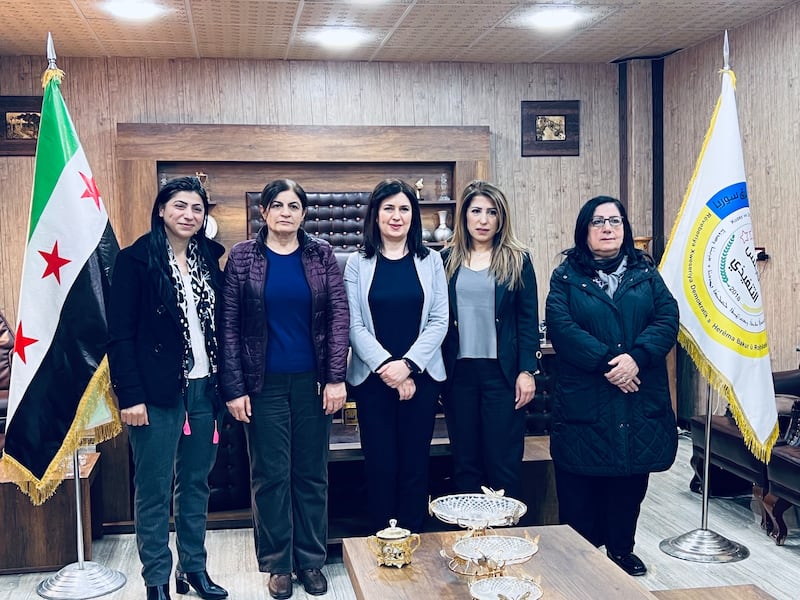 DAANES women leaders Adalat Omar, Siham Kareo, Aveen Swaid, Reema Barakat and Regina Ahmed (Shauna Corr)
For the past 14 years, oil-rich DAANES has largely governed itself.
In that time it has been working towards equality between men and women, as well as ethnic groups including the Kurds, Yazidi, Arabs, Christians and other minorities.
And they are not about to part with those rights, which they say are missing from both the new Syrian constitution and SDF-Damascus deal.
Head of DAANES Women’s Commission, Adalat Omar, said: “The new government in Damascus is trying to build a system that is marginalising women from making decisions and their existence in the defence ministry.
“It is clear in all the statements by the new government that they are giving room for women only to stay in their houses.”
Meanwhile, reports from Damascus suggest the Islamist group Hayat Tahrir al-Sham (HTS) which helped overthrow the Assad regime, is “asking women to cover their head”.
Representatives of democratic women’s group, Kongra Star (KS), said they were ‘shocked’ to hear this from women who visited the capital.
“It is not the culture of everybody to wear the hijab and after ISIS, women took it off again,” a spokesperson explained.
“But now they are putting it back on – not because they want to – but because they want to defend themselves.
“In Aleppo, a woman was going to take her documents [to work] and they told her, ‘you need to come with your father, your husband or your brother’.”
KS say HTS leader Abu Mohammed al-Julani “is not working in a democratic way, so now it’s possible the situation is changing and things are not going according to the agreement”.
Adalat Omar is also concerned about the group’s influence. She said: “All of us know the reality of HTS – which is considered a terrorist organisation that perpetrated a lot of massacres.
“We have to put pressure on countries to recognise our project instead of the terrorist system that existed in Damascus.”
 Ilham Omar at the Women’s House in Qamishli (Shauna Corr)
ISIS attempted to stamp out Syrian women’s freedoms through a campaign of terror that included public beheadings, enslavement and torture until Syrian forces, including women’s army the YPJ, defeated them in 2019 with help from the USA.
But that victory didn’t end the violence, with women from war-scarred Raqqa to Qamishli saying they remain under attack from Turkish-backed rebels and Isis sleeper cells.
Sherazad Jasum from women’s rights group, Zenobia Women’s Assembly, told how “ISIS ended the role of women in society” during their four-year onslaught and made them “suffer a lot” through underage marriages, polygamy, torture and displacement.
She added: “When the region was liberated from ISIS, women started to look for freedom. We still suffer from ISIS sleeper cells and they are trying to affect the security of the region and stop women’s movements asking for freedom.”
 Al-Hasakah cemetery dedicated to victims of the conflict and those who’ve fought in the Syrian Democratic Forces (Shauna Corr)
Her colleague, Bushra Mohammed, believes the deal with Damascus has allayed ‘fears’ HTS would launch a military operation in the region.
But added: “Women suffered a lot during ISIS control and we are afraid of such systems or power existing in Syria. We do not want to live that again.
“Women are marginalised a lot by the new power in Damascus.
“Al-Sharaa didn’t give any representation for women within the institutions… didn’t represent women in the national dialogue and will not include women in the constitution. It is the opposite in north and east Syria.
“A few days ago seven children were killed in Kobani by the Turkish state and al-Sharaa hasn’t stopped those activities yet. Turkish strikes are ongoing and al-Sharaa hasn’t done anything to stop that.”
Vian Adar, who fought ISIS with women’s army the YPJ, says Syria’s new constitution goes “against the agreement” with the SDF.
“It didn’t recognise the existence of women and was Islamic. This constitution is not accepted by our comrades in the military or the institutions of the autonomous administration. We all reject it.
“There is only one item in the constitution that is saying women have their own rights to study and work. These are normal rights for life.
“They are not considered ways to achieve a free life for women.
“In the next days there will be meetings to talk about the agreement… but maybe it will not be achieved.”
Co-chairs of Washokani informal internally displaced people’s camp, where over 16,200 live, also slammed the lack of women’s afforded women rights by the new Damascus institutions.
Bezan Abdullah, also a male advocate of the women’s revolution, said: “It is not a happy situation for us. We have concerns in the upcoming days that they will allow women and society to go back 100 years.
“In the previous regime, women didn’t get their own rights and even in the new constitution, this new power governing in Damascus didn’t mention the rights of women in the constitution. We are against this.
“We have achieved considerable women’s rights, for marginalised [people]. We can’t let all the gains women achieved go in vain.”
Co-chair Melak Salah said women in Washokani are “suffering” as a result of USAID cuts and while they would like to see an agreement that allows them to return to their villages, it must also protect their rights.
“All powers fight the autonomous administration and reject it because they want to prevent women’s rights,” she added.
“Even the Alawite women in Syria have started to ask about our project and for women’s rights.”
 Memorial to those killed, enslaved and tortured by ISIS at Raqqa’s Black Stadium (Shauna Corr)
Reports suggest the SDF-Damascus deal, which is to be implemented by the end of the year, will put DAANES’ borders, oilfields and airports under Syrian government control. Representatives of the administration did not confirm or deny this.
While it appears some details are yet to be thrashed out, many hope it will end clashes between Turkish-backed rebel groups and the Kurdish-led SDF, which continue following Assad’s fall.
Ruken Ahmed from Kongra Star said: “The situation in Syria changed after Assad went down. There is pressure to take out the autonomous administration and attacks are continuing.
“In Europe [and the US], they show this region as if it is good. But every day we are on the street defending the rights of women and different nationalities.
“There is fear of an internal war in Syria… and forces that are killing, are building up the same fear for Kurdish people.”
“We need to put down the guns,” said Elham Seyid Mohammed, who works in the Qamishli community.
Her colleague, Celila Brahmin Aci, added: “We agree with [the deal] because Syria will change its name and will not be the Arabic Republic of Syria, but the Republic of Syria.”
Meanwhile, co-chair of DAANES Executive Council, Aveen Swaid, said they are “committed to applying” the deal’s terms.
But with ‘the rights of women, youth and different nationalities’ missing from the current agreement, she says discussions are ongoing.
She added: “Kongra Star criticised this issue [saying] this happened because four men discussed the items that will be included in the agreement.”
Next time, she says there will be a woman in the room, adding: “Committees will be paused to discuss the details in the agreement and we will include items guaranteeing the rights of all Syrian women, not only the women of north and east Syria.”
 Shauna Corr in Syria
* All interviews were carried out through a translator.